

Population discontinuity in the Paris Basin linked to evidence of the Neolithic decline

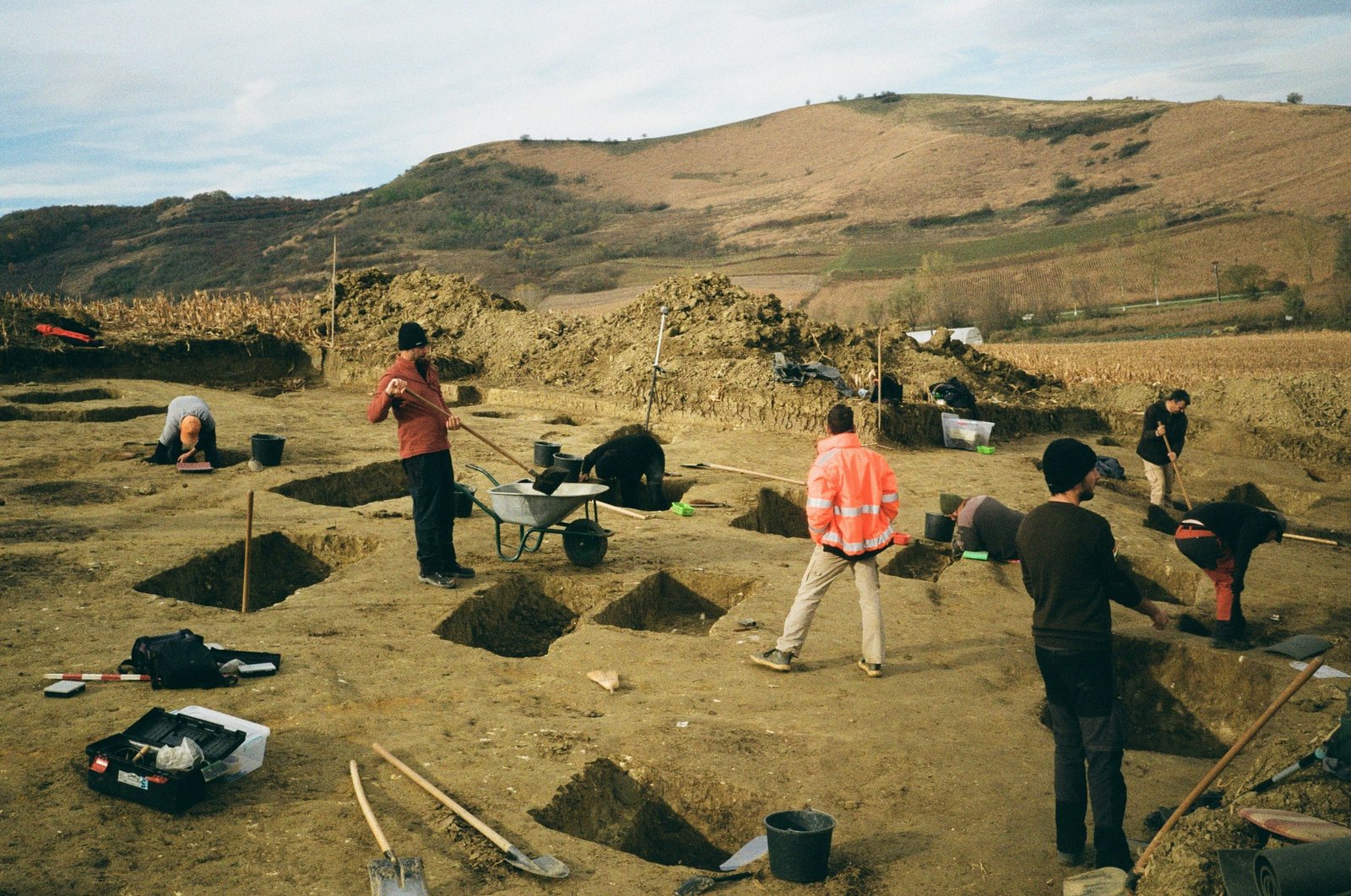
Archaeological excavation site with multiple researchers working around excavated stone structures and burial areas on a hillside landscape under partly cloudy sky.
Image Credit: Photo by Regös Környei on Unsplash (SourceLicense)

AI Summary of Peer-Reviewed Research

This page presents an AI-generated summary of a published research paper. The original authors did not write or review this article. See full disclosure ↓

Nature Ecology & Evolution·2026-04-03·Peer-reviewed·View original paper ↗·Follow this topic (RSS)
Publication Signals show what we were able to verify about where this research was published.MODERATECore publication signals for this source were verified. Publication Signals reflect the source’s verifiable credentials, not the quality of the research.
  • ✔ Peer-reviewed source
  • ✔ Published in indexed journal
  • ✔ No retraction or integrity flags

Key findings from this study

This research indicates that:

  • Genetic analysis reveals discontinuous populations occupying Bury across two burial phases, indicating demographic replacement rather than cultural continuity during the Neolithic decline.
  • Neolithic ancestry from southern regions expanded northward into the Paris Basin after the Neolithic decline, arriving around 2900 BC.
  • Genetic evidence of Yersinia pestis and Borrelia recurrentis in the dataset indicates infectious disease pressure coincided with the population transition.

Overview

This study examines population discontinuity in the Paris Basin during the Neolithic decline, spanning the transition between the fourth and third millennia BC. Genetic analysis of 132 ancient genomes from the allée sépulcrale at Bury revealed two genetically distinct burial phases separated by a hiatus in mortuary activity. The research documents a northward shift in Neolithic ancestry that entered the Paris Basin after the Neolithic decline, around 2900 BC, concurrent with evidence of infectious disease and environmental change.

Methods and approach

The authors sequenced 132 ancient genomes from two burial phases at Bury, a megalithic burial structure near Paris. The earlier phase dates to the late fourth millennium BC, ending around 3000 BC. The later phase dates to the early to mid-third millennium BC. Genetic analysis identified pedigree structures within each phase to assess social organization. Researchers examined pathogenic DNA to detect infectious disease signatures and analyzed paleoenvironmental indicators for evidence of forest regrowth.

Results

The two burial phases at Bury comprised largely discontinuous genetic groups with markedly different social structures, as evidenced by three large pedigrees recovered from genomic data. Genetic ancestry associated with Neolithic farmers from southern regions expanded northward into the Paris Basin following the Neolithic decline, arriving at approximately 2900 BC. The dataset yielded genetic evidence of infectious diseases including Yersinia pestis and Borrelia recurrentis, detected within the genomes of individuals from both phases. Paleoenvironmental data documented forest regrowth between the two burial phases, indicating vegetation recovery during the hiatus in mortuary activity.

Implications

The population turnover documented at Bury provides empirical support for demographic replacement in western Europe during the Neolithic decline, contrasting with earlier understanding that Neolithic ancestry persisted unchanged through this period. The temporal coincidence between genetic ancestry flux, infectious disease presence, and environmental change suggests multiple stress factors contributed to discontinuity in settlement patterns and mortuary practices. The cessation of megalith building in this region may reflect the demographic and social reorganization accompanying population replacement, rather than cultural continuity under resource pressure alone.

Scope and limitations

This summary is based on the study abstract and available metadata. It does not include a full analysis of the complete paper, supplementary materials, or underlying datasets unless explicitly stated. Findings should be interpreted in the context of the original publication.

Disclosure

  • Research title: Population discontinuity in the Paris Basin linked to evidence of the Neolithic decline
  • Authors: Frederik Valeur Seersholm, Abigail Ramsøe, Jialu Cao, P. Chambon, Karl-Göran Sjögren, Hugh McColl, Fabrice Demeter, Charleen Gaunitz, Lasse Vinner, Jesper Stenderup, Gabriele Scorrano, Ralph Fyfe
  • Institutions: Centre National de la Recherche Scientifique, Curtin University, KSL Consulting (Denmark), Musée de l'Homme, National Museum of Denmark, The University of Western Australia, Université Paris Cité, University of Copenhagen, University of Gothenburg, University of Plymouth, University of Rome Tor Vergata, University of Wisconsin–Madison
  • Publication date: 2026-04-03
  • DOI: https://doi.org/10.1038/s41559-026-03027-z
  • OpenAlex record: View
  • PDF: Download
  • Image credit: Photo by Regös Környei on Unsplash (SourceLicense)
  • Disclosure: This post was generated by Claude (Anthropic). The original authors did not write or review this post.

Get the weekly research newsletter

Stay current with peer-reviewed research without reading academic papers — one filtered digest, every Friday.

More posts