

What the study found
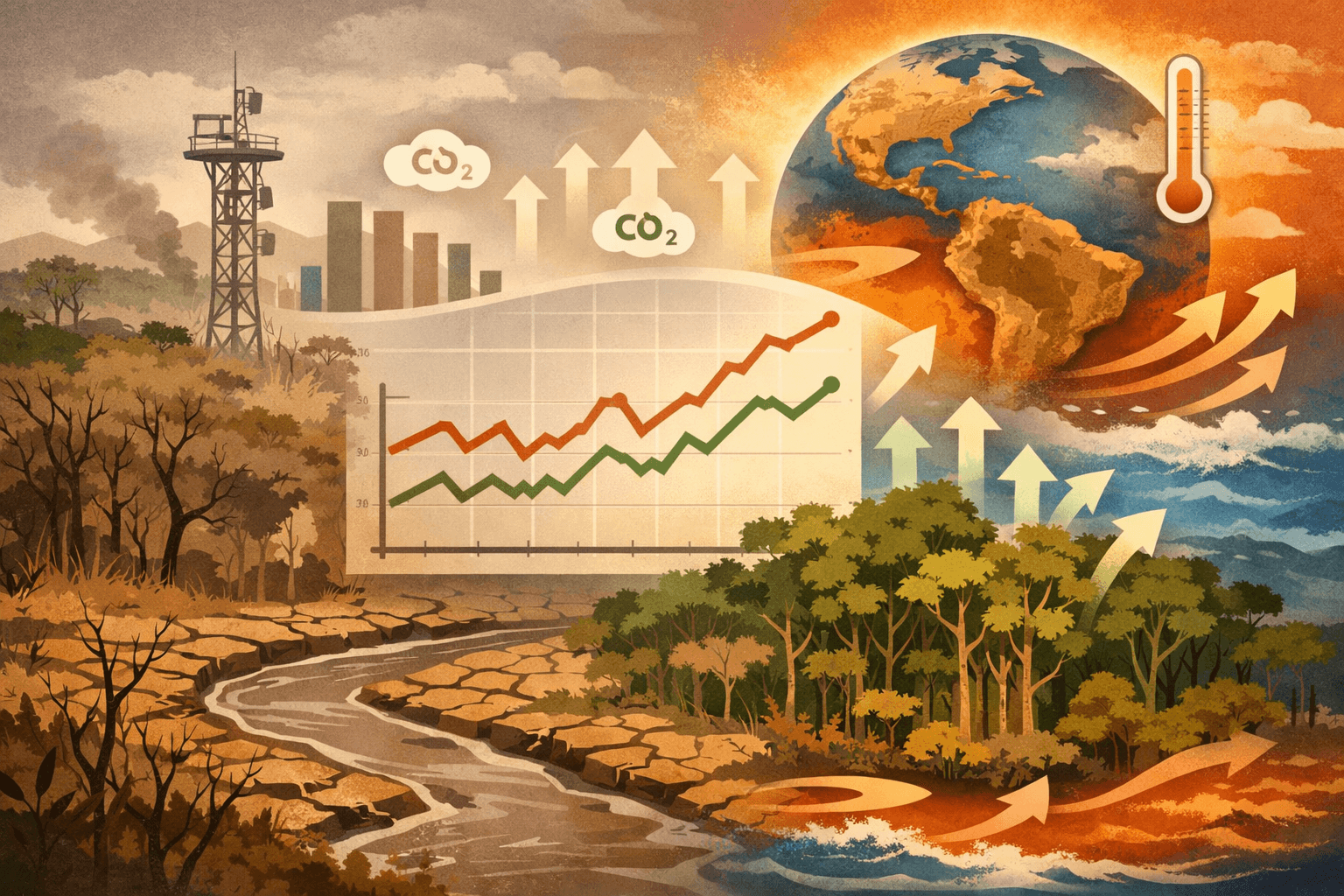
The study found that the Amazon region was a net carbon source in 2023, with a total of 0.01–0.17 PgC when fires were included. The authors attribute this weak carbon source mainly to reduced vegetation carbon uptake during the dry season, while stronger early-year uptake helped offset some of the annual losses.
Why the authors say this matters
The authors conclude that the findings show reduced vegetation carbon uptake across the Amazon during an extreme drought year. They also state that this weak carbon source contributed up to 30% of the net carbon loss in tropical land in 2023.
What the researchers tested
The researchers evaluated how the Amazon carbon cycle responded to the 2023 extreme event across different spatial scales. They combined atmospheric carbon dioxide mole fractions, eddy covariance flux data, low-latency Dynamic Global Vegetation Model simulations, an atmospheric inversion, and remote sensing data.
What worked and what didn't
Fire emissions were estimated at 0.15 PgC, with a range of 0.13–0.17 PgC, and were within the typical variability of the 2003–2023 period. The weak carbon source was instead linked to reduced vegetation uptake during August–October, while stronger-than-normal uptake in January–April was seen across data streams and spatial scales. The study also reports a shift from carbon sink to source in May and a peak source in October.
What to keep in mind
The abstract does not describe limitations beyond the data and time periods used. The reported values are specific to the 2023 event and the methods and datasets listed in the abstract.
Key points
- The Amazon was a net carbon source in 2023, totaling 0.01–0.17 PgC including fires.
- Fire emissions were 0.15 PgC and were within the usual variability from 2003 to 2023.
- Reduced vegetation carbon uptake during August–October was identified as the main reason for the weak carbon source.
- Stronger-than-normal carbon uptake early in the year helped offset annual losses.
- The study reports a shift from carbon sink to source in May and a peak source in October.
Disclosure
- Research title:
- Extreme 2023 drought made the Amazon a weak carbon source
- Authors:
- Santiago Botía, C. Q. Dias‐Júnior, Shujiro Komiya, A. M. van der Woude, Myriam Terristi, R. J. de Kok, Gerbrand Koren, Hella van Asperen, S. P. Jones, F. A. F. D'Oliveira, Ute Weber, E. P. Marques‐Filho, I. M. Cely, A. Araujo, J. V. Lavric, D. Walter, X. Li, J. P. Wigneron, B. D. Stocker, J. Gonçalves de Souza, Michael O’Sullivan, S. Sitch, P. Ciais, F. Chevallier, W. Li, Ingrid T. Luijkx, Wouter Peters, C. A. Quesada, S. Zaehle, S. Trumbore, A. Bastos
- Institutions:
- CEA Paris-Saclay, CEA Paris-Saclay, Centre National de la Recherche Scientifique, Centre National de la Recherche Scientifique, Commissariat à l'Énergie Atomique et aux Énergies Alternatives, Commissariat à l'Énergie Atomique et aux Énergies Alternatives, Institut National de Recherche pour l'Agriculture, l'Alimentation et l'Environnement, Institut National de Recherche pour l'Agriculture, l'Alimentation et l'Environnement, Instituto Federal de Educação, Ciência e Tecnologia do Pará, Instituto Federal de Educação, Ciência e Tecnologia do Pará, Instituto Nacional de Pesquisas da Amazônia, Integrated Carbon Observation System, Interaction Sol Plante Atmosphère, Interaction Sol Plante Atmosphère, Laboratoire des Sciences du Climat et de l'Environnement, Laboratoire des Sciences du Climat et de l'Environnement, Leipzig University, Leipzig University, Max Planck Institute for Biogeochemistry, Max Planck Institute for Biogeochemistry, Max Planck Institute for Biogeochemistry, Max Planck Institute for Biogeochemistry, Max Planck Institute for Biogeochemistry, Max Planck Institute for Biogeochemistry, Max Planck Institute for Biogeochemistry, Max Planck Institute for Biogeochemistry, Max Planck Institute for Biogeochemistry, Max Planck Institute for Chemistry, Microsoft (Brazil), Oeschger Centre for Climate Change Research, Optima Pharmazeutische (Germany), Tsinghua University, Universidade Federal da Bahia, Université de Versailles Saint-Quentin-en-Yvelines, Université de Versailles Saint-Quentin-en-Yvelines, Université Paris-Saclay, Université Paris-Saclay, University of Bern, University of Exeter, University of Exeter, University of Exeter, University of Groningen, Utrecht University, Wageningen University & Research, Wageningen University & Research, Wageningen University & Research, Wageningen University & Research
- Publication date:
- 2026-02-01
- OpenAlex record:
- View
Get the weekly research newsletter
Stay current with peer-reviewed research without reading academic papers — one filtered digest, every Friday.