

AI Summary of Peer-Reviewed Research
This page presents an AI-generated summary of a published research paper. The original authors did not write or review this article. See full disclosure ↓
⚠️ This article summarizes published research and is intended for informational purposes only. It does not constitute medical advice or clinical guidance.
Publication Signals show what we were able to verify about where this research was published.STRONGWe verified multiple publication signals for this source, including independently confirmed credentials. Publication Signals reflect the source’s verifiable credentials, not the quality of the research.
- ✔ Peer-reviewed source
- ✔ Published in indexed journal
- ✔ No retraction or integrity flags
Key findings from this study
- The study found that RNA sequencing identified a pathogenic HEY1::NCOA2 fusion, establishing definitive diagnosis of mesenchymal chondrosarcoma and excluding morphological mimics such as fibrosarcoma.
- The authors report that multimodal treatment combining VAC chemotherapy, radiotherapy, and surgery achieved partial metabolic response, with subsequent sirolimus maintenance therapy providing disease control.
- The researchers demonstrate that molecular evidence of PI3K/AKT/mTOR pathway activation in this mesenchymal chondrosarcoma case supported initiation of targeted mTOR inhibitor therapy.
Overview
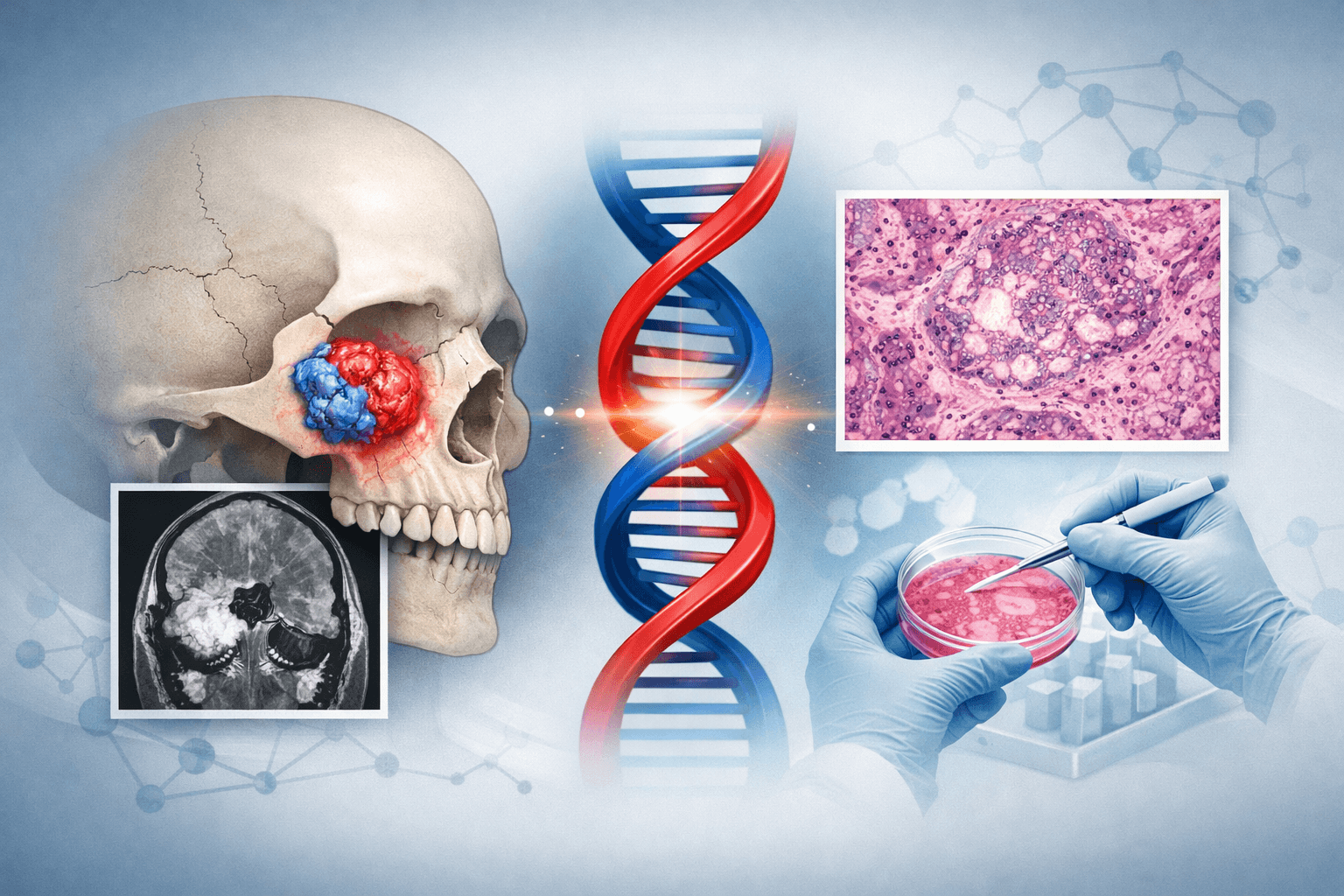
Mesenchymal chondrosarcoma (MCS) is a rare, aggressive chondrosarcoma subtype affecting less than 1% of all chondrosarcomas with predominant incidence in adolescents and young adults. Diagnosis proves challenging due to significant morphological overlap with other high-grade spindle cell sarcomas, particularly when the cartilaginous component is minimal or absent. The HEY1::NCOA2 gene fusion has emerged as a highly specific molecular marker substantially improving diagnostic accuracy and suggesting therapeutic implications. This case report documents a 13-year-old girl presenting with progressive right cheek swelling and a destructive maxillary sinus mass ultimately confirmed as MCS via molecular analysis.
Methods and approach
Clinical presentation included a 3-month history of progressive right cheek swelling in a 13-year-old female. Imaging studies revealed a destructive mass in the right maxillary sinus. Histopathological evaluation assessed tumor morphology, vimentin expression, Ki-67 proliferation index, and CD34 immunophenotype. Comprehensive molecular analysis employed RNA sequencing to identify gene fusions, specifically confirming HEY1::NCOA2 and excluding ETV6::NTRK3. Treatment consisted of VAC chemotherapy (vincristine, actinomycin D, cyclophosphamide), local radiotherapy to 60 Gy, cranial prophylactic radiotherapy to 12 Gy, and debulking surgery. Follow-up imaging with 18 F-FDG PET/CT assessed metabolic response. Maintenance therapy with the mTOR inhibitor sirolimus was subsequently initiated based on pathway analysis suggesting PI3K/AKT/mTOR activation.
Results
Histopathological evaluation demonstrated a high-grade spindle cell tumor initially misinterpreted as fibrosarcoma. The neoplasm exhibited diffuse vimentin positivity, elevated Ki-67 proliferation index of 35%-40%, and CD34 negativity. RNA sequencing confirmed a pathogenic HEY1::NCOA2 gene fusion while excluding ETV6::NTRK3 fusion, establishing definitive diagnosis of mesenchymal chondrosarcoma. Multimodal treatment incorporating chemotherapy, radiotherapy, and surgery achieved partial metabolic response on 18 F-FDG PET/CT. Subsequent maintenance therapy with sirolimus provided disease control in this aggressive craniofacial malignancy.
Implications
Molecular diagnostics, particularly RNA sequencing, play a pivotal role in establishing mesenchymal chondrosarcoma diagnosis and differentiating it from morphologically overlapping high-grade pediatric sarcomas. The HEY1::NCOA2 fusion serves dual function: confirming diagnosis with high specificity and providing biological rationale for targeted therapeutic strategies. This case represents one of the very few pediatric maxillary MCS cases managed with confirmed HEY1::NCOA2 fusion and sirolimus-based maintenance therapy, suggesting potential efficacy of mTOR inhibition in this aggressive malignancy.
Identification of pathogenic gene fusions may inform treatment selection beyond conventional chemotherapy and radiotherapy in pediatric mesenchymal chondrosarcoma. The PI3K/AKT/mTOR pathway activation in MCS supports consideration of targeted maintenance approaches following multimodal therapy. Integration of molecular findings with conventional oncologic management represents an evolving paradigm for aggressive craniofacial sarcomas in adolescent patients.
Scope and limitations
This summary is based on the study abstract and available metadata. It does not include a full analysis of the complete paper, supplementary materials, or underlying datasets unless explicitly stated. Findings should be interpreted in the context of the original publication.
Disclosure
- Research title: Maxillary mesenchymal chondrosarcoma harboring HEY1::NCOA2 fusion in a 13-year-old girl: a rare case report and literature review
- Authors: Şule Çalışkan Kamış, Begül Yağcı, Ayşe Selcan Koç, Güliz Durak, Ali Yitik
- Publication date: 2026-03-05
- DOI: https://doi.org/10.3389/fped.2026.1758538
- OpenAlex record: View
- PDF: Download
- Disclosure: This post was generated by Claude (Anthropic). The original authors did not write or review this post.
Get the weekly research newsletter
Stay current with peer-reviewed research without reading academic papers — one filtered digest, every Friday.