

AI Summary of Peer-Reviewed Research
This page presents an AI-generated summary of a published research paper. The original authors did not write or review this article. See full disclosure ↓
Publication Signals show what we were able to verify about where this research was published.STRONGWe verified multiple publication signals for this source, including independently confirmed credentials. Publication Signals reflect the source’s verifiable credentials, not the quality of the research.
- ✔ Peer-reviewed source
- ✔ Published in indexed journal
- ✔ No retraction or integrity flags
Key findings from this study
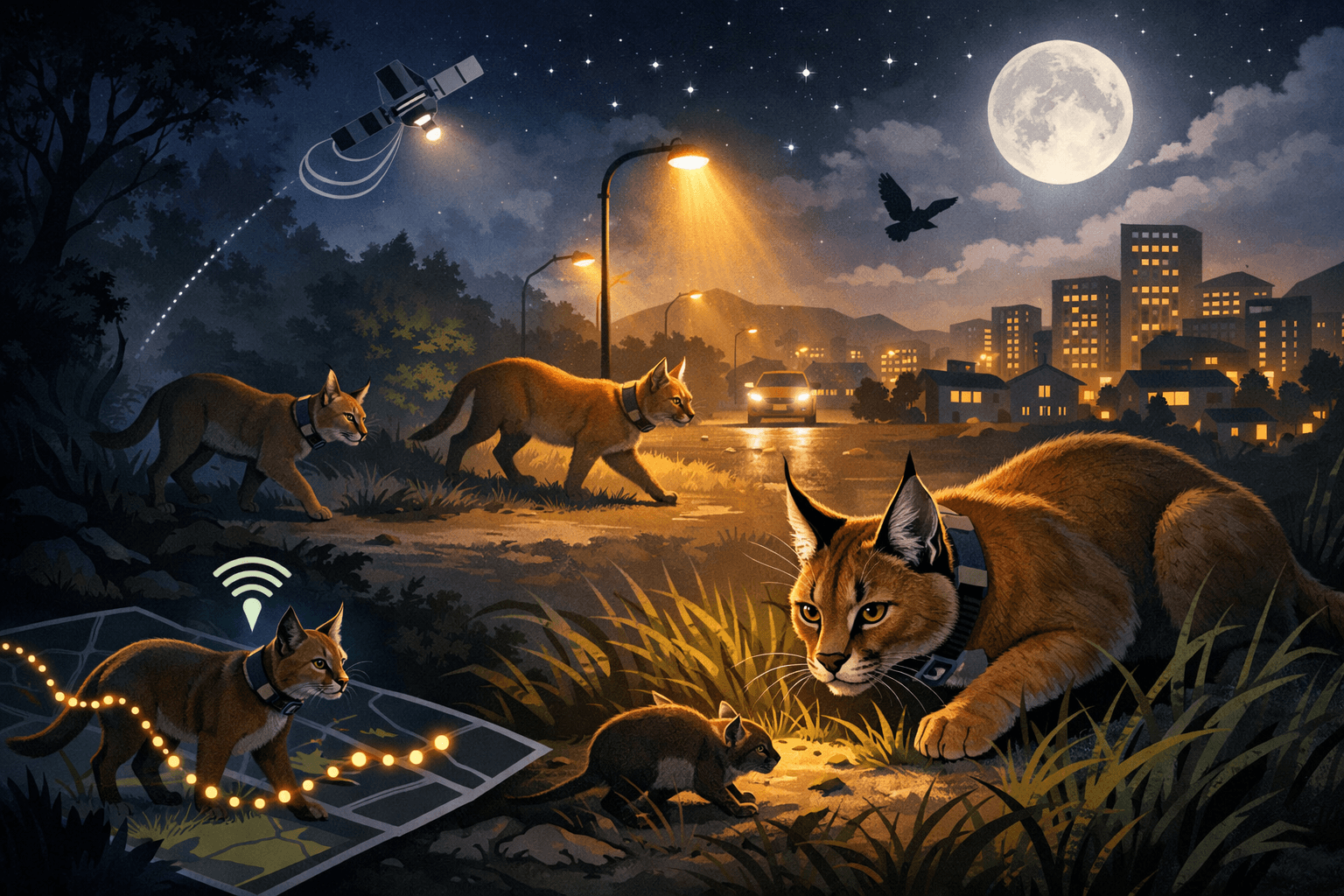
- The study found that caracals avoided direct artificial light as measured by upward radiance during movement, yet simultaneously selected areas closer to urbanization, indicating a complex relationship with human-modified landscapes.
- The researchers demonstrate that subadult caracals exhibited greater tolerance to artificial light at night than adults, suggesting age-dependent behavioral flexibility in light pollution responses.
- The authors report that caracal foraging behavior was primarily influenced by direct artificial light via public street lighting, with avoidance of highly illuminated areas for kill site placement.
Overview
This study examines how artificial light at night (ALAN) influences the behavior of caracals (Caracal caracal), an adaptable terrestrial carnivore capable of inhabiting urban environments. The research investigates the effects of direct and indirect ALAN sources on movement patterns, habitat selection, and foraging behavior across adult and subadult individuals of both sexes using GPS collar data and behavioral observations.
Methods and approach
The researchers deployed GPS collars on 17 adult and 7 subadult caracals to collect nocturnal movement and behavioral data. Movement and habitat selection patterns were analyzed using integrated step selection functions (iSSFs), while foraging habitat selection was evaluated through resource selection functions (RSFs) applied to kill sites. ALAN exposure was quantified through multiple metrics: total upward radiance, public streetlights, and urban skyglow. Analyses examined age-class and sex-specific variation in responses to direct and indirect light pollution while accounting for the broader urbanization gradient.
Results
Caracals demonstrated strong avoidance of direct ALAN as measured by upward radiance, with this variable strongly driving movement patterns. Simultaneously, caracals selected areas closer to urbanization, revealing a complex relationship wherein both ALAN and urbanization constrain and potentially benefit the species. Subadult caracals exhibited greater tolerance to ALAN than adults. Foraging behavior was primarily influenced by direct ALAN via public street lighting, with caracals avoiding highly illuminated areas for kill site placement. These findings indicate that distinct yet interconnected behavioral responses to artificial light vary across movement, habitat selection, and foraging contexts.
Implications
ALAN functions as a multifaceted pollutant that differentially influences carnivore behavior across ecological contexts and ontogenetic stages. The observed avoidance of direct illumination during foraging suggests that light pollution may disrupt predation efficiency or expose caracals to increased predation risk, with potential cascading effects on population dynamics and feeding ecology. The greater tolerance in subadults relative to adults indicates possible life-history trade-offs or behavioral plasticity that may facilitate urban colonization but could carry costs not apparent in the current analysis.
Understanding the relative importance of direct versus indirect ALAN sources and their interaction with urbanization intensity is critical for developing targeted mitigation strategies. The complexity of caracal responses to ALAN—simultaneously avoiding light while selecting nearby urban areas—suggests that single-mechanism interpretations of light pollution effects are insufficient. Future conservation efforts should consider spatial heterogeneity in light regimes and age-structured population responses when designing interventions to reduce ALAN impacts on terrestrial carnivores in human-modified landscapes.
Scope and limitations
This summary is based on the study abstract and available metadata. It does not include a full analysis of the complete paper, supplementary materials, or underlying datasets unless explicitly stated. Findings should be interpreted in the context of the original publication.
Disclosure
- Research title: Illuminating the influence of artificial light at night on the behavior of an adaptable carnivore
- Authors: Christopher J. Hickling, Laurel E. K. Serieys, Gabriella R. M. Leighton, Sarah S. Kienle, Jaqueline M. Bishop, Kathleen A. Carroll
- Institutions: University of Cape Town, University of Rhode Island
- Publication date: 2026-01-28
- DOI: https://doi.org/10.1016/j.scitotenv.2026.181469
- OpenAlex record: View
- Disclosure: This post was generated by Claude (Anthropic). The original authors did not write or review this post.
Get the weekly research newsletter
Stay current with peer-reviewed research without reading academic papers — one filtered digest, every Friday.


