

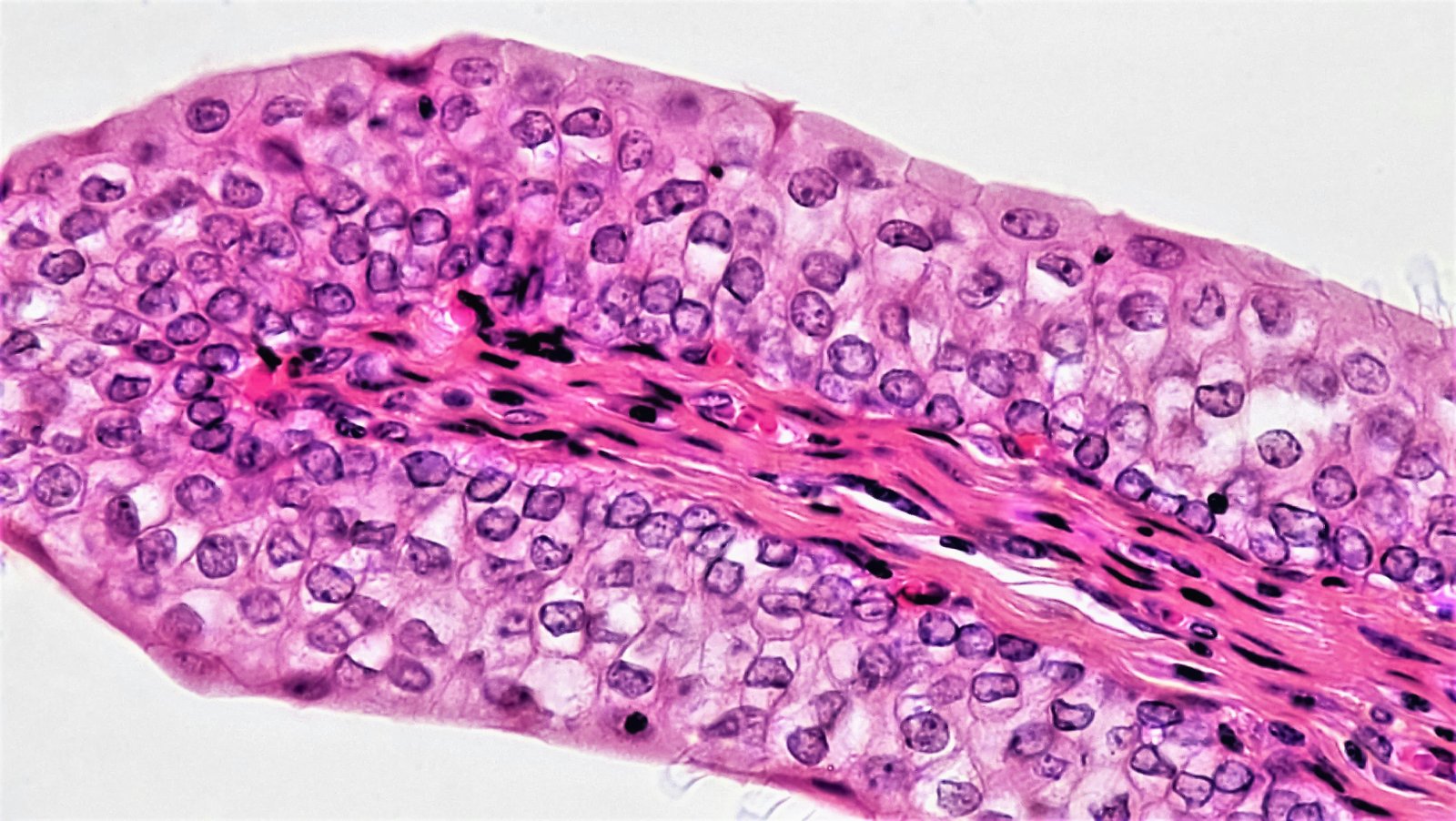
Key findings from this study
Key points
- The study found that primary tumors from patients who later developed recurrences exhibited smaller, more asymmetric, and denser nuclei than non-recurrent tumors, suggesting morphometric features present at diagnosis may stratify recurrence risk.
- The authors report that recurrent specimens demonstrated significant longitudinal nuclear remodeling characterized by increased size and asymmetry, alongside elevated proliferation and reduced lamin A/C expression at the nuclear envelope.
- The researchers demonstrate that quantitative nuclear morphometry integrated with immunophenotyping and genomic data identifies recurrence-associated phenotypic remodeling not visible on routine histology or imaging.
Overview
Chordoma recurrence and metastasis significantly impact overall survival, yet reliable prognostic biomarkers remain scarce. This study integrates quantitative nuclear morphometry with immunophenotyping and genomic profiling across 26 tumor specimens from 12 patients to determine whether nuclear morphological changes correlate with recurrence risk and metastatic behavior.
Methods and approach
The researchers analyzed 26 specimens from 12 adults: 8 patients with non-recurrent tumors and 4 patients with multiple long-term recurrences or metastases spanning 7 to 16 years. Whole-exome sequencing, immunohistochemistry, and quantitative nuclear morphometry characterized each specimen. Standard imaging and routine histology were evaluated for comparative differences.
Results
Routine imaging and histology identified no consistent differences between recurrent and non-recurrent groups. Nuclear morphometry revealed substantial intertumoral variability in non-recurrent tumors and significant longitudinal remodeling in recurrent specimens. Primary tumors from patients who subsequently recurred exhibited smaller, more asymmetric, and denser nuclei relative to stable tumors. Recurrent samples demonstrated elevated proliferation rates and reduced lamin A/C expression. Pleomorphic nuclei showed focal disruption and detachment of lamin A/C from the nuclear envelope. Tumor mutational burden remained low across all samples, varied between patients and timepoints, and showed a tendency toward higher values in recurrent cases.
Implications
Quantitative nuclear morphometry captures recurrence-associated phenotypic remodeling not detected by conventional histopathologic assessment. The integration of morphometric parameters with immunophenotypic markers and genomic data establishes a quantitative framework for stratifying recurrence risk in chordoma. Nuclear morphological features, particularly size asymmetry and lamin A/C alterations, may identify patients at elevated risk for long-term recurrence or metastatic progression.
These findings support the development of digital pathology and artificial intelligence approaches grounded in objective nuclear parameters. Pending validation in larger patient cohorts, morphometric analysis could enhance prognostic accuracy and inform surveillance strategies for chordoma management.
The low and variable tumor mutational burden indicates that genomic metrics alone may be insufficient for recurrence prediction. A multimodal phenotypic and genomic approach appears necessary to characterize the heterogeneous evolutionary dynamics underlying chordoma recurrence.
Scope and limitations
This summary is based on the study abstract and available metadata. It does not include a full analysis of the complete paper, supplementary materials, or underlying datasets unless explicitly stated. Findings should be interpreted in the context of the original publication.
Disclosure
- Research title: Correlation Between Molecular Genetic Analysis and Nuclear Pleomorphism in Long-Term Recurrent and Metastatic Chordoma
- Authors: Sarah R. Ullmann, Julian Schreier, Juan Carlos Alberto Uribe Caputi, Marilena Georgiades, Joana Maria Ullmann, Christoph H. Lohmann, Martin Röpke, Denny Schanze, Sabine Franke, Franziska Sabrina Karras, A. Roessner
- Institutions: Otto-von-Guericke-Universität Magdeburg, Universidad Autónoma de Bucaramanga, University of Rostock
- Publication date: 2026-03-11
- DOI: https://doi.org/10.3390/cancers18060898
- OpenAlex record: View
- PDF: Download
- Image credit: Photo by Bioscience Image Library by Fayette Reynolds on Unsplash (Source • License)
- Disclosure: This post was generated by Claude (Anthropic). The original authors did not write or review this post.
Disclosure
- Research title:
- Correlation Between Molecular Genetic Analysis and Nuclear Pleomorphism in Long-Term Recurrent and Metastatic Chordoma
- Publication date:
- 2026-03-11
- OpenAlex record:
- View
- Image credit:
- Photo by Bioscience Image Library by Fayette Reynolds on Unsplash · Unsplash License
Get the weekly research newsletter
Stay current with peer-reviewed research without reading academic papers — one filtered digest, every Friday.