

A sociological approach to Japan’s war frames and security threats

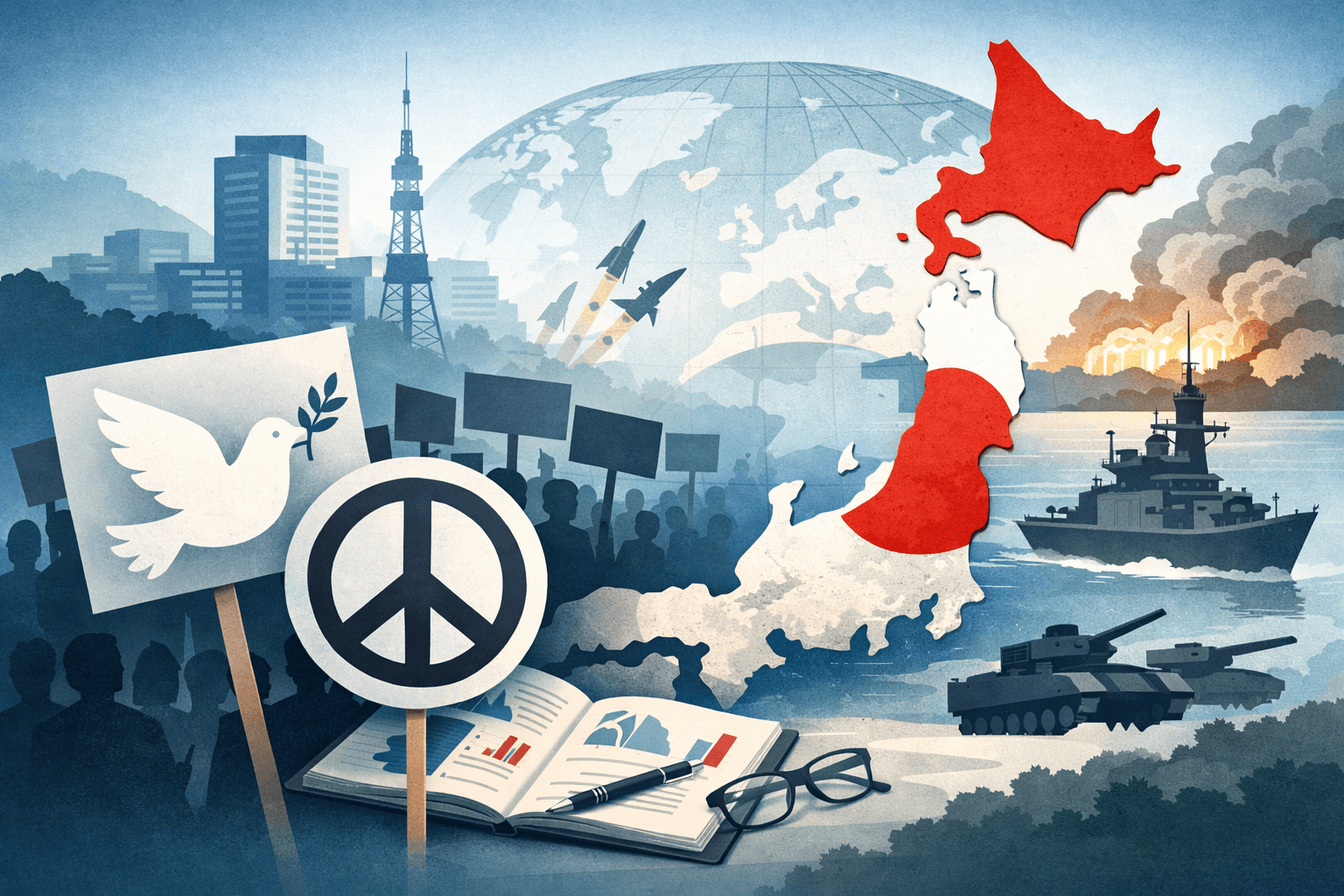
An illustration showing peace and military symbols including a dove, peace sign, and protest crowd on the left, contrasted with military imagery including a warship, tanks, and missiles on the right, with a globe and map of Asia in the background.

AI Summary of Peer-Reviewed Research

This page presents an AI-generated summary of a published research paper. The original authors did not write or review this article. See full disclosure ↓

⚠️ This summary is for informational purposes only and does not constitute legal advice. Laws vary by jurisdiction and change over time. Consult a qualified legal professional for advice specific to your situation.

The Sociological Review·2026-03-01·Peer-reviewed·View original paper ↗·Follow this topic (RSS)
Publication Signals show what we were able to verify about where this research was published.STANDARDAvailable publication signals for this source were verified. Publication Signals reflect the source’s verifiable credentials, not the quality of the research.

Fewer signals were independently confirmable for this source. That reflects the limits of what’s on record — not a judgment about the research.

  • ✔ No retraction or integrity flags

Key findings from this study

  • The study found that Russia's 2022 invasion triggered Japanese public fear of Taiwan and Okinawa conflicts, partly explaining increased defense spending despite sustained pacifist attachment.
  • The researchers demonstrate that opposition parties, intellectuals, and civil society articulated critical perspectives on securitization that diverged significantly from official security expert positions.
  • The authors report that examining war frames and civil society voices reveals social contradictions—simultaneous defense budget increases and pacifist commitment—that elite-focused analysis obscures.

Overview

This article addresses a gap in sociology of war scholarship by examining evolving social attitudes toward potential conflict rather than historical wars alone. It analyzes how Japan reconciles increased defense spending with persistent pacifist sentiment following Russia's 2022 invasion of Ukraine. The study adopts a sociological lens focused on opposition voices and civil society rather than political elites and security experts.

Methods and approach

The researchers conducted interviews with leftwing politicians and intellectuals after the Ukraine invasion, supplemented by polling data and media analysis. Ethnographic observation occurred in southern Okinawa. This triangulated approach combined qualitative interview data with quantitative polling and observational fieldwork to capture both elite perspectives and broader public sentiment.

Results

Japan's defense budget expansion occurred simultaneously with sustained public attachment to pacifism, an apparent contradiction explained partly by fear of Taiwan and Okinawa conflicts triggered by Russian aggression. Opposition parties, intellectuals, and civil society members articulated critical perspectives on securitization processes that differed from official security discourse. The analysis reveals how war frames evolved in response to external geopolitical shocks while historical pacifist commitments remained socially embedded.

Implications

The study demonstrates that examining critical voices and civil society perspectives provides essential insight into security discourse reception that elite-focused international relations analysis overlooks. Understanding how publics reconcile competing imperatives—enhanced defense capacity and pacifist values—requires integrating sociological attention to war legacies with contemporary security attitudes. This approach illuminates the social complexity underlying apparent policy contradictions and reveals tensions between institutional security measures and historical collective memory.

The findings suggest that sociologists and international relations scholars must bridge disciplinary divides to adequately explain public responses to securitization. Defense policy outcomes reflect not only strategic calculations but also negotiation with embedded historical narratives and civil society resistance. Japan's case demonstrates how geopolitical events trigger public anxiety that can shift security attitudes while cultural commitments to pacifism persist, creating dynamic rather than static public opinion landscapes.

Future research on security discourse reception should prioritize subnational sites like Okinawa where geopolitical anxieties concentrate most acutely. Integrating ethnographic observation with interview and polling methodologies captures how local populations interpret national security policies through place-specific historical experiences. This geographic attention reveals how national-level security debates manifest differently across territorial contexts with distinct war legacies.

Scope and limitations

This summary is based on the study abstract and available metadata. It does not include a full analysis of the complete paper, supplementary materials, or underlying datasets unless explicitly stated. Findings should be interpreted in the context of the original publication.

Disclosure

  • Research title: A sociological approach to Japan’s war frames and security threats
  • Authors: Paul Jobin, Shigeto Sonoda, Arata Hirai
  • Institutions: Asia University, Institute of Sociology, Academia Sinica, The University of Tokyo, Tokai University
  • Publication date: 2026-03-01
  • DOI: https://doi.org/10.1177/00380261261423731
  • OpenAlex record: View
  • Disclosure: This post was generated by Claude (Anthropic). The original authors did not write or review this post.

Get the weekly research newsletter

Stay current with peer-reviewed research without reading academic papers — one filtered digest, every Friday.

More posts