
Using a two-stage D-Optimal mode to select equipment for flexible manufacturing systems

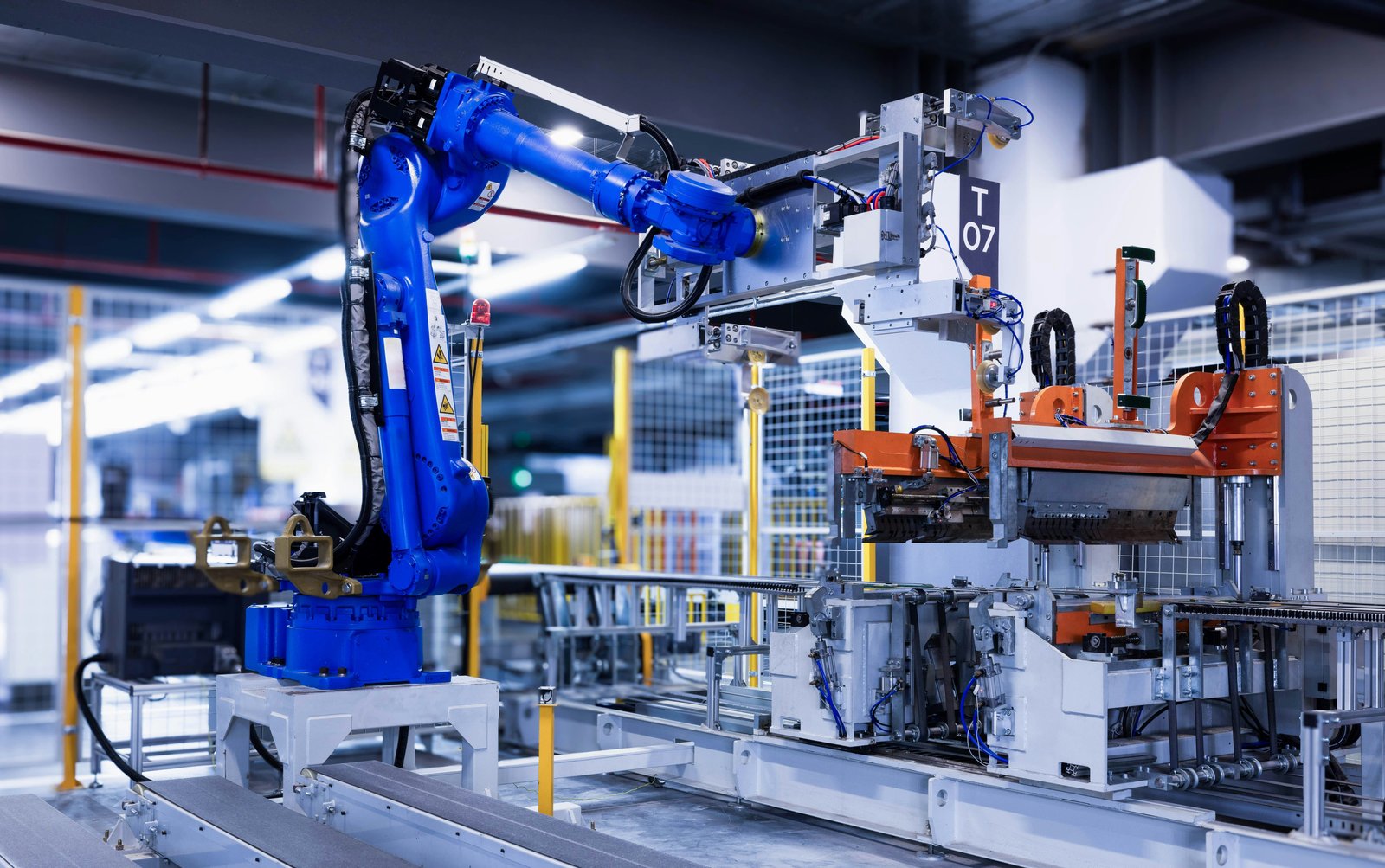
A modern manufacturing facility with a blue robotic arm positioned over industrial assembly equipment, including white and orange machinery on a factory floor with safety barriers visible in the background.
Image Credit: Photo by Homa Appliances on Unsplash (SourceLicense)

AI Summary of Peer-Reviewed Research

This page presents an AI-generated summary of a published research paper. The original authors did not write or review this article. See full disclosure ↓

Scientific Reports·2026-02-26·Peer-reviewed·View original paper ↗·Follow this topic (RSS)
Publication Signals show what we were able to verify about where this research was published.STRONGWe verified multiple publication signals for this source, including independently confirmed credentials. Publication Signals reflect the source’s verifiable credentials, not the quality of the research.
  • ✔ Peer-reviewed source
  • ✔ Published in indexed journal
  • ✔ No retraction or integrity flags

Overview

This research addresses equipment selection optimization within flexible manufacturing systems through application of a two-stage D-Optimal experimental design framework. The study utilizes discrete event simulation to evaluate equipment combinations in an electronics manufacturing context, deriving a weighted composite response metric incorporating production rate, waste generation, and cycle time. The investigation challenges the assumption that maximum automation yields optimal operational efficiency.

Methods and approach

The methodology employs a two-stage D-Optimal design methodology coupled with discrete event simulation to systematically evaluate equipment configurations. A weighted response-surface metric was constructed integrating multiple production performance indices. The first optimization stage generated a response-surface value of 14733.09, which was refined in the second stage to 151317.88, indicating progressive optimization through iterative design refinement. The approach enables systematic exploration of equipment combination possibilities while balancing multiple competing objectives.

Key Findings

The optimization process identified an equipment configuration achieving 92.8% automation utilization. This finding demonstrates that complete automation does not enhance manufacturing efficiency, indicating an optimal balance between automated and non-automated operations. The progression from first-stage to second-stage response values demonstrates measurable improvement through the two-stage refinement process, establishing a mathematically quantifiable optimal equipment combination for the studied electronics manufacturing context.

Implications

The research demonstrates the viability of applying D-Optimal experimental design to equipment selection problems in manufacturing systems. The methodology provides a generalizable framework applicable across industrial sectors facing similar equipment selection decisions. By validating that partial automation outperforms full automation, the study establishes a quantitative basis for investment decisions regarding manufacturing equipment, potentially reducing capital expenditure while maintaining or improving operational metrics. The balanced approach to equipment selection represents a departure from conventional industry assumptions favoring maximum mechanization, supporting strategic resource allocation decisions grounded in empirical optimization rather than automation-centric paradigms.

Scope and limitations

This summary is based on the study abstract and available metadata. It does not include a full analysis of the complete paper, supplementary materials, or underlying datasets unless explicitly stated. Findings should be interpreted in the context of the original publication.

Disclosure

  • Research title: Using a two-stage D-Optimal mode to select equipment for flexible manufacturing systems
  • Authors: Xiaomo Yu, Jie Mi, Jiajia Liu, Long Long, Xiuming Li, Qinglian Mo
  • Institutions: Guangxi Research Institute of Chemical Industry, Nanning Normal University
  • Publication date: 2026-02-26
  • DOI: https://doi.org/10.1038/s41598-026-41466-7
  • OpenAlex record: View
  • PDF: Download
  • Image credit: Photo by Homa Appliances on Unsplash (SourceLicense)
  • Disclosure: This post was generated by Claude (Anthropic). The original authors did not write or review this post.

Get the weekly research newsletter

Stay current with peer-reviewed research without reading academic papers — one filtered digest, every Friday.

More posts