

What the study found
Pure Pursuit with Dynamic Steering Control (PP-DSC) improved trajectory tracking for an autonomous mobile robot in open-area tests. In simulation of a chemical plant, a safety-integrated version of the method had mixed results and depended on the layout.
What the authors say this matters
The authors conclude that the method can improve tracking in open-field environments and that industrial deployment should use geometry-specific algorithm selection. They also state that the safety integration provided automatic velocity reduction in hazard zones for Process Safety Management (PSM) compliance.
What the researchers tested
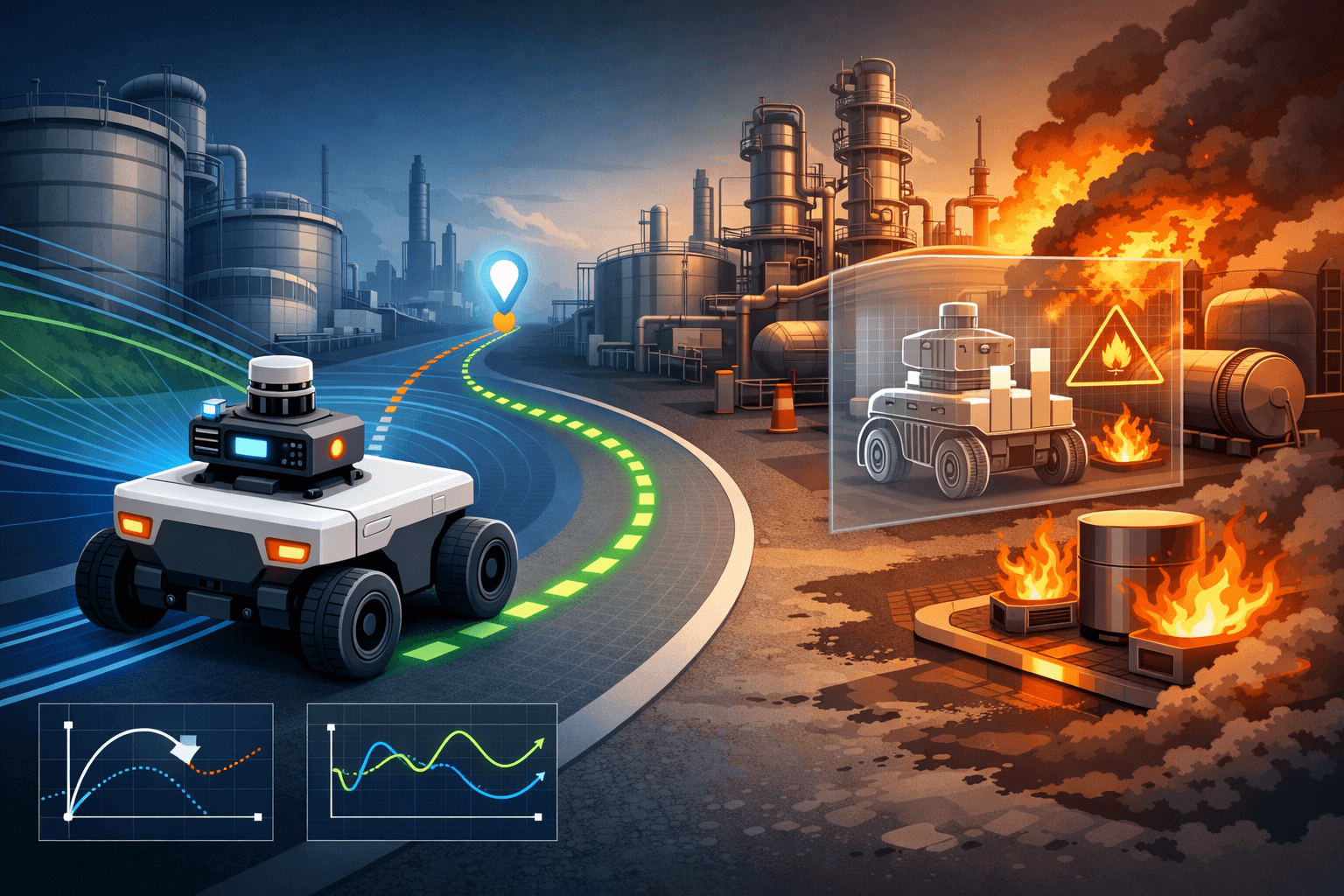
The researchers proposed PP-DSC, which adaptively adjusts lookahead distance and velocity based on steering angle. They deployed it on a four-wheeled steering-type autonomous mobile robot using Robot Operating System 2 (ROS 2) Jazzy with sensor fusion from GNSS-RTK, IMU, and wheel encoders, and they tested straight, circular, and figure-eight trajectories at 1.0–5.0 m/s in an open area. They also extended the method with a Fire and Explosion Index (F&EI)-based safety factor and tested that version in simulation in an empty fruit bunch biodiesel plant.
What worked and what didn't
In the open area, PP-DSC achieved mean lateral deviations of 0.05 m, 0.07 m, and 0.08 m on straight, circular, and figure-eight trajectories, respectively, which the abstract says was a 68–82% improvement over standard PP. In the industrial simulation, standard PP outperformed Safety-integrated PP-DSC by 15.6% because of tight turning radii of 5–9 m, although the safety-integrated version still showed 11–17% improvement in moderate-curvature sections. The F&EI-based safety integration added less than 1% tracking overhead.
What to keep in mind
The abstract describes open-area experiments and a simulation for the chemical plant setting, not a real plant deployment. It also says the industrial results depended on the geometry of the route, and the abstract does not describe additional limitations beyond that.
Key points
- PP-DSC improved tracking in open-area tests compared with standard Pure Pursuit.
- Mean lateral deviation was 0.05 m, 0.07 m, and 0.08 m on straight, circular, and figure-eight paths.
- A safety-integrated version used a Fire and Explosion Index (F&EI)-based safety factor for hazard zones.
- In the biodiesel plant simulation, standard PP outperformed the safety-integrated version by 15.6% overall.
- The abstract says the safety integration added less than 1% tracking overhead.
Disclosure
- Research title:
- PP-DSC improved tracking in open areas, with mixed industrial results
- Publication date:
- 2026-02-13
- OpenAlex record:
- View
Get the weekly research newsletter
Stay current with peer-reviewed research without reading academic papers — one filtered digest, every Friday.