

AI Summary of Peer-Reviewed Research
This page presents an AI-generated summary of a published research paper. The original authors did not write or review this article. See full disclosure ↓
Publication Signals show what we were able to verify about where this research was published.STRONGWe verified multiple publication signals for this source, including independently confirmed credentials. Publication Signals reflect the source’s verifiable credentials, not the quality of the research.
- ✔ Peer-reviewed source
- ✔ Published in indexed journal
- ✔ No retraction or integrity flags
Overview
This study investigates the ecological and stochastic mechanisms governing persistence and colonization of Porphyromonas gingivalis, an oral pathogen critical to periodontal disease pathogenesis. The research addresses the apparent paradox that P. gingivalis exhibits quorum-dependent growth requiring population density thresholds for replication yet persists at low abundances in vivo. The investigation integrates experimental microbiology with mathematical modeling to elucidate how population dynamics, interspecies interactions, and stochastic processes enable pathogen maintenance below deterministic extinction barriers.
Methods and approach
Quantitative growth experiments characterized P. gingivalis population dynamics and identified Allee-type growth kinetics through cubic Allee-effect modeling. Conditioned medium from Veillonella parvula was employed to assess early-colonizer facilitation effects on quorum thresholds. Stochastic mathematical extensions and Fokker-Planck analysis quantified the role of microenvironmental noise in enabling subthreshold persistence. Long-term subthreshold survival experiments validated theoretical predictions. Co-culture experiments with P. gingivalis and V. parvula across replicate trials evaluated rescue outcomes for subcritical inocula. A two-species replicator model mapped observed co-culture outcomes onto parameter space defined by (β, γ) coordinates.
Key Findings
A cubic Allee-effect model quantified a critical population density threshold below which P. gingivalis populations collapse deterministically. Conditioned medium from V. parvula reduced this quorum threshold, indicating facilitation by early colonizers. Stochastic analysis demonstrated that microenvironmental noise enables population persistence below the deterministic Allee barrier, a finding corroborated by persistent survival in subthreshold long-term experiments. In co-culture experiments, V. parvula reliably reached carrying capacity and consistently constrained terminal dynamics to either P. gingivalis-V. parvula coexistence or P. gingivalis extinction. The two-species replicator model mapped these outcomes to restricted regions of the (β, γ) parameter space, with V. parvula establishment limiting accessible dynamical outcomes.
Implications
These findings reconcile the apparent discrepancy between P. gingivalis quorum-dependent growth requirements and its frequent low-abundance detection in oral biofilms. Stochastic fluctuations in local microenvironments provide a mechanistic explanation for subthreshold persistence, suggesting that pathogen colonization does not require deterministic crossing of population density thresholds. The facilitation provided by early colonizers like V. parvula alters fundamental parameters governing P. gingivalis establishment dynamics. The restricted parameter space identified through the two-species replicator model suggests that perturbations reducing interspecies facilitation or shifting community composition could constrain P. gingivalis persistence and associated inflammatory responses.
Disclosure
- Research title: Ecological and stochastic determinants of the growth and persistence of the oral pathogen Porphyromonas gingivalis
- Authors: Moemen Hussein, Arnab Barua, Mohammad A. Qasaimeh, Matthew Smardz, Patricia I. Diaz, Haralampos Hatzikirou
- Institutions: Alexandria University, Khalifa University of Science and Technology, New York University, New York University Abu Dhabi, Technische Universität Dresden, University at Buffalo, State University of New York
- Publication date: 2026-02-26
- DOI: https://doi.org/10.1038/s41540-026-00662-x
- OpenAlex record: View
- PDF: Download
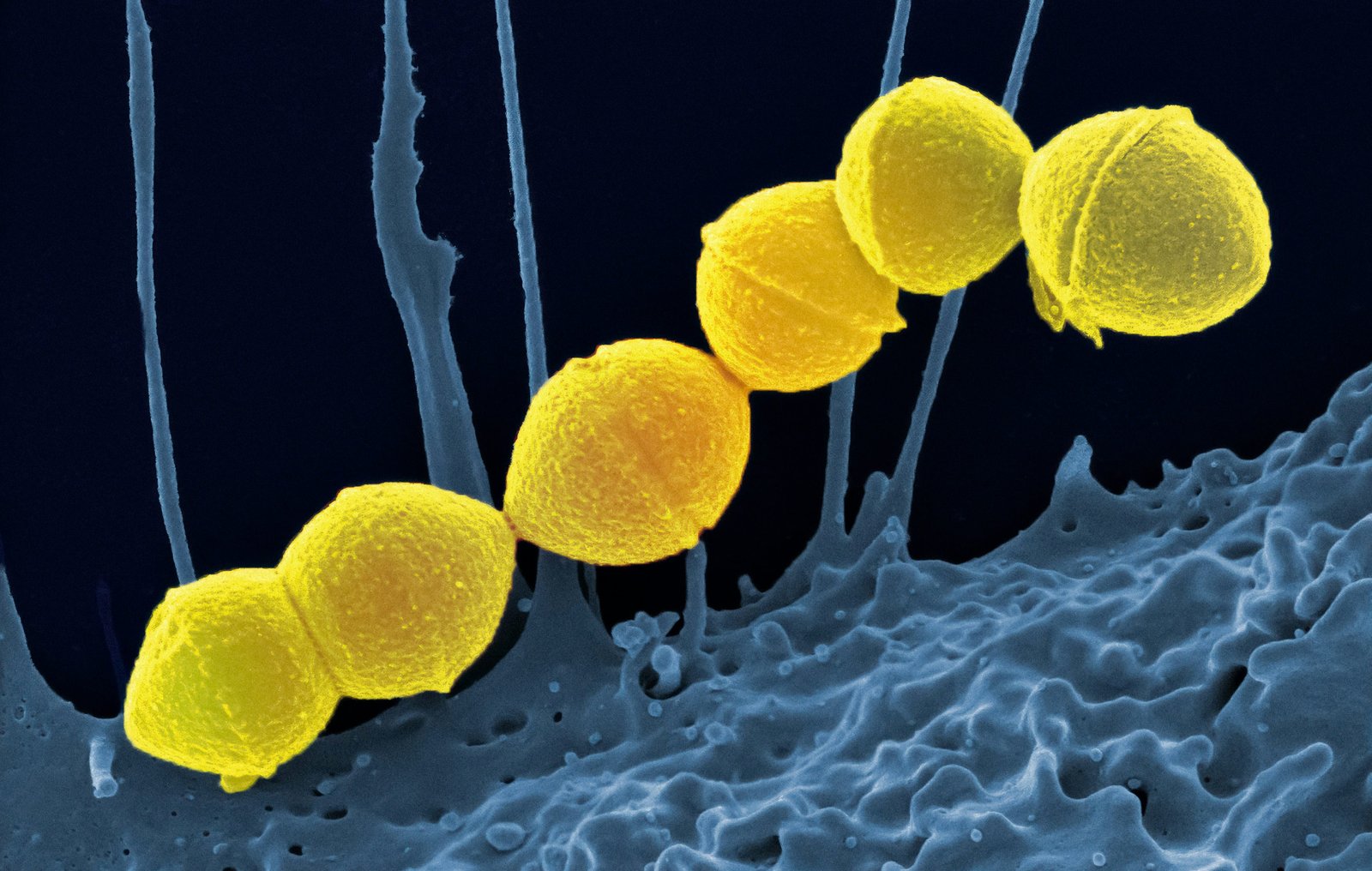
- Image credit: Photo by National Institute of Allergy and Infectious Diseases on Unsplash (Source • License)
- Disclosure: This post was generated by Claude (Anthropic). The original authors did not write or review this post.
Get the weekly research newsletter
Stay current with peer-reviewed research without reading academic papers — one filtered digest, every Friday.