

AI Summary of Peer-Reviewed Research
This page presents an AI-generated summary of a published research paper. The original authors did not write or review this article. See full disclosure ↓
Publication Signals show what we were able to verify about where this research was published.MODERATECore publication signals for this source were verified. Publication Signals reflect the source’s verifiable credentials, not the quality of the research.
- ✔ Peer-reviewed source
- ✔ Published in indexed journal
- ✔ No retraction or integrity flags
Overview
This research addresses critical safety limitations in commercial UAV deployment by developing an autonomous chemical reaction-based airbag system to mitigate impact forces during uncontrolled descent scenarios. The system represents a departure from conventional compressed-gas canister approaches, leveraging chemical inflation to achieve rapid deployment with reduced volumetric and integration requirements. The work directly targets a primary obstacle to widespread civilian UAV operations: hazard mitigation from in-flight failures resulting in free-fall impact.
Methods and approach
The investigation centered on designing and experimentally evaluating a chemically-actuated airbag safety system integrated with a multi-rotor UAV platform. The chemical inflation mechanism was selected to enable faster deployment kinetics compared to conventional gas canister systems while maintaining compatibility with existing UAV payload constraints. Experimental protocols measured impact force reduction across controlled descent scenarios, capturing both force measurements before and after system deployment. The mass characteristics of the safety system were assessed relative to the selected platform's payload capacity to ensure practical feasibility without compromising operational utility.
Key Findings
Controlled impact testing demonstrated a 66% reduction in peak impact force, decreasing from 4638.8 N to 1562.76 N. Airbag inflation was achieved within a fraction of a second, indicating rapid autonomous actuation capability upon detection of rapid descent conditions. The integrated safety system remained within the payload capacity constraints of the selected multi-rotor UAV platform, establishing technical feasibility for field deployment without requiring substantial platform modifications.
Implications
The chemically-actuated airbag approach offers quantifiable improvements over existing compressed-gas systems through superior deployment speed and reduced integration complexity. These characteristics address critical barriers to scalable implementation across heterogeneous civilian UAV operations, where payload capacity and system reliability remain significant practical constraints. The demonstration of substantial impact force attenuation suggests potential for significant risk reduction in scenarios involving in-flight system failure.
Scope and limitations
This summary is based on the study abstract and available metadata. It does not include a full analysis of the complete paper, supplementary materials, or underlying datasets unless explicitly stated. Findings should be interpreted in the context of the original publication.
Disclosure
- Research title: Development of Chemical Reaction Airbag Safety System for Multi-Rotor UAV to Mitigate Free-Fall Collision Impact
- Authors: Brady Villiger, Hossein Eslamiat
- Institutions: Southern Illinois University Carbondale
- Publication date: 2026-03-12
- DOI: https://doi.org/10.3390/drones10030199
- OpenAlex record: View
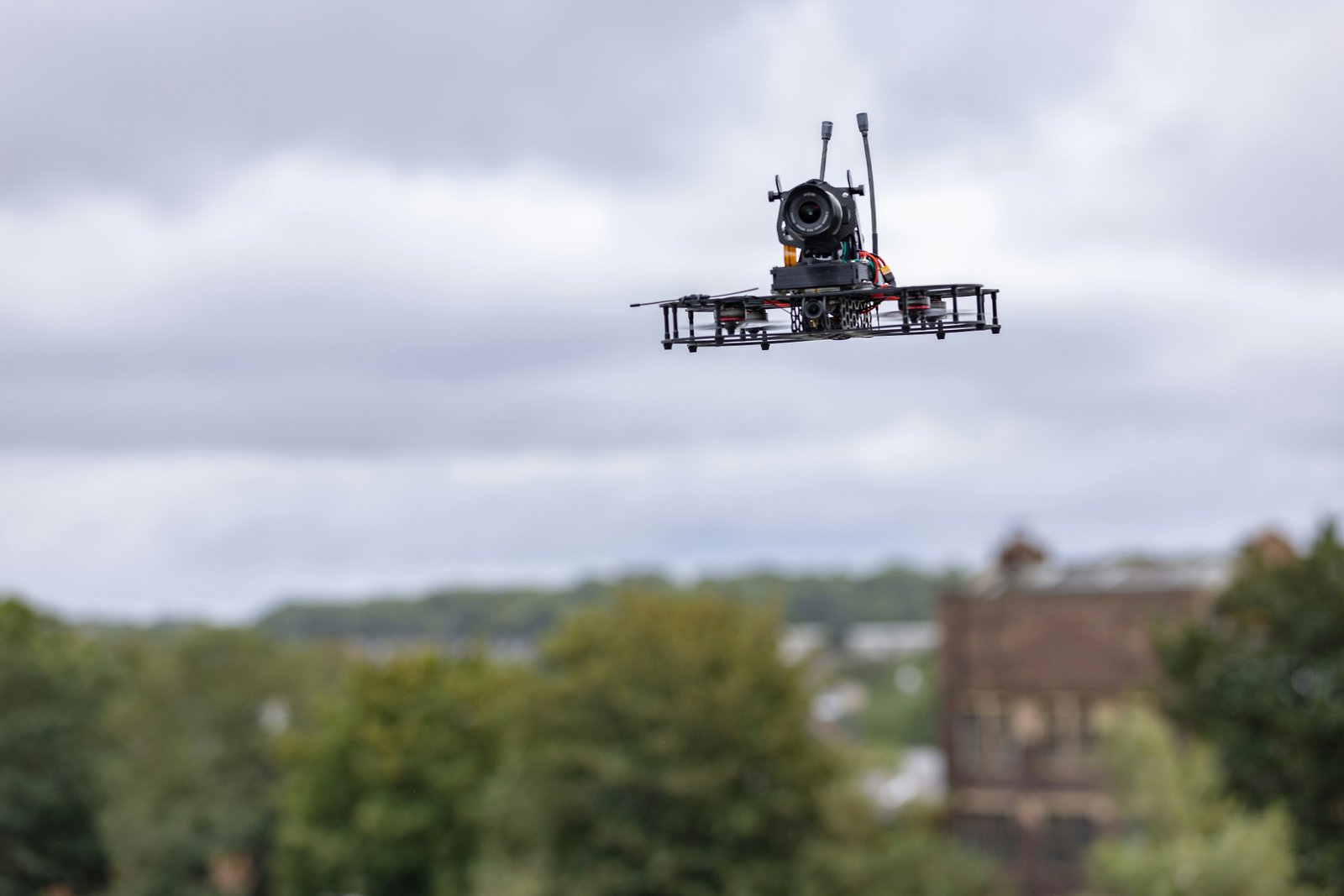
- Image credit: Photo by ThisisEngineering on Unsplash (Source • License)
- Disclosure: This post was generated by Claude (Anthropic). The original authors did not write or review this post.
Get the weekly research newsletter
Stay current with peer-reviewed research without reading academic papers — one filtered digest, every Friday.