

AI Summary of Peer-Reviewed Research
This page presents an AI-generated summary of a published research paper. The original authors did not write or review this article. See full disclosure ↓
Publication Signals show what we were able to verify about where this research was published.MODERATECore publication signals for this source were verified. Publication Signals reflect the source’s verifiable credentials, not the quality of the research.
- ✔ Peer-reviewed source
- ✔ No retraction or integrity flags
Key findings from this study
- The study found that periodic variation of winding shaft diameter effectively dissipates rope and tape structural defects in bobbins.
- The researchers demonstrate that optimal performance occurs at a diameter amplitude of 1 mm and a variation period of 22.5 thread guide strokes.
- The authors report that a second-order regression model quantifies the relationship between shaft diameter parameters and generalized winding structure quality at 0.95 confidence.
Overview
The article addresses winding quality in textile machines that operate at constant product output speed. A friction-drive winding mechanism equipped with a periodic diameter variation device was developed to disperse structural defects (rope and tape winding) in bobbins. The mechanism systematically modulates winding shaft diameter to improve package quality during formation.
Methods and approach
A second-order factorial experiment identified optimal parameters for the diameter-variation dissipating device. The researchers evaluated how amplitude and period of winding shaft diameter changes affected winding structure quality. Regression modeling established relationships between operational parameters and a generalized quality indicator at 0.95 confidence level.
Results
The study obtained a regression model describing winding structure quality as a function of amplitude and period of winding shaft diameter variation. Greatest defect dissipation was achieved with a diameter change amplitude of 1 mm and a period of 22.5 thread guide strokes. Experimental data clearly demonstrated structural changes in winding when using the dissipating device.
The regression model quantitatively characterizes the relationship between mechanical parameters and package quality. These results provide rational selection criteria for technological parameters in production environments and new machine designs. The model enables prediction of winding quality under varying operating conditions.
Implications
Implementation of this diameter-modulation method addresses a critical limitation in existing winding mechanisms: the inability to control density and geometric parameters during package formation. The approach offers automated quality control without fundamental redesign of friction-drive systems. This method is applicable to self-twisting spinning machines and similar textile equipment requiring constant output speed.
The findings suggest that periodic shaft modulation represents a practical solution for eliminating structural defects inherent in constant-speed winding. Widespread adoption could improve package quality across textile production facilities. Further application of this principle may extend to other bobbin-formation processes where defect control is economically important.
Scope and limitations
This summary is based on the study abstract and available metadata. It does not include a full analysis of the complete paper, supplementary materials, or underlying datasets unless explicitly stated. Findings should be interpreted in the context of the original publication.
Disclosure
- Research title: Development of a winding mechanism for spreading the tow winding on textile packages with a periodic change in the diameter of the winding drum
- Authors: Mahammadali Nuraddin Nuriyev, Ganira Zargar Jabbarova
- Institutions: Azerbaijan State University of Economics
- Publication date: 2026-03-31
- DOI: https://doi.org/10.21303/2461-4262.2026.004214
- OpenAlex record: View
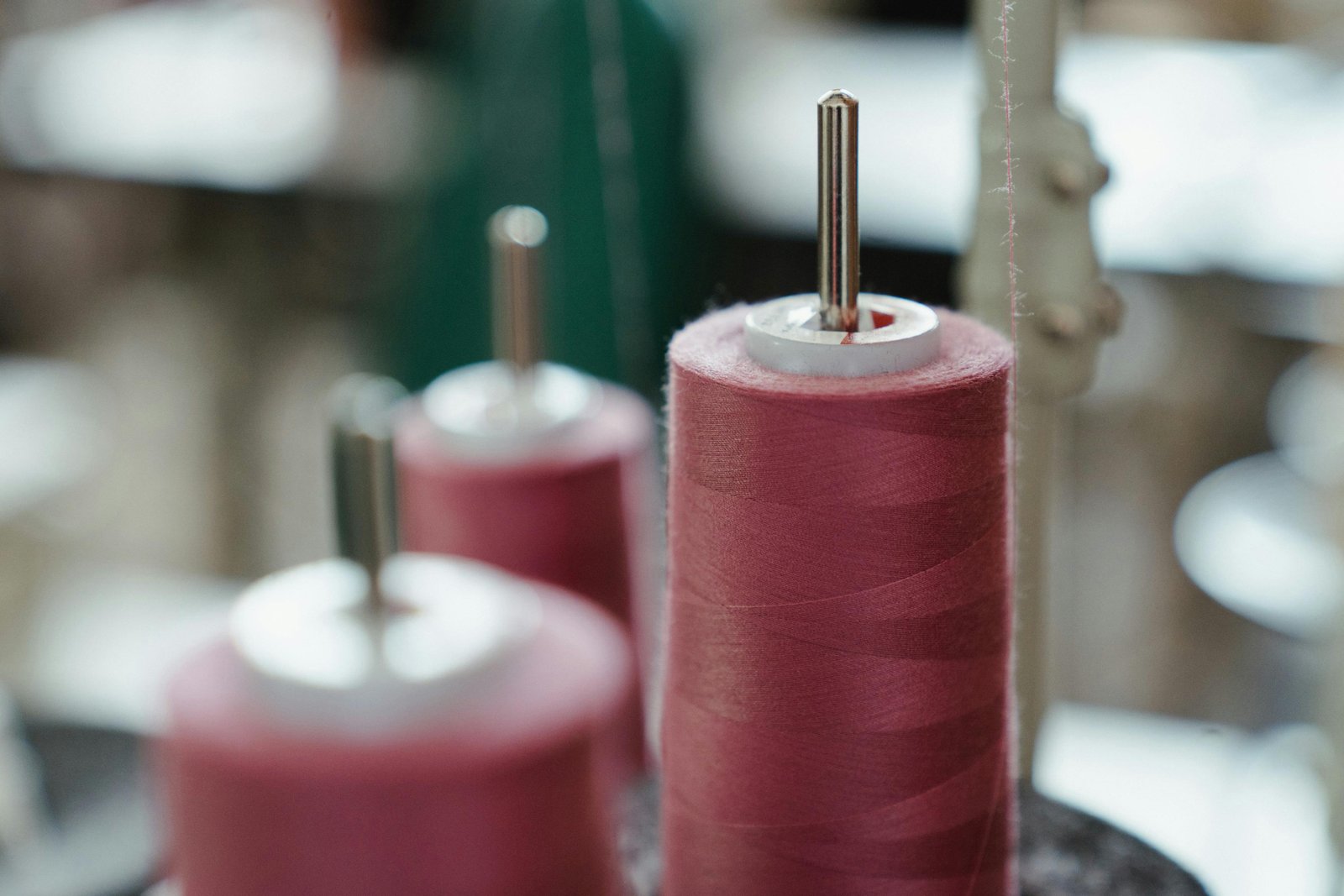
- Image credit: Photo by cottonbro studio on Pexels (Source • License)
- Disclosure: This post was generated by Claude (Anthropic). The original authors did not write or review this post.
Get the weekly research newsletter
Stay current with peer-reviewed research without reading academic papers — one filtered digest, every Friday.