

Key findings from this study
This research indicates that:
Key points
- Dancers engaged with sonification either as a tool to confirm movement precision or as a medium for undirected creative exploration.
- Formalized hip-hop movement vocabularies enable structured design of interactive sonification scenarios.
- Synchronized motion sensing and sound loops facilitate both individual and collective improvisation in dance contexts.
Overview
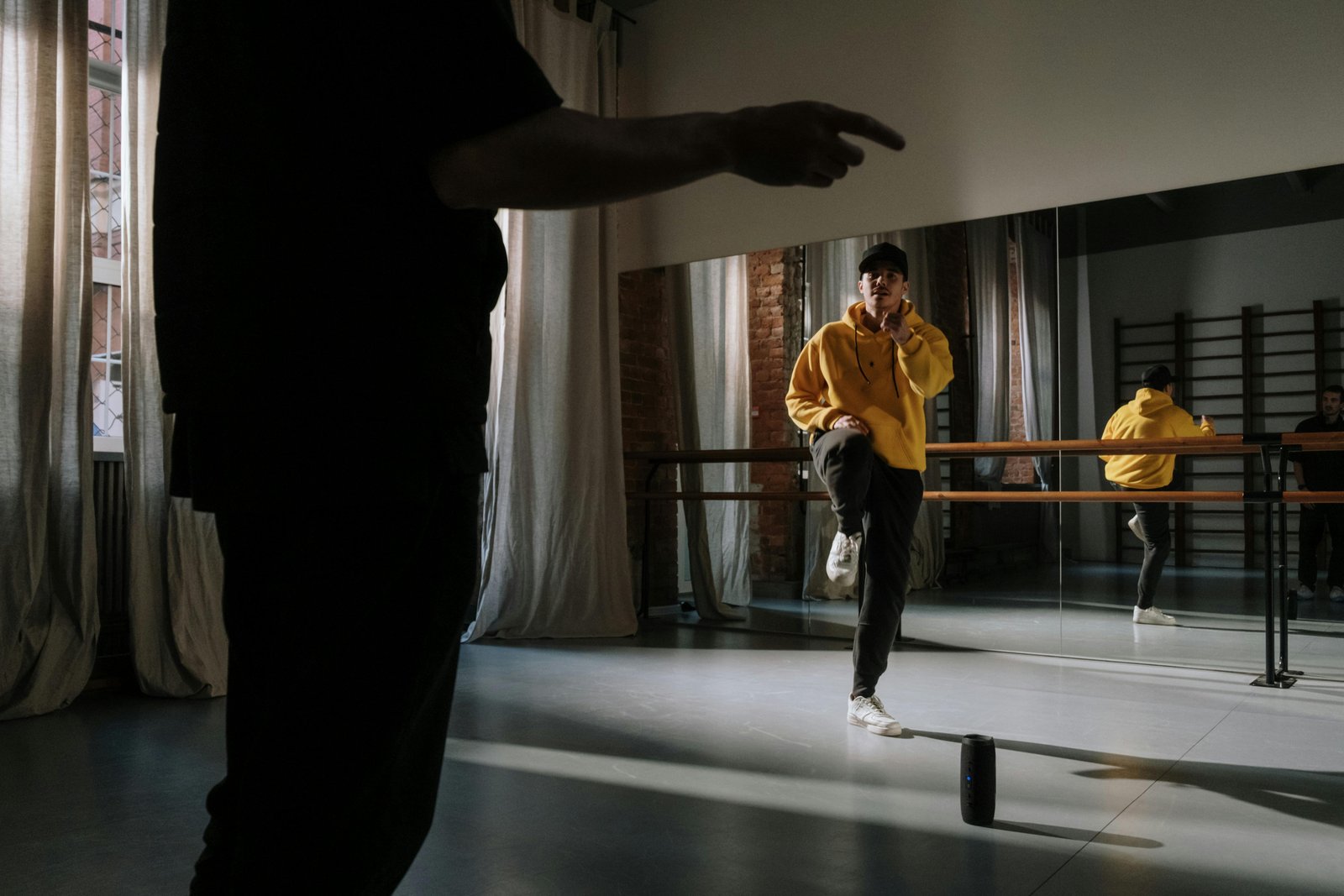
This work investigates interactive sonification for hip-hop dance improvisation, grounding the design in hip-hop practice through autobiographical methodology. The research addresses how dancers respond to unfamiliar music in battles, leveraging synchronized motion sensing and interactive sound loops. Five interaction scenarios formalize a hip-hop-specific movement vocabulary to support both individual and collective improvisation.
Methods and approach
The authors employed autobiographical design methodology rooted in hip-hop practice expertise. They developed five interaction scenarios based on formalized hip-hop movement vocabulary. Three interconnected workshops investigated dancer engagement with sonification during improvisation using synchronized motion sensing and interactive sound loops.
Results
Dancers perceived sonification in two primary ways: as validation of their executed movements or as an open-ended medium for exploratory improvisation. The interactive sonification system supported both individual technical responses and collective group dynamics during improvisation activities. Workshop participants demonstrated varied approaches to integrating real-time sound feedback into their movement generation and interpretation processes.
Implications
This research extends human-computer interaction scholarship into hip-hop dance contexts, addressing a previously underexplored domain. The formalized movement vocabulary and design scenarios provide actionable frameworks for future interactive sonification systems in dance practices. The distinct interpretations of sonification reveal that effective movement-sound systems must accommodate multiple user orientations: technical validation and open creative exploration.
Scope and limitations
This summary is based on the study abstract and available metadata. It does not include a full analysis of the complete paper, supplementary materials, or underlying datasets unless explicitly stated. Findings should be interpreted in the context of the original publication.
Disclosure
- Research title: Designing Interactive Movement Sonification For Hip-Hop Dance
- Authors: Louise Grebel, Sarah Fdili Alaoui, Benjamin Matuszewski, Emilien Ghomi, Frédéric Bevilacqua
- Institutions: Centre National de la Recherche Scientifique, Institut de Recherche et Coordination Acoustique Musique, Sciences et Technologies de la Musique et du Son, Sorbonne Université, University of the Arts London
- Publication date: 2026-04-13
- DOI: https://doi.org/10.1145/3772318.3790703
- OpenAlex record: View
- Image credit: Photo by cottonbro studio on Pexels (Source • License)
- Disclosure: This post was generated by Claude (Anthropic). The original authors did not write or review this post.
Disclosure
- Research title:
- Designing Interactive Movement Sonification For Hip-Hop Dance
- Publication date:
- 2026-04-13
- OpenAlex record:
- View
- Image credit:
- Pexels • cottonbro studio · Pexels License
Get the weekly research newsletter
Stay current with peer-reviewed research without reading academic papers — one filtered digest, every Friday.