

What the study found
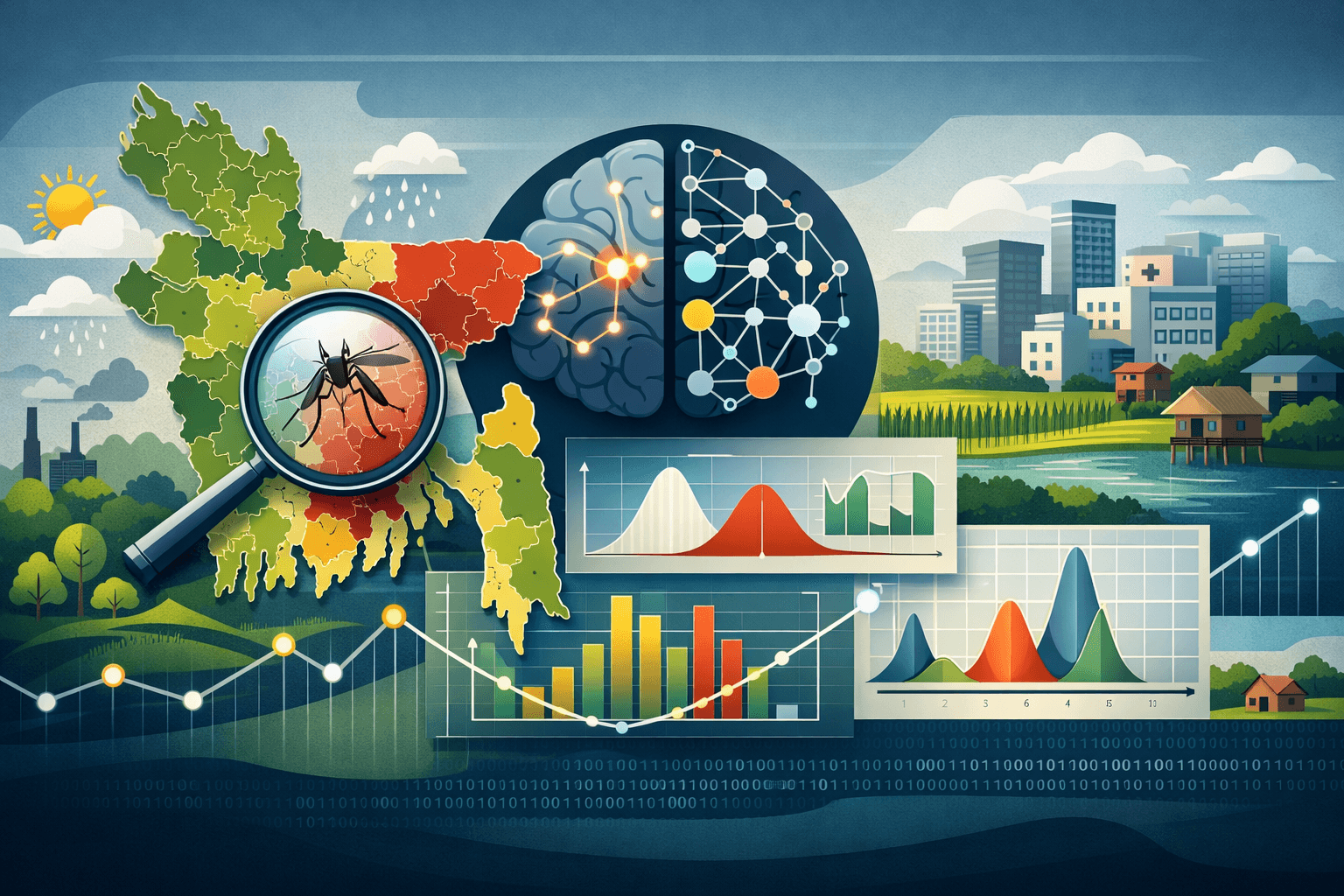
A district-level dengue early warning system for Bangladesh produced accurate and interpretable predictions by combining climate, socio-demographic, economic, healthcare, and environmental data. The study identified climate as the strongest predictor of dengue transmission, with poverty and healthcare capacity also contributing.
Why the authors say this matters
The authors conclude that their integrated framework provides transparent, interpretable predictions and district-level early warnings. They say this supports adaptive dengue outbreak preparedness and resource allocation in Bangladesh.
What the researchers tested
The researchers examined dengue cases across all 64 districts in Bangladesh from 2017 to 2024. They combined DGHS (Directorate General of Health Services) case records with climate, socio-demographic, economic, and healthcare indicators, and used machine learning, deep learning, SHAP (Shapley Additive Explanations), and Bayesian spatio-temporal models.
What worked and what didn't
The MLP (Multi-Layer Perceptron, a type of neural network) model performed best for yearly prediction, with accuracy of 0.93 and ROC-AUC of 0.99. ConvLSTM (Convolutional Long Short-Term Memory, a model for spatial and time-based patterns) performed best for monthly prediction, with recall of 0.88 and ROC-AUC of 0.81, and Bayesian BYM2_RW2 with lagged effects improved predictive fit with DIC of 3671.055.
What to keep in mind
The abstract does not describe limitations in detail. The findings are specific to dengue in Bangladesh and to the data and methods used in this study.
Key points
- The study built a district-level dengue early warning system for Bangladesh.
- Climate was reported as the strongest predictor of dengue transmission.
- Poverty and healthcare capacity also contributed to dengue prediction.
- The MLP model had the best yearly performance, while ConvLSTM performed best for monthly prediction.
- Bayesian spatio-temporal modeling with lagged effects improved predictive fit.
Disclosure
- Research title:
- District-level dengue predictions improved with climate and health data
- Publication date:
- 2026-03-05
- OpenAlex record:
- View
Get the weekly research newsletter
Stay current with peer-reviewed research without reading academic papers — one filtered digest, every Friday.