

Overview
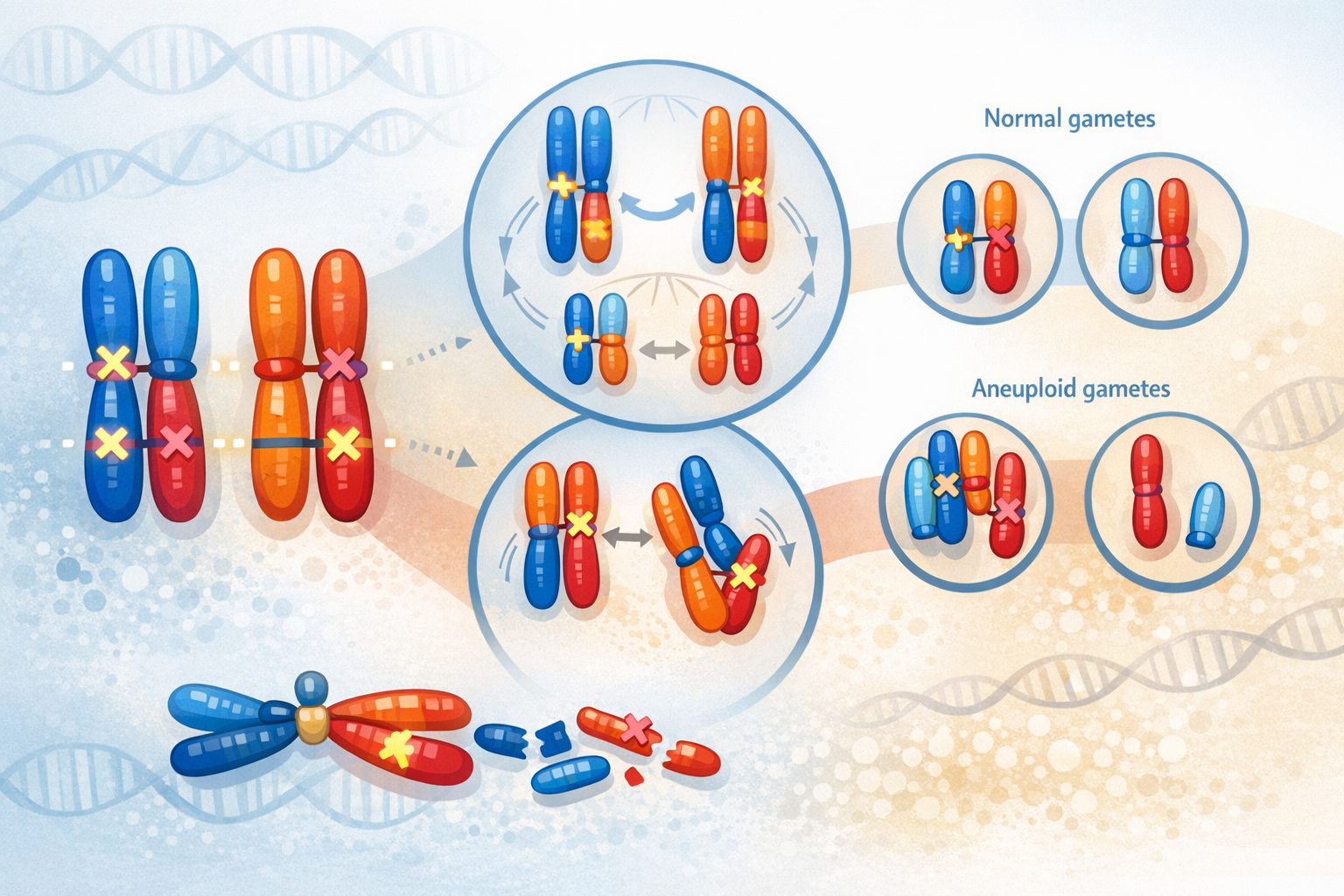
Meiotic nondisjunction, the failure of chromosomes to segregate properly during meiosis, generates aneuploid gametes and represents the primary cause of pregnancy loss. Accurate chromosome segregation depends on the number and positioning of crossovers, which are sites of genetic exchange between homologous chromosomes. Prior investigations of nondisjunction in acrocentric and telocentric chromosomes in both human and Drosophila systems have documented alterations in crossover positioning and frequency that vary between meiosis I and meiosis II errors. However, limited evidence from normally segregating chromosomes in metacentric trisomies has indicated potential differences in the behavior of metacentric chromosomes compared to acrocentric and telocentric chromosomes during nondisjunction events. This study addresses this gap by examining spontaneous meiotic nondisjunction of the metacentric chromosome 2 in Drosophila melanogaster to determine whether chromosome architecture influences the recombination patterns associated with segregation failure.
Methods and approach
The investigation utilized whole-genome sequencing to analyze spontaneous meiotic nondisjunction events involving Drosophila melanogaster chromosome 2, a metacentric chromosome. This approach enabled detailed characterization of the recombination landscape in nondisjunction events, with particular attention to patterns previously identified as potentially impacting chromosome segregation differently based on chromosomal architecture. The analysis focused on three recombination configurations: absence of crossovers, distally positioned crossovers, and proximally positioned crossovers. Comparative analysis was conducted between the recombination patterns observed in chromosome 2 nondisjunction and previously characterized patterns associated with the telocentric X chromosome to identify chromosome-specific differences in the relationship between crossover positioning and segregation failure.
Key Findings
The analysis revealed that meiotic nondisjunction of the metacentric chromosome 2 exhibits a distinct recombination profile compared to the telocentric X chromosome. Unlike X chromosome nondisjunction, which is characterized by pronounced alterations in crossover landscape, chromosome 2 nondisjunction is primarily associated with reduced recombination rather than dramatic shifts in crossover positioning. Quantitative differences in the proportions of nondisjunction events displaying altered recombination patterns were observed between chromosomes X and 2, indicating that abnormal crossover positions exert differential effects on chromosomes with different centromere positions and overall architecture. The findings demonstrate that metacentric chromosomes do not simply recapitulate the recombination-nondisjunction relationships established for acrocentric and telocentric chromosomes, but instead exhibit chromosome-specific sensitivities to particular recombination configurations.
Implications
These findings establish that the recombination-based mechanisms underlying meiotic nondisjunction are not uniform across chromosomes but are influenced by chromosome-specific structural features, particularly centromere position and chromosome architecture. The differential impact of crossover positioning on segregation accuracy between metacentric and telocentric chromosomes suggests that models of meiotic nondisjunction must account for chromosomal context when predicting segregation outcomes. This chromosome specificity has implications for understanding patterns of human aneuploidy, where different chromosomes exhibit distinct frequencies of nondisjunction. The demonstration that reduced recombination, rather than altered crossover positioning, is the primary feature of chromosome 2 nondisjunction indicates that the relationship between crossover landscape and segregation fidelity varies according to chromosome architecture. Future investigations of meiotic error mechanisms must consider these chromosome-specific differences to fully elucidate the factors contributing to aneuploidy risk across the genome.
Disclosure
Key points
- Research title: Chromosome-specific differences in the recombination landscape of spontaneous meiotic nondisjunction
- Authors: Carolyn A. Turcotte, Jeff Sekelsky
- Publication date: 2026-01-07
- DOI: https://doi.org/10.64898/2026.01.06.697974
- OpenAlex record: View
- Disclosure: This post was generated by Claude (Anthropic). The original authors did not write or review this post.
Disclosure
- Research title:
- Chromosome-specific differences in the recombination landscape of spontaneous meiotic nondisjunction
- Publication date:
- 2026-01-07
- OpenAlex record:
- View
Get the weekly research newsletter
Stay current with peer-reviewed research without reading academic papers — one filtered digest, every Friday.