Tag: Global and Planetary Change

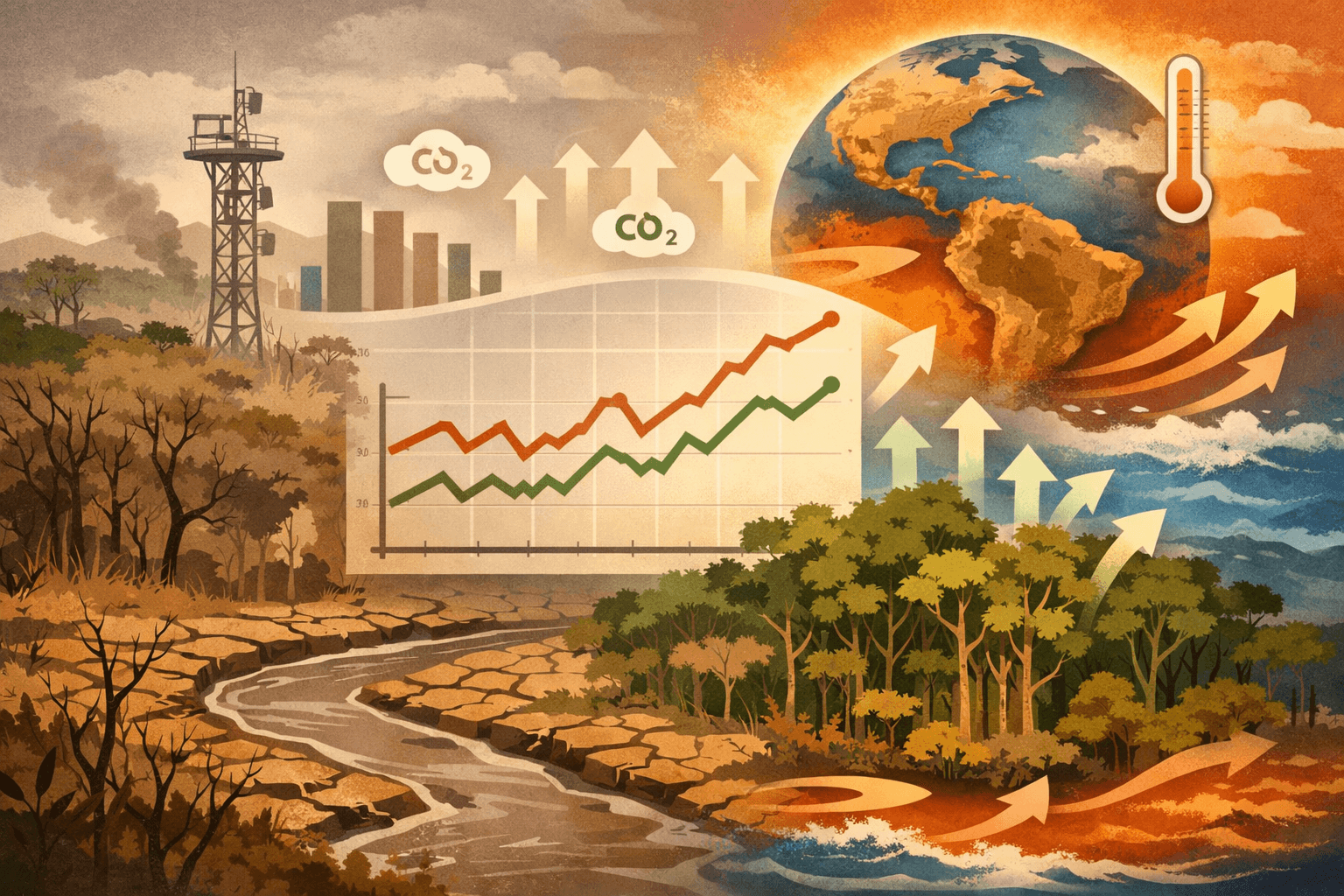
Extreme 2023 drought made the Amazon a weak carbon source
2023 Amazon drought reduced vegetation carbon uptake, turning the region into a weak carbon source independent of fire emissions, revealing climate vulnerability.

UK climate strategy and standards support emissions action
Explore UK climate strategy toward 2050 net-zero target, examining carbon leakage, greenhouse gas accounting, life-cycle assessment, and ISO standards for emissions reduction and climate adaptation.

Pantropical forest leaf longevity is converging toward a middle range
Pantropical moist forests show converging leaf longevity under climate change, with long-longevity regions declining and short-longevity regions increasing.

Framework proposed for feasible, equitable land-based climate mitigation
Framework integrating numerical modelling with stakeholder coproduction for feasible, equitable assessment of land-based climate mitigation technologies across governance levels.

Southern land evaporation linked to North China extreme rain
Study identifies atmospheric circulation patterns and cross-regional evaporation precursors driving extreme precipitation trends in North China using information flow analysis.

Hydrogen contrail ice crystal formation depends on entrained aerosols
Systematic microphysical simulations reveal ice crystal formation mechanisms in hydrogen-combustion contrails, establishing foundation for climate impact parameterization.

Large CDR pathways may discourage faster emissions cuts
Analysis of how reliance on carbon dioxide removal in climate scenarios may substitute for immediate emissions reductions, creating carbon budget overshoot and justice concerns.

Flood susceptibility in the Kabul River Basin rises toward 2100
Projection of flood susceptibility in the Kabul River Basin through 2100 integrating climate, population, and land cover dynamics using XGBoost machine learning with high predictive accuracy.

Global green wave shifts north and east
—
Study reveals accelerated north-east shift in global green wave trajectory, indicating restructured vegetation phenology and hemispheric productivity changes through 21st century.

High-altitude ice clouds show daytime cooling and nighttime warming
—
A rapid satellite-based methodology quantifies radiative forcing from high-altitude ice clouds and contrails using geostationary observations with 15% accuracy.