Tag: Astrophysics and Star Formation Studies
AGN jet lobe growth matches self-similar scaling
—
in AstrophysicsWhat the study found AGN jet lobe growth followed analytic self-similar scaling relations and converged with resolution. The authors also found that the energy split between thermal and kinetic forms departed from the idealized picture and depended strongly on artificial viscosity. Why the authors say this matters The findings indicate that SPH-based jet modeling can…

Non-equilibrium condensation matches chondrite mineral classes
What the study found Chondrite precursors may have formed through kinetic non-equilibrium condensation rather than only equilibrium processes. The model results suggest that different cooling rates and pressures can produce three mineralogical types, with more departure from equilibrium leading to more oxidized and hydrous mineralogies. Why the authors say this matters The authors say this…

DM Tau disk shows non-thermal line broadening
—
in AstrophysicsBayesian analysis of molecular line observations confirms nonthermal broadening of 0.4 sound speeds in the DM Tau protoplanetary disk, providing evidence for turbulence.

Tomographic line analysis identifies possible embedded planets in disks
—
in AstrophysicsTomographic analysis of molecular line observations enables detection of embedded planets in protoplanetary disks, revealing multiple planet candidates in HD 135344B and MWC 758.

Large protoplanetary disks show widespread non-Keplerian gas motions
—
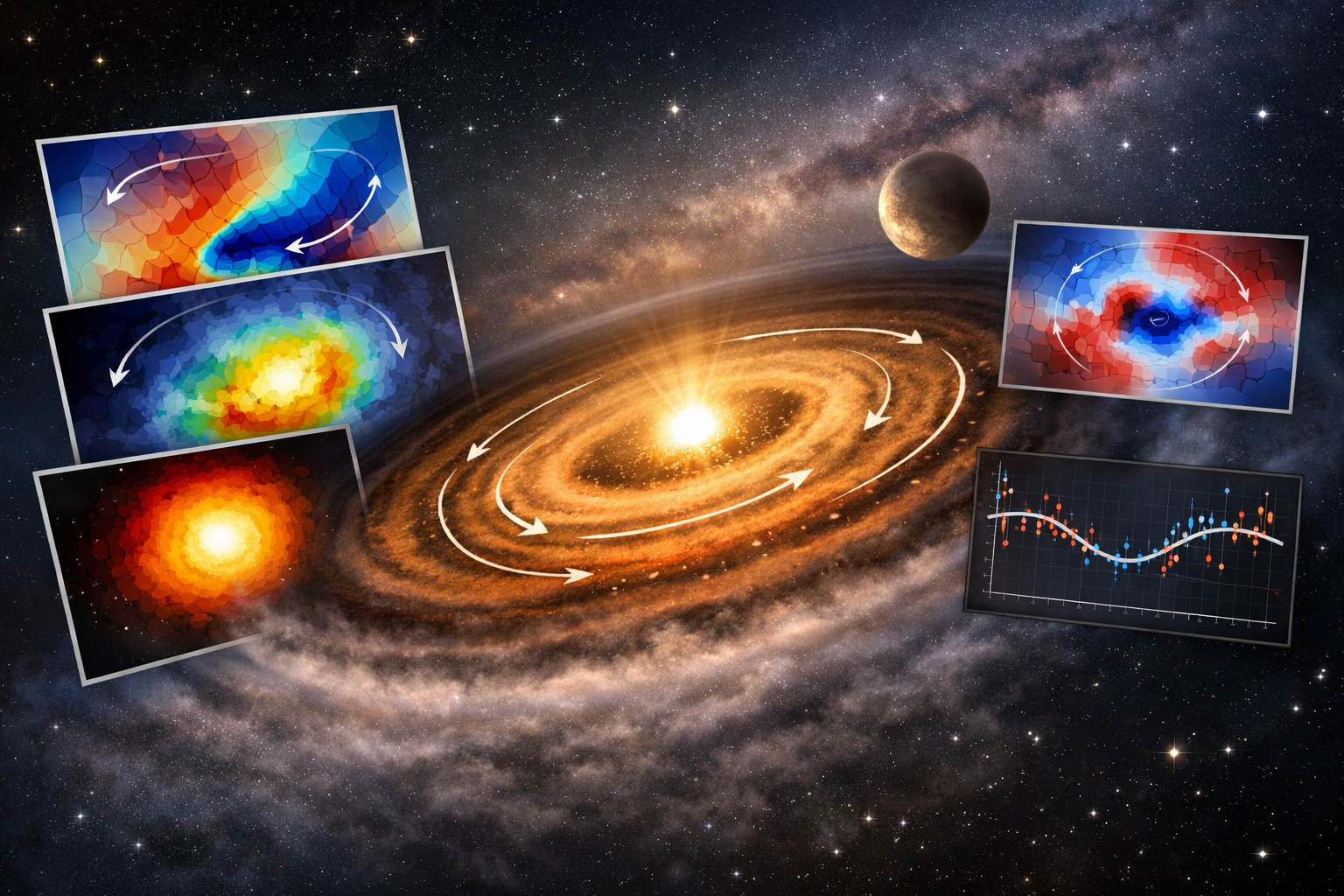
in AstrophysicsTwo-dimensional kinematic mapping of 15 protoplanetary disks reveals ubiquitous non-Keplerian deviations including spiral structures, with systematic differences between disk classifications.

Vertical gas flows are widespread in protoplanetary disks
—
in AstrophysicsStudy of vertical gas flows in 14 protoplanetary disks using ALMA observations reveals ubiquitous vertical motions driven by diverse physical mechanisms during planet formation.