

What the study found
Vertical gas motions were detected in most of the 14 protoplanetary disks studied. The authors report two recurring patterns: oscillatory up-and-down flows, which they link to instabilities, and transitions from downward to upward motion, which they interpret as the bases of disk winds.
Why the authors say this matters
The study suggests that vertical flows are a natural part of protoplanetary disk processes and are relevant to the earliest stages of planet formation. The authors conclude that deep, high-spectral-resolution line data can reveal these motions, but that the overall flow structure is too complex to identify one dominant physical mechanism across all disks.
What the researchers tested
The researchers analyzed 14 disks from the exoALMA Large Program using the 12 CO J = 3–2 and 13 CO J = 3–2 emission lines. They modeled the Keplerian velocity field with discminer, then extracted line-of-sight velocity residuals to measure radial and vertical gas motion.
What worked and what didn't
In most disks, the vertical velocity amplitudes were only a few tens of m s−1. Two disks, MWC758 and CQ Tau, showed two spiral velocity features in their residual maps, with red- and blueshifted signals interpreted as vertical velocities up to about 350 m s−1, and MWC758 also showed fast upward motions up to 500 m s−1 in its outer disk.
What to keep in mind
Synthetic observations from (magneto)hydrodynamic simulations were used to validate the method. The abstract says strong molecular winds appear to be relatively rare in 12 CO and 13 CO, and it notes that the complex velocity structure prevents identifying a single coherent driving mechanism; further theoretical investigation is needed. Limitations are otherwise not described in the available summary.
Key points
- Vertical gas motions were found in most of the 14 disks analyzed.
- Two recurring patterns were reported: oscillatory up/down flows and transitions from downward to upward motion.
- Most velocity amplitudes were only a few tens of m s−1.
- MWC758 and CQ Tau showed spiral velocity features interpreted as vertical speeds up to about 350 m s−1.
- MWC758 also showed fast upward motions up to 500 m s−1 in its outer disk.
Disclosure
- Research title:
- Vertical gas flows are widespread in protoplanetary disks
- Publication date:
- 2026-03-16
- OpenAlex record:
- View
- Image credit:
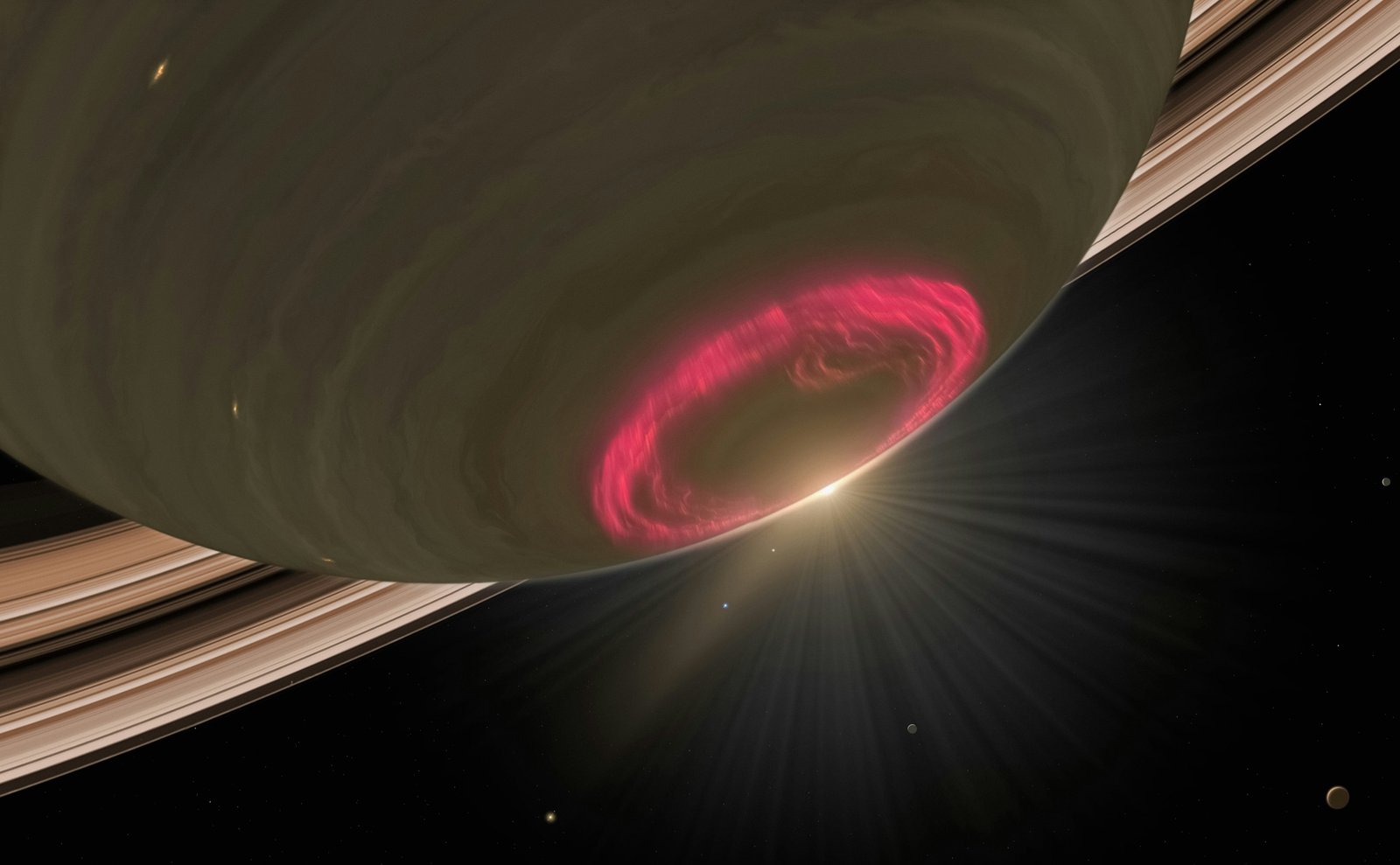
- Photo by NASA Hubble Space Telescope on Unsplash · Unsplash License
Get the weekly research newsletter
Stay current with peer-reviewed research without reading academic papers — one filtered digest, every Friday.