

AI Summary of Peer-Reviewed Research
This page presents an AI-generated summary of a published research paper. The original authors did not write or review this article. See full disclosure ↓
⚠️ This summary is for informational purposes only and does not constitute financial or investment advice. Past research findings do not guarantee future outcomes. Consult a qualified financial professional before making investment decisions.
Publication Signals show what we were able to verify about where this research was published.STANDARDAvailable publication signals for this source were verified. Publication Signals reflect the source’s verifiable credentials, not the quality of the research.
Fewer signals were independently confirmable for this source. That reflects the limits of what’s on record — not a judgment about the research.
- ✔ Published in indexed journal
- ✔ No retraction or integrity flags
Key findings from this study
- The study found that returning CBAM revenues to vulnerable products increases global welfare while reducing emissions compared with standard implementation.
- The researchers demonstrate that CBAM effects vary substantially across products, driven by export values, emission intensity, and EU market reliance.
- The authors report that conventional CBAM design increases EU welfare but imposes substantial losses on trading partners globally.
Overview
The European Union's Carbon Border Adjustment Mechanism charges imports based on embedded carbon emissions. This study integrates product-level tariff accounting with multi-country partial equilibrium modeling to assess effects across 222 steel products. Analysis reveals CBAM reduces global emissions modestly while increasing EU welfare but imposing substantial losses globally. Product-level heterogeneity driven by export values, emission intensity, and EU market dependence determines differential impacts.
Methods and approach
The researchers combined a product-level CBAM-equivalent tariff accounting framework with a multi-country partial equilibrium model. The analysis encompassed 222 steel products across the EU and major trading partners. This integration allowed quantification of carbon emissions reductions and economic welfare changes at granular product resolution rather than aggregate national scales.
Results
Revenue redistribution to vulnerable products increases global welfare relative to standard CBAM implementation. Simultaneously, this reallocation achieves further emissions reductions in iron and steel sectors. The study demonstrates substantial variation in CBAM effects across individual products based on export competitiveness, carbon intensity profiles, and market concentration. EU welfare gains occur alongside global welfare declines under conventional policy design.
Implications
Product-level policy design proves critical for balancing mitigation effectiveness with economic feasibility. Revenue-recycling mechanisms targeting vulnerable sectors can simultaneously improve global welfare outcomes and strengthen climate objectives. This approach addresses distributional concerns that threaten political viability of border carbon policies across trading nations.
Scope and limitations
This summary is based on the study abstract and available metadata. It does not include a full analysis of the complete paper, supplementary materials, or underlying datasets unless explicitly stated. Findings should be interpreted in the context of the original publication.
Disclosure
- Research title: Returning European Union carbon border adjustment revenues to specific products increases global welfare and reduces emissions
- Authors: Lanxin Zhang, Zongguo Wen, Yawei Wang, Mao Xu
- Institutions: Tsinghua University, Tsinghua–Berkeley Shenzhen Institute
- Publication date: 2026-03-05
- DOI: https://doi.org/10.1038/s43247-026-03357-7
- OpenAlex record: View
- PDF: Download
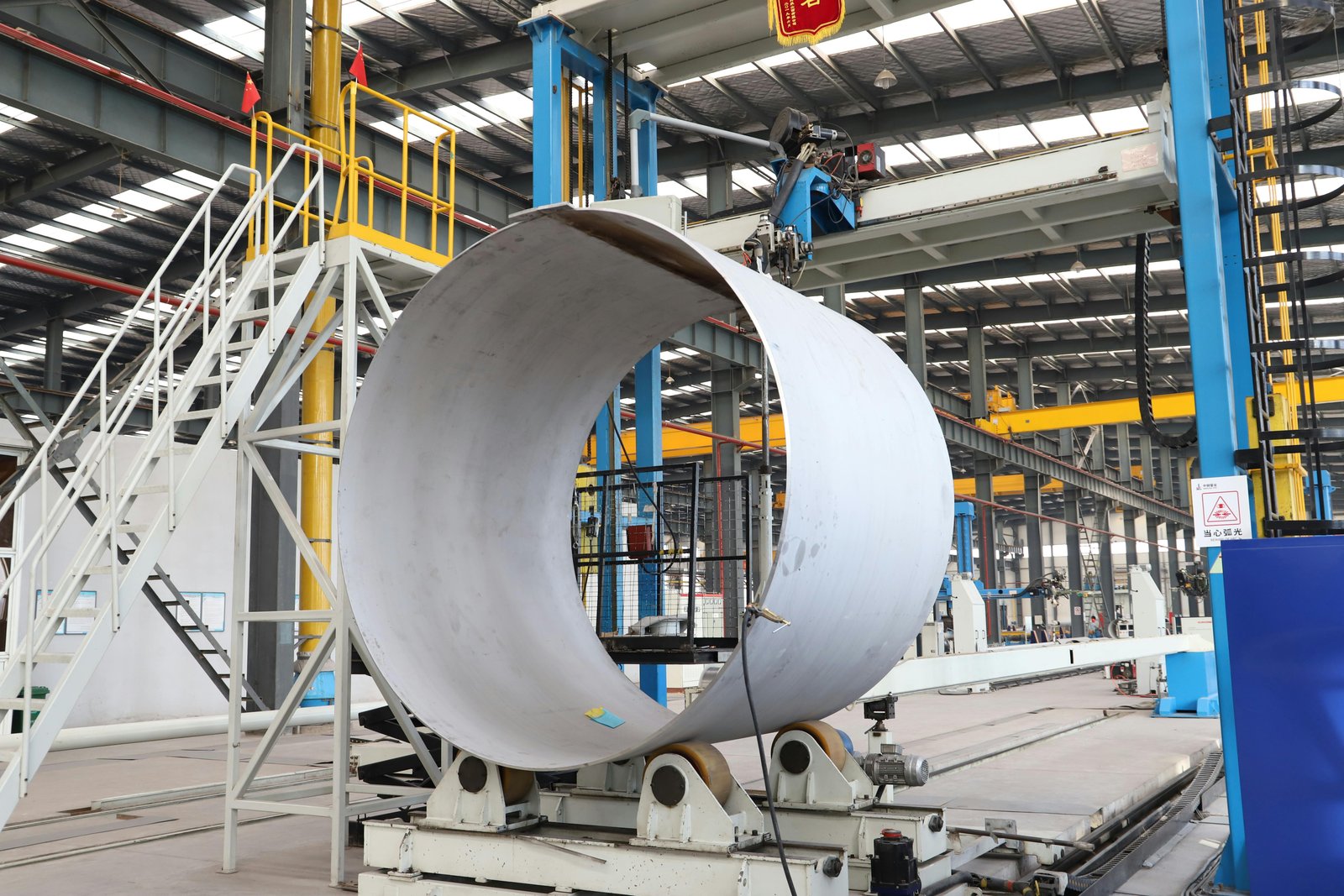
- Image credit: Photo by SINOSTEEL STAINLESS STEEL PIPE on Pexels (Source • License)
- Disclosure: This post was generated by Claude (Anthropic). The original authors did not write or review this post.
Get the weekly research newsletter
Stay current with peer-reviewed research without reading academic papers — one filtered digest, every Friday.