

AI Summary of Scholarly Research
This page presents an AI-generated summary of a published research paper. The original authors did not write or review this article. See full disclosure ↓
⚠️ This summary is for informational purposes only and does not constitute financial or investment advice. Past research findings do not guarantee future outcomes. Consult a qualified financial professional before making investment decisions.
Publication Signals show what we were able to verify about where this research was published.STANDARDAvailable publication signals for this source were verified. Publication Signals reflect the source’s verifiable credentials, not the quality of the research.
Fewer signals were independently confirmable for this source. That reflects the limits of what’s on record — not a judgment about the research.
- ✔ Published in indexed journal
- ✔ No retraction or integrity flags
- ✔ Journal impact data available (H-index: 157)
Overview
The paper analyzes optimal policy responses to carbon dioxide removal (CDR) when storage can be either permanent or non-permanent. It places CDR within a welfare and public economics framework that distinguishes the long-run climatic effects of permanent sinks from transient effects of non-permanent sinks. The conceptual contribution isolates how non-permanent CDR interacts with mitigation incentives, marginal damages, and the appropriate valuation metric for removal activities relative to the social cost of carbon.
Methods and approach
An analytical welfare framework is developed to compare outcomes under permanent and non-permanent CDR. The model characterizes the marginal welfare trade-offs from deploying removal technologies that permanently extract atmospheric carbon versus technologies that sequester carbon temporarily and subsequently release it. Optimal pricing, the implied social cost of removal, and the temperature implications are derived endogenously. Institutional requirements for monitoring, liability assignment, and financing are analyzed qualitatively to assess the informational and enforcement burdens of alternative regulatory regimes.
Key Findings
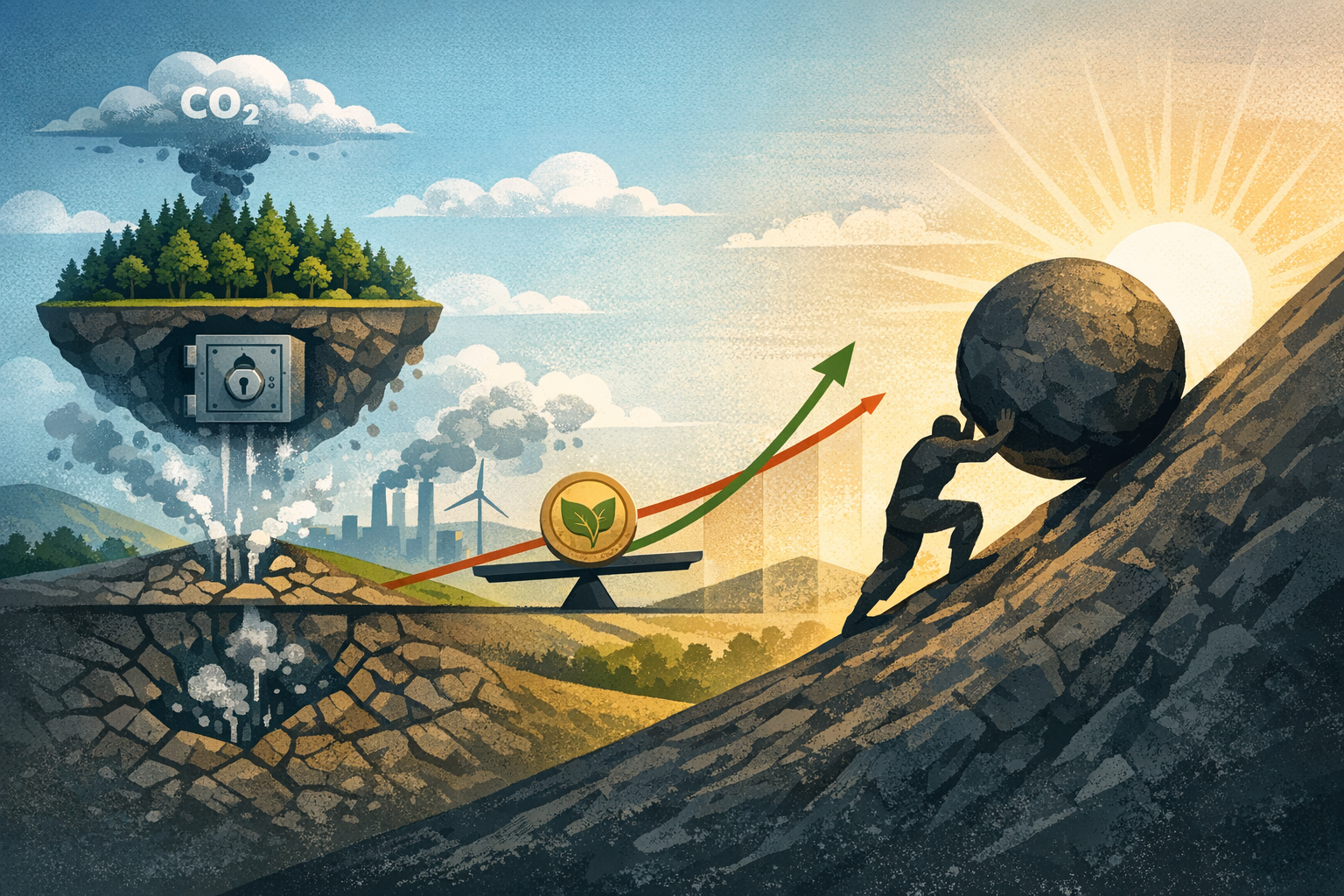
Non-permanent CDR reduces near-term mitigation costs by substituting for emissions reductions, even though stored carbon is re-emitted eventually. Unlike permanent CDR, deployment of non-permanent CDR does not lower the optimal long-run temperature level. The welfare valuation of non-permanent removals differs from the conventional social cost of carbon because an incremental social cost of removal arises from the marginal damages associated with future emissions released from temporary storage. The model identifies trade-offs between short-run cost savings and long-run climate outcomes depending on the availability of permanent sinks and the expected duration of temporary sequestration.
Implications
Policy design must address monitoring accuracy, liability horizons, and financing mechanisms to ensure that non-permanent CDR is deployed in a welfare-improving manner. Three regulatory regimes are evaluated with respect to informational intensity: (i) price-based instruments that internalize marginal damages of re-release via adjusted removal prices; (ii) liability-based regimes that impose ex post obligations on storage providers for eventual emissions; and (iii) hybrid arrangements that combine upfront financing with performance-contingent transfers. Institutional capacity to verify storage durations and enforce long-run obligations is decisive for selecting among regimes; where such capacity is weak, reliance on non-permanent CDR risks undermining long-run temperature targets.
Disclosure
- Research title: Pigou’s Advice and Sisyphus’ Warning: Carbon Pricing with Non-Permanent Carbon Dioxide Removal
- Authors: Max Franks, Friedemann Gruner, Kai Lessmann, Ottmar Edenhofer
- Publication date: 2026-01-21
- DOI: https://doi.org/10.1007/s10640-025-01060-3
- OpenAlex record: View
- Disclosure: This post was generated by Claude (Anthropic). The original authors did not write or review this post.
Get the weekly research newsletter
Stay current with peer-reviewed research without reading academic papers — one filtered digest, every Friday.