

Numerical Modeling of Relativistic Effects in Synchrotron-emitting Shocks

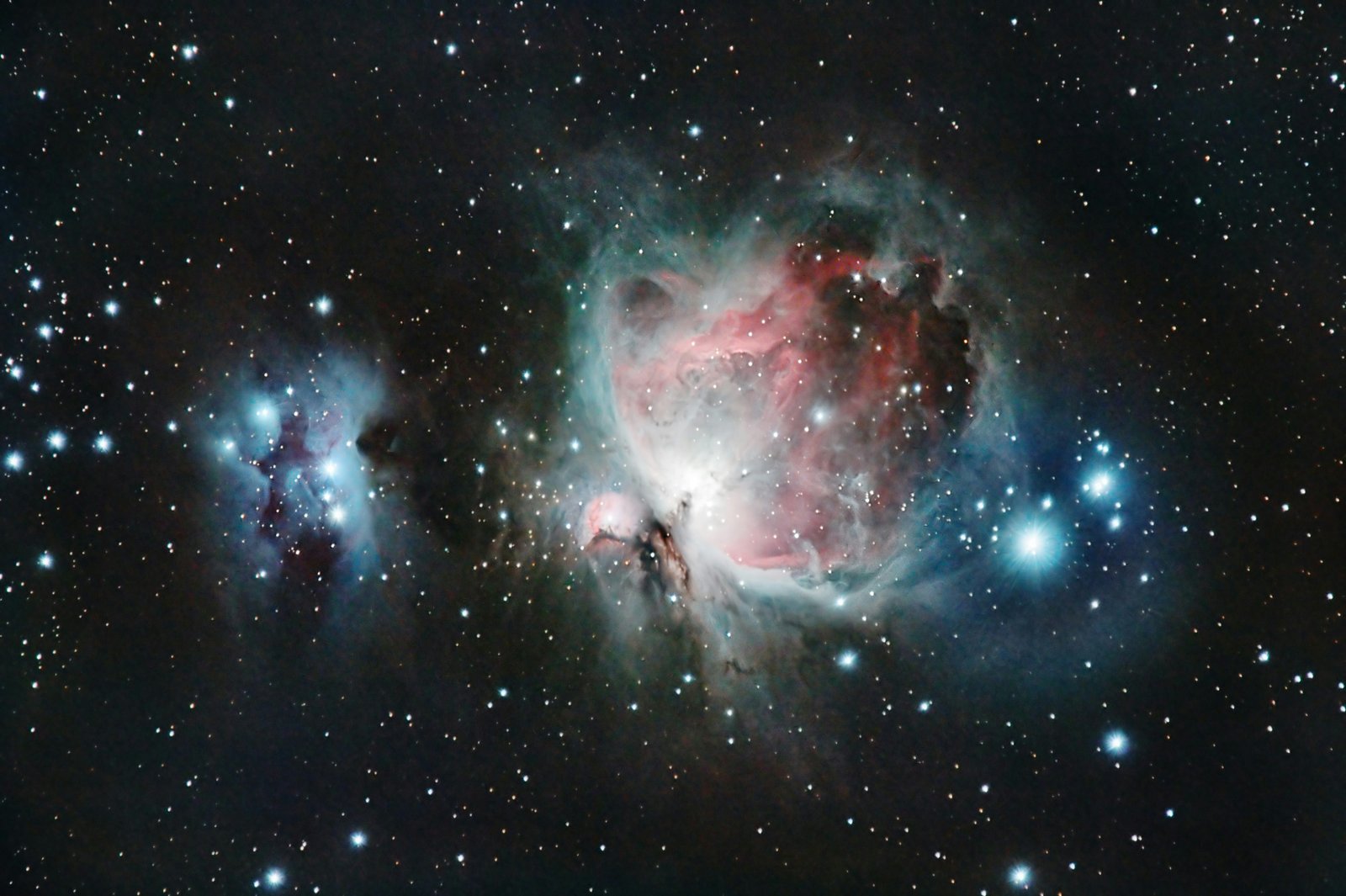
A vast cosmic nebula dominates the center of a starfield, displaying vibrant pink, green, and blue gas clouds with bright stars scattered throughout the dark space.
Image Credit: Photo by Arnaud Mariat on Unsplash (SourceLicense)

AI Summary of Peer-Reviewed Research

This page presents an AI-generated summary of a published research paper. The original authors did not write or review this article. See full disclosure ↓

The Astrophysical Journal·2026-03-10·Peer-reviewed·View original paper ↗·Follow this topic (RSS)
Publication Signals show what we were able to verify about where this research was published.STRONGWe verified multiple publication signals for this source, including independently confirmed credentials. Publication Signals reflect the source’s verifiable credentials, not the quality of the research.
  • ✔ Peer-reviewed source
  • ✔ Published in indexed journal
  • ✔ No retraction or integrity flags

Key findings from this study

  • The study found that full relativistic treatment becomes necessary once shock proper velocity exceeds Γβsh ≳ 0.1.
  • The authors demonstrate that approximate models can be inaccurate by more than an order of magnitude in transrelativistic shocks.
  • The study indicates that inferred physical properties of some fast blue optical transients and jetted tidal disruption events may be systematically biased due to use of approximate analytic models.

Overview

Synchrotron emission from astrophysical transients such as gamma-ray bursts, radio supernovae, neutron star mergers, tidal disruption events, and fast blue optical transients is typically modeled using simplified analytic approximations. These approximations fail to account for special-relativistic effects that become important in high-velocity shocks. The authors developed a numerical model that solves the full radiative-transfer problem for synchrotron-emitting shocks while incorporating all relativistic effects. This full-volume model can calculate synchrotron emission from shocks of arbitrary velocity and is designed to be flexible enough to apply to diverse astrophysical sources. The work addresses a critical gap in modeling transrelativistic explosions where shock proper velocities approach or exceed values at which conventional approximations break down. The model is made publicly available to support analysis of the growing population of relativistic synchrotron-emitting transients observed across multiple wavelengths and event types.

Methods and approach

The authors constructed a numerical code that solves the complete radiative-transfer problem in synchrotron-emitting shocks without relying on simplified approximations. The full-volume treatment accounts for all special-relativistic effects that become significant at high shock velocities. The model is designed to handle shocks of arbitrary velocity and to be applicable across a wide range of astrophysical contexts. Using this numerical framework, the authors systematically evaluated the accuracy of more commonly employed approximate analytic models by comparing predictions across different shock velocity regimes. The code incorporates both thermal and nonthermal electron populations as potential sources of synchrotron emission. The flexible architecture allows application to various transient classes including fast blue optical transients, jetted tidal disruption events, neutron star mergers, and relativistic supernovae. The publicly released code enables detailed modeling of synchrotron emission in cases where shock proper velocity approaches or exceeds the transrelativistic regime.

Results

The full-volume treatment becomes necessary once the shock proper velocity exceeds Γβsh ≳ 0.1, defining the threshold where relativistic effects cannot be neglected. Approximate analytic models commonly used in the literature can be inaccurate by more than an order of magnitude when applied to transrelativistic shocks. This substantial error margin affects physical property inferences for observed sources including fast blue optical transients and jetted tidal disruption events where approximate models are typically employed. The numerical comparisons reveal systematic biases introduced by simplified treatments that ignore relativistic corrections to radiative transfer. The model demonstrates that accurate flux predictions require full numerical solutions in the velocity regime relevant to many observed explosive transients. Prior theoretical work indicated thermal electrons become important for mildly relativistic shocks, a regime the new model can properly address. The results have direct implications for interpreting synchrotron observations across multiple transient classes where shock velocities reach βsh ∼ 0.1-0.5 or higher.

Implications

The demonstrated inaccuracy of approximate models in the transrelativistic regime suggests that inferred physical properties of fast blue optical transients, jetted tidal disruption events, and other relativistic explosions may be systematically biased. Order-of-magnitude errors in flux predictions translate directly to uncertainties in derived parameters such as shock energy, ambient density, and magnetic field strength. The availability of the full numerical code enables reanalysis of existing observations and more accurate modeling of future detections in this velocity regime. Applications extend to neutron star mergers, broad-line Type Ic supernovae, and low-luminosity gamma-ray bursts where relativistic shock interactions with circumstellar material occur. Accurate synchrotron modeling can help constrain merger physics, test progenitor models, and resolve tensions regarding the presence of thermal electron emission in specific events. The growing population of detected relativistic transients across radio, optical, and high-energy wavelengths requires modeling tools that properly account for special-relativistic effects. The publicly available code provides a foundation for systematic studies addressing microphysics questions and improving parameter inference from multi-wavelength observations of explosive astrophysical phenomena.

Scope and limitations

This summary is based on the study abstract and available metadata. It does not include a full analysis of the complete paper, supplementary materials, or underlying datasets unless explicitly stated. Findings should be interpreted in the context of the original publication.

Disclosure

  • Research title: Numerical Modeling of Relativistic Effects in Synchrotron-emitting Shocks
  • Authors: Ross Ferguson, Ben Margalit
  • Institutions: University of Minnesota
  • Publication date: 2026-03-10
  • DOI: https://doi.org/10.3847/1538-4357/ae3a93
  • OpenAlex record: View
  • Image credit: Photo by Arnaud Mariat on Unsplash (SourceLicense)
  • Disclosure: This post was generated by Claude (Anthropic). The original authors did not write or review this post.

Get the weekly research newsletter

Stay current with peer-reviewed research without reading academic papers — one filtered digest, every Friday.

More posts