

Negotiating Physical Health: Professional Logics in Community Mental Health Practice

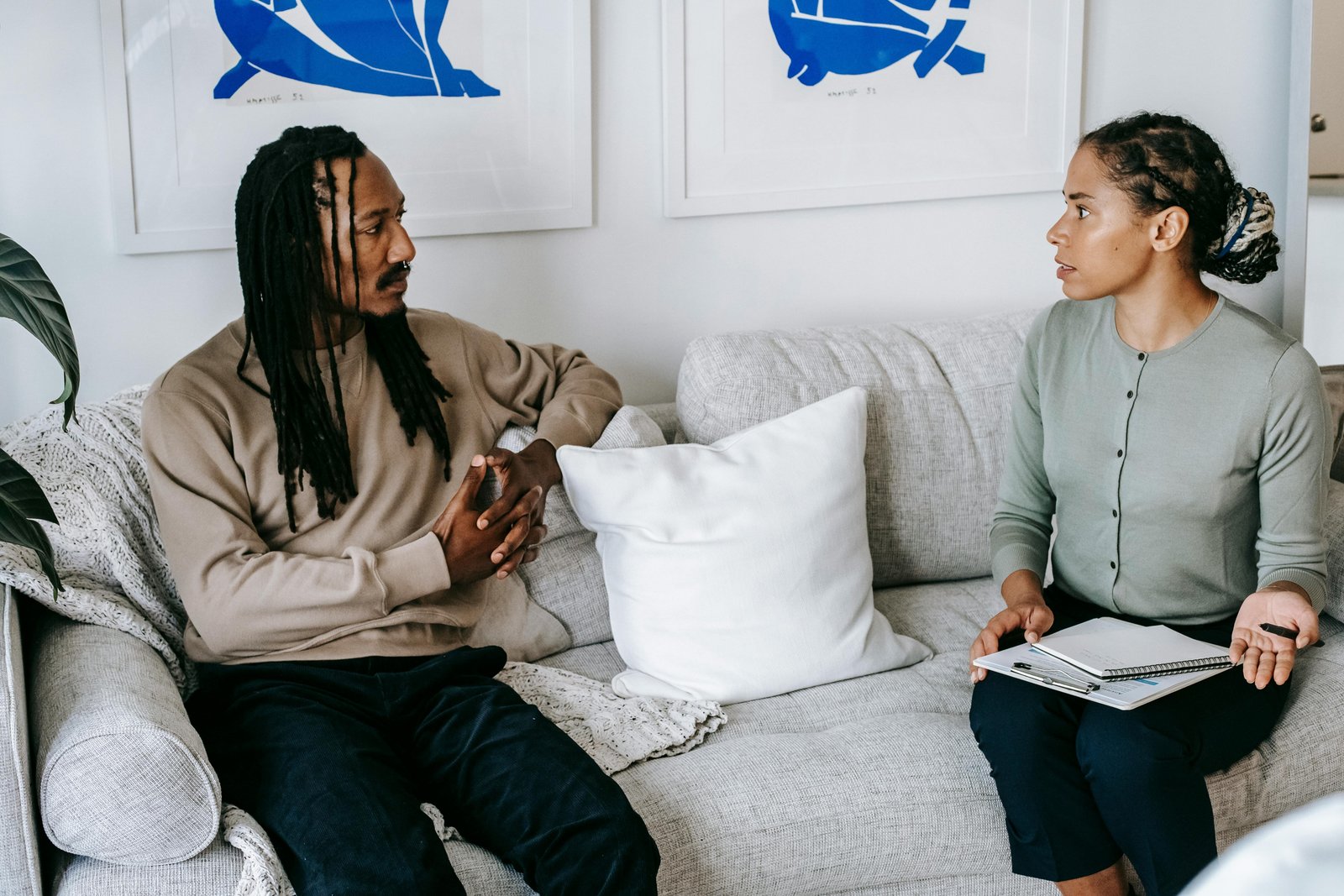
Two people sit facing each other on a gray couch in a bright, minimalist office space with white walls and blue abstract artwork, one holding a cup and the other holding a clipboard, in what appears to be a counseling or consultation session.
Image Credit: Photo by Alex Green on Pexels (SourceLicense)

AI Summary of Peer-Reviewed Research

This page presents an AI-generated summary of a published research paper. The original authors did not write or review this article. See full disclosure ↓

⚠️ This article summarizes published research and is intended for informational purposes only. It does not constitute medical advice or clinical guidance.

International Journal of Environmental Research and Public Health·2026-04-10·Peer-reviewed·View original paper ↗·Follow this topic (RSS)
Publication Signals show what we were able to verify about where this research was published.MODERATECore publication signals for this source were verified. Publication Signals reflect the source’s verifiable credentials, not the quality of the research.
  • ✔ Peer-reviewed source
  • ✔ No retraction or integrity flags

Key findings from this study

This research indicates that:

  • Physical health becomes integrated through five distinct professional logics that both enable and constrain action within CMH practice.
  • Trusting relationships, organisational mandates, and service fragmentation create conditions that privilege psychological stability while treating physical health as delegable or secondary.
  • Practitioners adopt ethics of restraint when confronting limited patient motivation, balancing health promotion aspirations against concerns about autonomy and coercion.
  • Systematic integration requires simultaneous attention to helping relationships, everyday environments, and organisational structures rather than isolated interventions or individual-level knowledge transfer.

Overview

Community mental health (CMH) workers in Germany support individuals with serious mental illness who experience substantial preventable physical health inequities. This study examines how CMH practitioners understand and address physical health within their everyday practice and organisational contexts.

Methods and approach

Researchers conducted five group discussions with 30 CMH workers and analysed the data using interpretive qualitative methodology. The analysis identified five distinct professional logics structuring how physical health becomes integrated into CMH support activities.

Results

Physical health integration in CMH practice operates through five interconnected professional logics. First, trusting relationships simultaneously enable action and constrain it through concerns about overstepping professional boundaries. Second, practitioners prioritise psychological stability as a core organisational mandate, which can displace physical health considerations. Third, physical health occupies an ambiguous position—acknowledged as important yet frequently delegated to medical specialists or other services. Fourth, practitioners navigate fragile patient motivation by adopting restraint, attempting to avoid coercion while supporting health outcomes. Fifth, health promotion aspirations confront structural constraints including resource limitations, fragmented service systems, and organisational priorities.

These logics operate across three interconnected levels: the helping relationship between worker and service user; the everyday environments where support occurs; and the broader organisational structures within which CMH operates. Rather than individual attitudes or knowledge gaps, the analysis reveals systemic conditions that shape what becomes possible or thinkable within practice. The findings demonstrate that physical health integration requires attention to relational dynamics, environmental contexts, and structural arrangements simultaneously.

Implications

CMH systems internationally can strengthen physical health integration by addressing these three interconnected levels rather than implementing isolated interventions. Organisations might examine how service mandates, team composition, and inter-agency partnerships create conditions enabling or constraining physical health support. Structural changes—such as co-location of services, clarified role definitions, or dedicated physical health responsibilities—could reduce ambiguity and support more systematic integration.

The research highlights that professional logics reflect rational responses to competing demands and genuine constraints rather than individual failures or resistance. Practitioners simultaneously manage immediate relationships, organisational survival, and ethical commitments. Policy and service development informed by these findings can create conditions supporting holistic practice without requiring practitioners to resolve systemic contradictions individually. The findings extend beyond Germany to other CMH contexts navigating similar relational, organisational, and structural challenges.

Scope and limitations

This summary is based on the study abstract and available metadata. It does not include a full analysis of the complete paper, supplementary materials, or underlying datasets unless explicitly stated. Findings should be interpreted in the context of the original publication.

Disclosure

  • Research title: Negotiating Physical Health: Professional Logics in Community Mental Health Practice
  • Authors: Gesa Pult, Fabian Frank
  • Institutions: Protestant University of Applied Sciences Freiburg, University of Education Freiburg
  • Publication date: 2026-04-10
  • DOI: https://doi.org/10.3390/ijerph23040479
  • OpenAlex record: View
  • PDF: Download
  • Image credit: Photo by Alex Green on Pexels (SourceLicense)
  • Disclosure: This post was generated by Claude (Anthropic). The original authors did not write or review this post.

Get the weekly research newsletter

Stay current with peer-reviewed research without reading academic papers — one filtered digest, every Friday.

More posts