

About This Article
This is an AI-generated summary of a research paper. The original authors did not write or review this article. See full disclosure ↓
Overview
Current proposals in Australia to deploy desexed cats for rodent control on dairy farms lack sufficient empirical validation. Although 15 farmers from nine properties in Queensland and New South Wales have expressed support for such programs, the evidence base remains inadequate to justify implementation. The paper outlines multiple categories of evidence needed before farm cat programs can be considered a viable solution to rodent problems in Australian agriculture.
Methods and approach
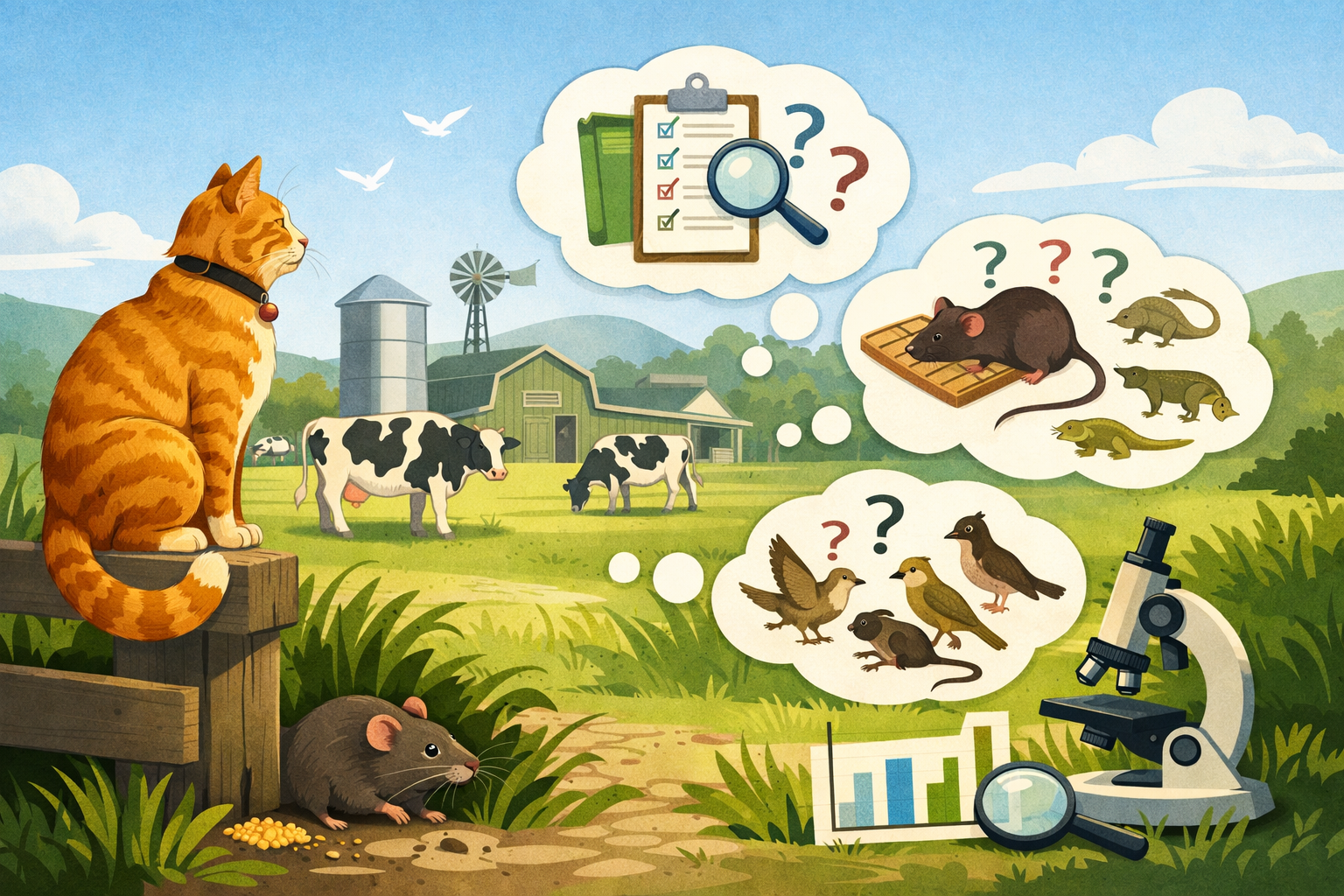
The authors conduct a systematic evaluation of the evidentiary gaps required to validate cats as rodent control agents. They identify three primary evidence categories: direct and indirect population monitoring of rodents to establish suppression efficacy and optimal cat densities; dietary analysis through stomach content examination, fecal analysis, collar-mounted video recording, and stable isotope analysis of tissues to quantify rodent predation and non-target wildlife predation; and population monitoring of farm cat populations to detect unintended immigration. The authors additionally propose economic modeling to compare farm cat programs against alternative rodent control methodologies.
Results
No quantitative results are presented, as this is a position paper establishing evidence requirements rather than reporting empirical findings. The analysis identifies critical gaps in the current knowledge base regarding rodent suppression effectiveness, required cat densities, predation patterns on both target and non-target species, and comparative cost-effectiveness.
Implications
Current promotion of farm cats as a solution to Australian agricultural rodent problems proceeds without adequate empirical foundation. The absence of direct monitoring data on rodent population suppression, dietary analysis of farm cats, and cat population dynamics creates substantial uncertainty regarding program efficacy and potential ecological consequences. Implementation without this evidence represents a substantial policy risk.
Disclosure
- Research title: It’s Premature to Encourage Working Cats for Rodent Control on Australian Dairy Farms
- Authors: Michael Charles Calver, Heather M. Crawford, Tim Kurz, J. A. L. Watson, Bruce L. Webber
- Publication date: 2026-01-29
- DOI: https://doi.org/10.3390/ani16030417
- OpenAlex record: View
- PDF: Download
- Disclosure: This post was generated by artificial intelligence. The original authors did not write or review this post.