

What the study found
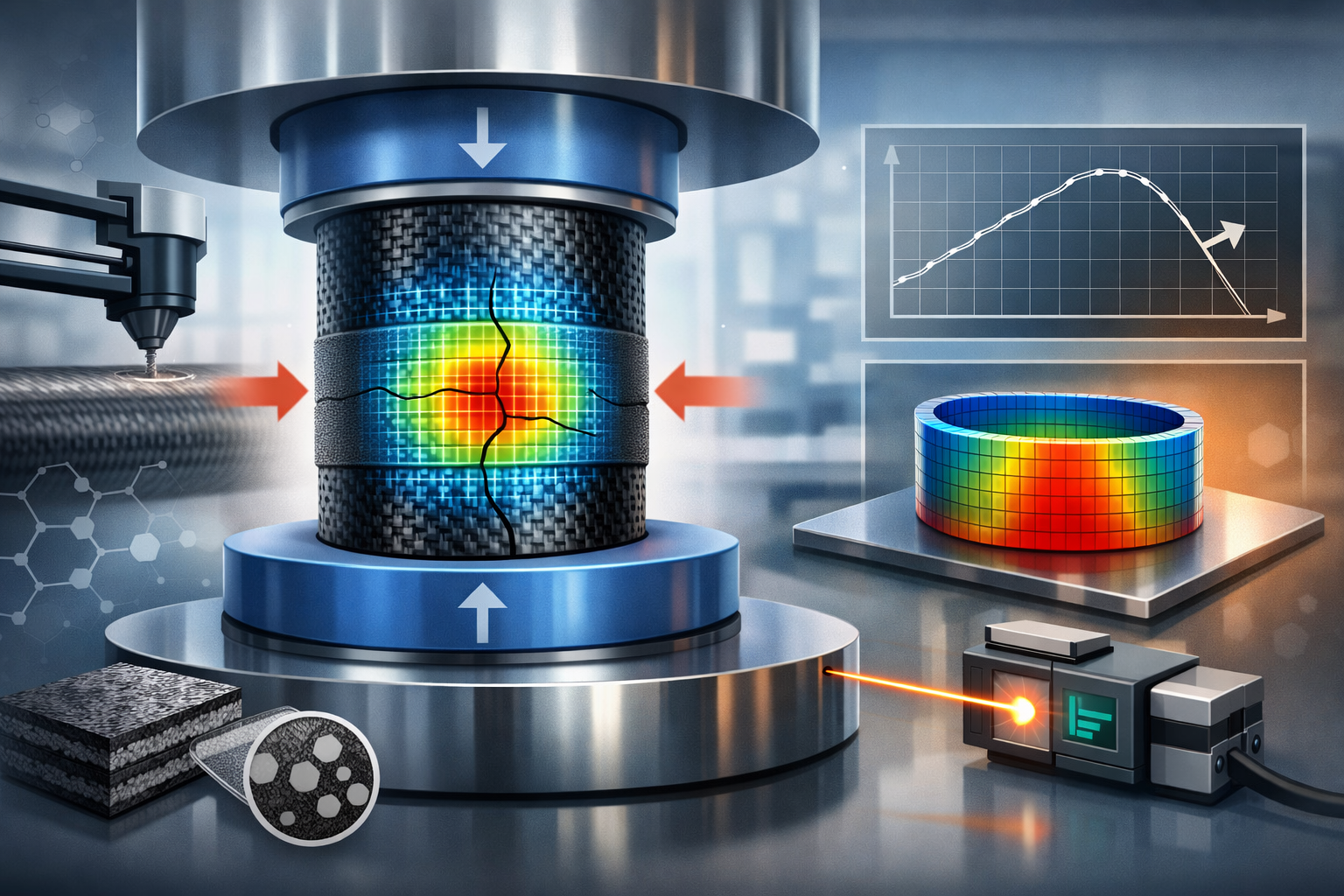
The study found that isotropic dilation can be used to characterize the mechanical behavior of wrapped carbon fiber composite cylinders, with failure appearing to be strain-dominated. Hoop strains at lap joint failure were reported at about 1.77 mε, and this was within acceptable deviation from the analytical solution.
Why the authors say this matters
The authors conclude that isotropic dilation offers controlled testing of burst properties without requiring the high-pressure facilities used in current burst pressure testing. The study suggests this could support future work on scalable testing protocols and high-accuracy predictive modeling.
What the researchers tested
The researchers fabricated thin carbon fiber cylinder shells using an integrated 3D printing and manual shaping approach, including lap joints. They fitted ring samples on donut-shaped incompressible rubber pucks and expanded them radially by axially jamming oversized indenters until failure, while also using full-field strain measurements and biaxial strain gauges.
What worked and what didn't
Experimental results were supported by analytical solutions, and the measured hoop strain at lap joint failure was close to the analytical prediction. In dynamic loading, failure modes showed more severe damage, including geometrical deformation and peripheral laminate failure.
What to keep in mind
The abstract does not describe detailed limitations beyond noting that the work is presented as a foundation for future investigations. The summary also does not provide broader performance data beyond the reported failure strain and observed dynamic damage modes.
Key points
- Isotropic dilation was used to characterize wrapped carbon fiber composite cylinders.
- Failure was described as strain-dominated, with lap joint hoop strain at about 1.77 mε.
- The measured failure strain was within acceptable deviation of the analytical solution.
- Dynamic loading produced more severe damage, including geometrical deformation and peripheral laminate failure.
- The authors say the approach avoids the need for high-pressure burst-testing facilities.
Disclosure
- Research title:
- Isotropic dilation measured strain-dominated failure in wrapped carbon fiber cylinders
- Publication date:
- 2026-02-28
- OpenAlex record:
- View
Get the weekly research newsletter
Stay current with peer-reviewed research without reading academic papers — one filtered digest, every Friday.