

Overview
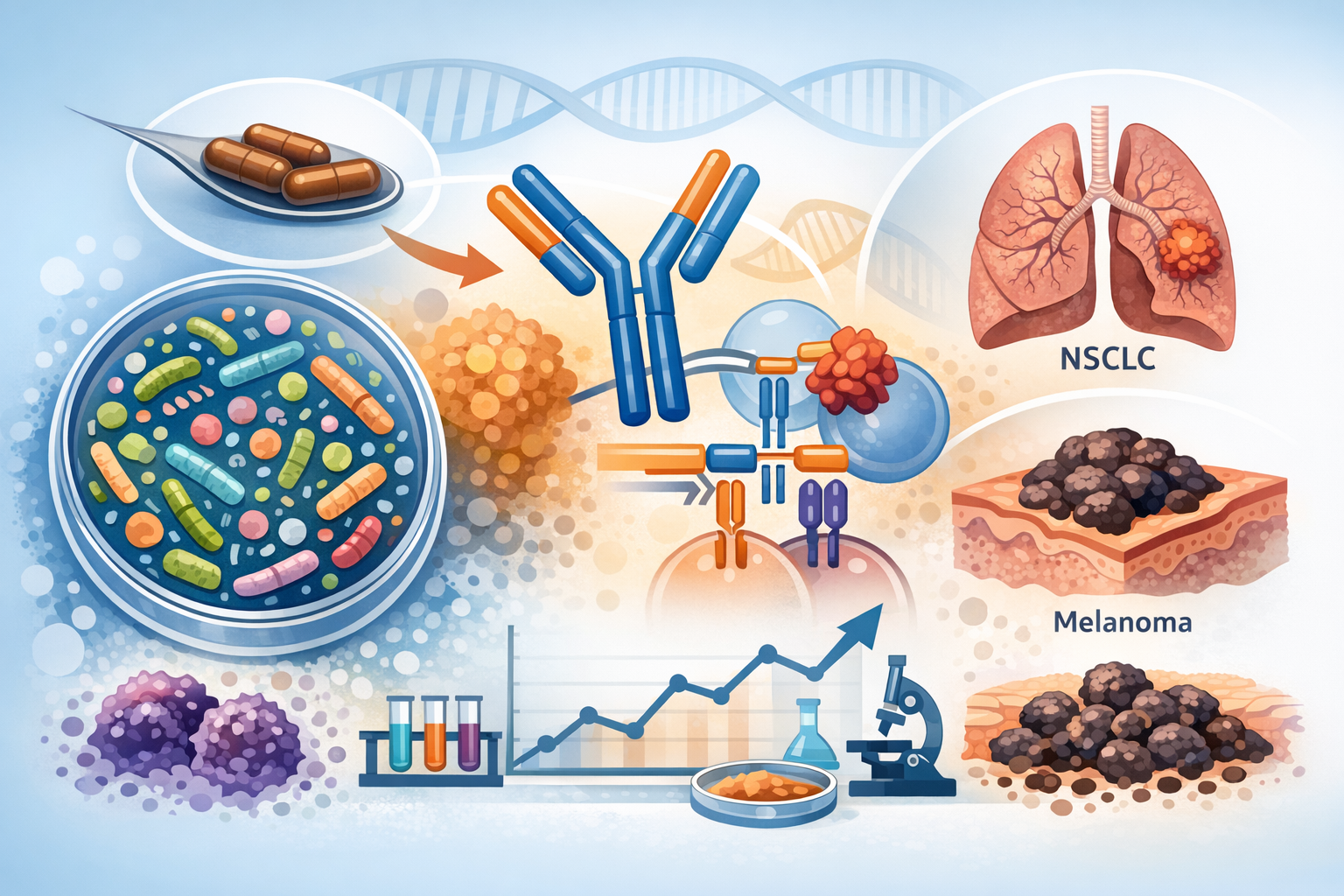
A multicenter, open-label phase 2 trial evaluated whether single-donor fecal microbiota transplantation (FMT) administered orally immediately prior to immune checkpoint inhibitor (ICI) initiation modulates clinical activity in first-line non-small cell lung cancer (NSCLC) and melanoma. Two parallel cohorts received FMT plus anti-PD-1 in NSCLC (n=20) or FMT plus combined anti-PD-1 and anti-CTLA-4 (dual ICI) in melanoma (n=20). The primary endpoint was objective response rate (ORR) in NSCLC; secondary endpoints included ORR in melanoma, safety, and characterization of donor–host microbiome dynamics.
Methods and approach
Participants received a single course of frozen oral FMT capsules derived from healthy donors immediately prior to initiation of protocol-specified ICI (anti-PD-1 for NSCLC; anti-PD-1 plus anti-CTLA-4 for melanoma). Clinical response and safety were prospectively collected and adjudicated, with an independent data and safety monitoring committee oversight. Longitudinal shotgun metagenomic sequencing of stool was performed to assess taxonomic and strain-level changes, donor–recipient similarity, and species-level gains or losses after FMT. Mechanistic interrogation included antibiotic-treated, tumor-bearing mouse models recolonized with post-FMT human stool, with targeted reintroduction of candidate bacterial species to test effects on ICI antitumor activity.
Results
In the NSCLC cohort the primary endpoint was met: ORR 80% (16/20). In the melanoma cohort ORR was 75% (15/20). Safety assessments deemed FMT acceptable by the monitoring committee; no grade ≥3 adverse events were reported in NSCLC, whereas 65% of melanoma patients experienced grade ≥3 adverse events in the dual-ICI setting. Metagenomic analyses showed that clinical responders developed a distinct post-FMT gut microbiome composition that was not explained by global donor–recipient similarity or by measurable strain-level engraftment. Responders demonstrated significantly greater loss of baseline bacterial species versus non-responders, with recurrent depletion of taxa including Enterocloster citroniae, Enterocloster lavalensis, and Clostridium innocuum; this pattern was reproducible across three previously published oncology FMT datasets. In murine models, reintroduction of the specific bacterial species lost after FMT abrogated the enhanced antitumor effect of ICI conferred by post-FMT stool.
Implications
These data indicate that healthy-donor FMT administered prior to first-line ICI can be associated with high ORR in NSCLC and melanoma cohorts, and implicate loss of specific baseline bacterial taxa—rather than durable donor strain engraftment—as a key correlate of therapeutic benefit. The findings prioritize mechanistic hypotheses in which removal of deleterious taxa modulates host–tumor immune interactions and suggest that therapeutic modulation of the microbiome may require strategies that induce targeted depletion as well as or instead of engraftment. Safety outcomes emphasize differing toxicity profiles when FMT is combined with dual ICI, underscoring the need for controlled randomized trials and deeper mechanistic studies to define optimal donor selection, timing, and compositional targets for microbiome-based interventions.
Disclosure
- Research title: Fecal microbiota transplantation plus immunotherapy in non-small cell lung cancer and melanoma: the phase 2 FMT-LUMINate trial
- Authors: Sreya Duttagupta, Meriem Messaoudene, Sebastian Hunter, Antoine Desîlets, Rahima Jamal, Catalin Mihalcioiu, Wiam Belkaïd, Nicolas Marcoux, Marine Fidelle, Déborah Suissa, Mayra Ponce, Mallia Geiger
- Publication date: 2026-01-28
- DOI: https://doi.org/10.1038/s41591-025-04186-5
- OpenAlex record: View
- Disclosure: This post is an AI-generated summary of a research work. It was prepared by an editor. The original authors did not write or review this post.