

About This Article
This is an AI-generated summary of a research paper. The original authors did not write or review this article. See full disclosure ↓
Overview
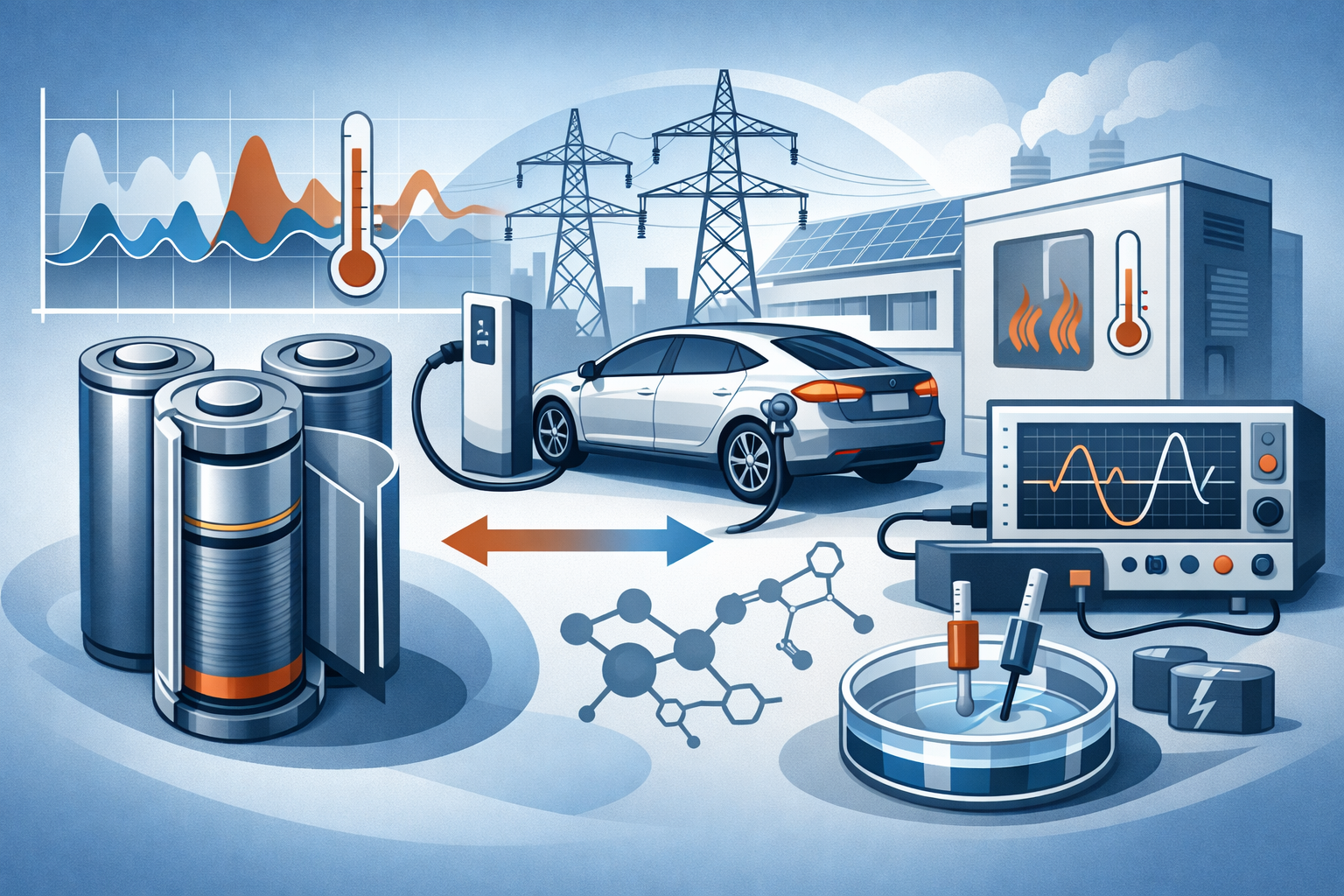
This experimental study quantifies the degradation mechanisms of cylindrical lithium-ion cells subjected to vehicle-to-grid cycling under real-world operating conditions extracted from commercial EV charging infrastructure. The investigation systematically evaluated the interplay between V2G cycling patterns, thermal exposure, and electrochemical aging to establish service life implications for grid-coupled battery systems.
Methods and approach
Commercially available cylindrical lithium-ion cells were exposed to controlled long-term aging protocols incorporating calendar aging and V2G cycling regimens. Experimental variables included state of charge conditions, depth of discharge windows (30-80% and 30-95% SOC ranges), ambient temperature (40°C elevated condition), and cycling profiles derived from actual V2G charger operational data. Capacity retention and degradation kinetics were monitored across extended aging periods to establish comparative baselines between V2G cycling and static storage modes.
Results
Elevated temperature (40°C) emerged as the primary degradation accelerant, with synergistic effects at high storage SOC conditions exceeding 80%. Shallow V2G cycling in the 30-50% SOC window produced capacity fade comparable to calendar aging at high state of charge, indicating that cycling depth and thermal environment govern cell lifetime more significantly than cycling frequency alone. Daily V2G equivalent cycling loads of 62% of a full equivalent cycle were shown to sustain cell functionality without lifetime compromise.
Implications
The findings establish quantitative bounds for V2G deployment strategies during vehicle idle periods, indicating that continuous grid-connected cycling at moderate depths remains thermodynamically feasible without accelerated end-of-life progression. This result validates economic and environmental cost-reduction scenarios in distributed energy storage and grid stabilization applications utilizing EV battery systems. The study demonstrates that shallow V2G cycling protocols can operate within acceptable degradation envelopes comparable to static storage, supporting broader adoption of vehicle-to-grid architectures in vehicle-idle operational windows.
Disclosure
- Research title: Experimental Investigation of the Impact of V2G Cycling on the Lifetime of Lithium-Ion Cells Based on Real-World Usage Data
- Authors: George Darikas, Mehmet Cagin Kirca, Nessa Fereshteh Saniee, Muhammad Rashid, Ihsan Mert Muhaddisoglu, Truong Quang Dinh, Andrew McGordon
- Publication date: 2026-01-08
- DOI: https://doi.org/10.3390/batteries12010022
- OpenAlex record: View
- Disclosure: This post was generated by artificial intelligence. The original authors did not write or review this post.