

Evaluation of the Load-Bearing Capacity of Cylindrical Stone Vaults Taking their Damage into Account

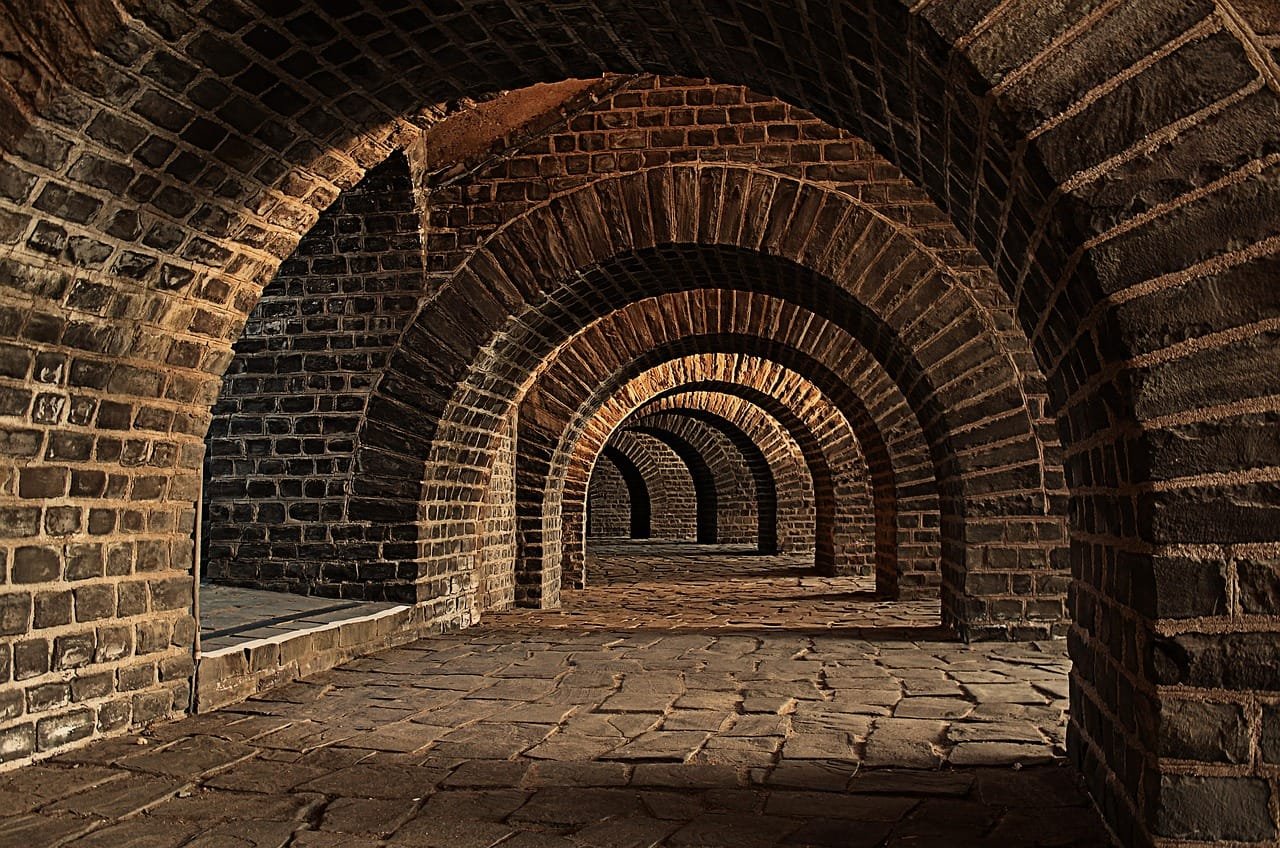
A series of receding brick and stone arches forming a vaulted tunnel or corridor, photographed from inside looking down the length of the structure, showing detailed masonry construction of the arch supports.
Image Credit: Photo by 132369 on Pixabay (SourceLicense)

AI Summary of Peer-Reviewed Research

This page presents an AI-generated summary of a published research paper. The original authors did not write or review this article. See full disclosure ↓

Modern Trends in Construction Urban and Territorial Planning·2026-03-30·Peer-reviewed·View original paper ↗·Follow this topic (RSS)
Publication Signals show what we were able to verify about where this research was published.MODERATECore publication signals for this source were verified. Publication Signals reflect the source’s verifiable credentials, not the quality of the research.
  • ✔ Peer-reviewed source
  • ✔ No retraction or integrity flags

Key findings from this study

  • The study found that isolated cracks in stone vaults do not automatically indicate loss of load-bearing capacity; failure occurs when crack populations create kinematic mechanisms.
  • The researchers demonstrate that failure modes in cylindrical vaults depend directly on the ratio between bending moment and axial force, producing three distinct destruction patterns.
  • The authors report that interaction dependencies between limiting bending moments and axial forces can be established experimentally and reproduced through calibrated numerical solid-state models.

Overview

The study develops a methodology for evaluating load-bearing capacity in cracked cylindrical stone vaults by establishing interaction dependencies between bending moments and axial forces. Standard analysis methods fail to account for crack behavior and combined stress states in historical masonry arches. The research establishes that vault failure results from progressive crack formation rather than initial damage, permitting structural assessment beyond traditional core analysis approaches.

Methods and approach

Experimental testing characterized destruction mechanisms of cylindrical stone vaults under varying stress conditions. Researchers applied isolated bending moments, isolated compressive forces, and combined loading to identify failure modes. Numerical solid-state models were calibrated against simple masonry test results to predict interactive dependencies. Rod-based arch models subsequently determined actual bending moment and axial force distributions in cross-sections for comparison against interaction curves.

Results

The researchers identified distinct failure mechanisms contingent on stress ratios. Pure bending moment loading caused masonry separation along unconnected sections. Pure axial compression produced longitudinal cracking. Combined bending and compression exhibited failure patterns dependent on the ratio between these forces. Experimental determination of interaction dependencies established limiting ratios reflecting the boundary between safe and unsafe stress combinations.

The study confirmed that initial cracks do not necessarily exhaust load-bearing capacity. Vault failure occurs when sufficient cracks form to convert the structure into a kinematic mechanism with mobile hinges. The numerical models, calibrated to experimental masonry data, successfully replicated observed failure mechanisms and enabled prediction of interaction dependencies without requiring full-scale vault testing.

Implications

The methodology permits structural engineers to assess historical masonry vaults with existing damage using validated numerical approaches. Rather than conservatively assuming crack initiation signals structural inadequacy, assessments can quantify remaining load-bearing reserve. This approach reduces unnecessary interventions in heritage structures where complete elimination of cracks may be infeasible or undesirable.

The interaction dependency framework provides a rational basis for design decisions in vault rehabilitation and load capacity evaluation. Engineers can establish safe stress combinations specific to material properties and damage states observed in situ. The approach bridges conventional arch theory, which neglects cracks, and practical assessment needs for damaged historical construction.

Scope and limitations

This summary is based on the study abstract and available metadata. It does not include a full analysis of the complete paper, supplementary materials, or underlying datasets unless explicitly stated. Findings should be interpreted in the context of the original publication.

Disclosure

  • Research title: Evaluation of the Load-Bearing Capacity of Cylindrical Stone Vaults Taking their Damage into Account
  • Authors: S. S. Zimin, R. B. Orlovich, S. V. Danilov, Yu. G. Maskalkova
  • Institutions: Belarusian Russian University, Peter the Great St. Petersburg Polytechnic University
  • Publication date: 2026-03-30
  • DOI: https://doi.org/10.23947/2949-1835-2026-5-1-40-47
  • OpenAlex record: View
  • PDF: Download
  • Image credit: Photo by 132369 on Pixabay (SourceLicense)
  • Disclosure: This post was generated by Claude (Anthropic). The original authors did not write or review this post.

Get the weekly research newsletter

Stay current with peer-reviewed research without reading academic papers — one filtered digest, every Friday.

More posts