Concept: Astrophysics and Star Formation Studies
DM Tau disk shows non-thermal line broadening
Turbulent motion detected in a young star's planet-forming disk

Milky Way circular velocity measured from stellar abundances
A new method uses stellar chemical patterns to map our galaxy's rotational speeds

Three ultra-faint Milky Way satellite candidates were discovered
Three extremely faint galaxies orbiting the Milky Way revealed in new survey data

Tomographic analysis detects possible embedded planets in disks
Detecting hidden planets in disk-forming regions using molecular line imaging

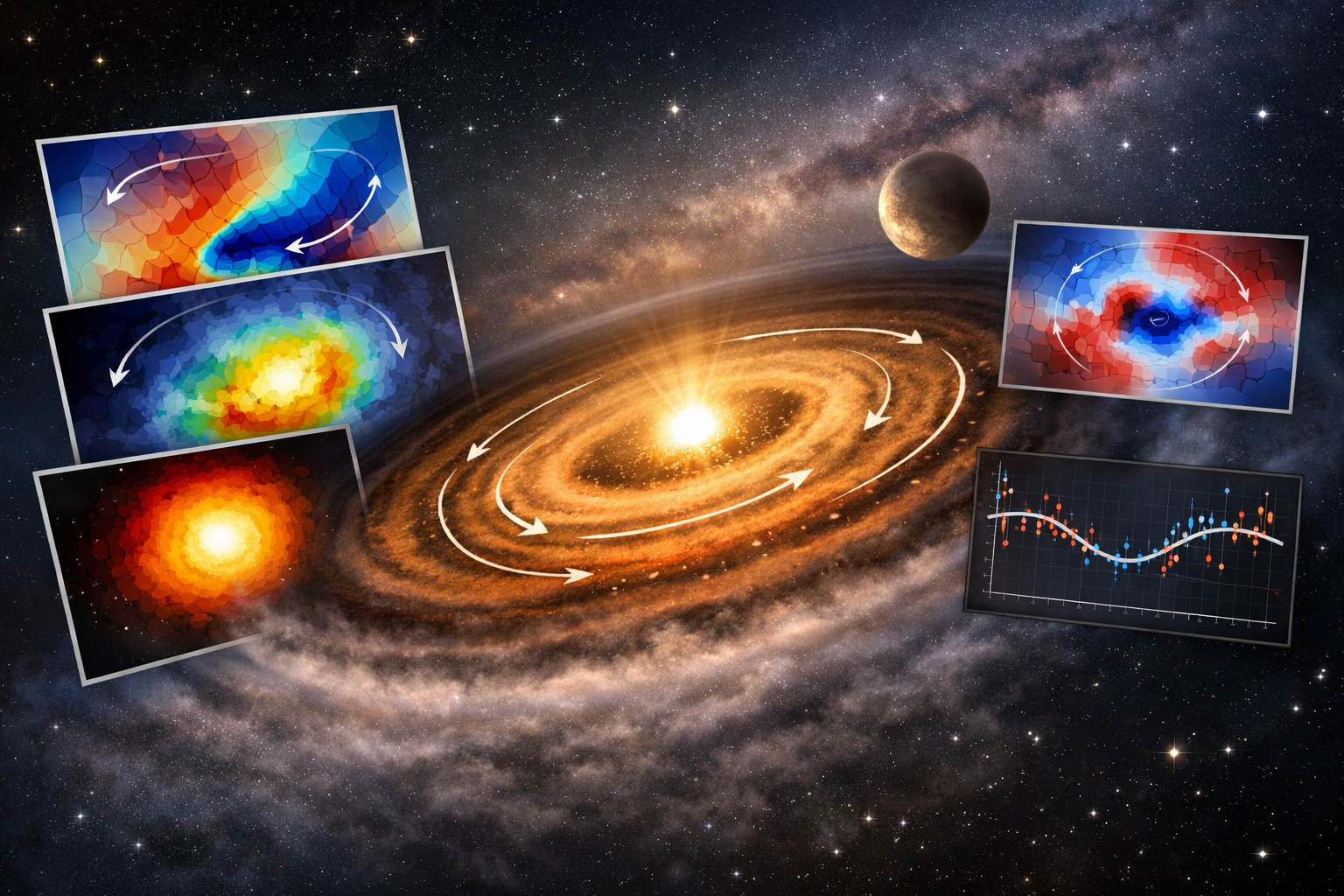
Large protoplanetary disks show widespread non-Keplerian gas motions
Mapping gas motion disruptions across 15 protoplanetary disks reveals signs of planetary formation

Vertical gas flows are widespread in protoplanetary disks
Detecting wind patterns and circulation in planet-forming disks