

About This Article
This is an AI-generated summary of a research paper. The original authors did not write or review this article. See full disclosure ↓
Overview
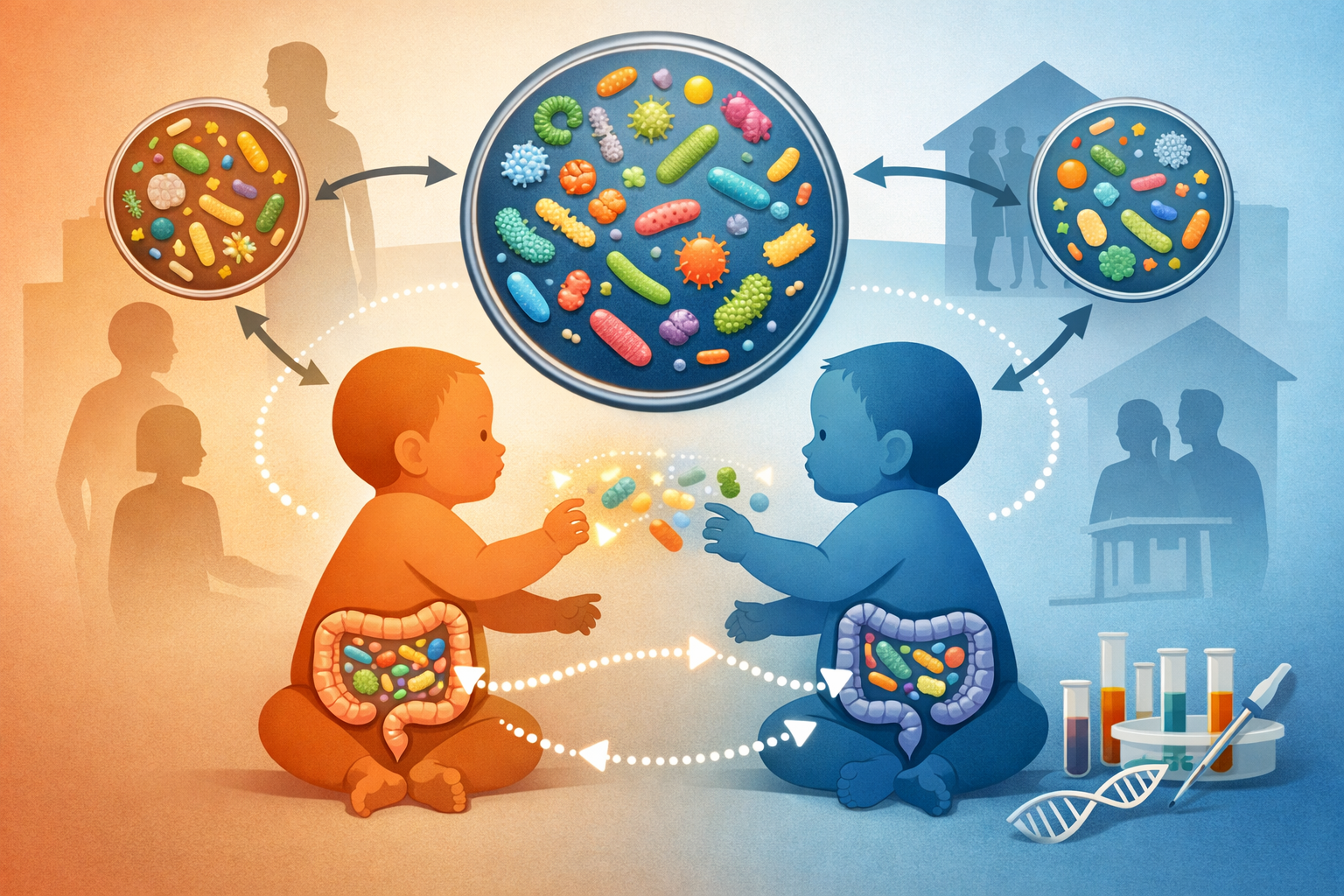
This metagenomic survey characterizes microbiome transmission patterns among infants, educators, and families in nursery settings during the first year of attendance. The study establishes that interpersonal transmission between infants substantially shapes the developing gut microbiome in the nursery environment, complementing maternal microbial transmission established in earlier infancy.
Methods and approach
A longitudinal metagenomic survey was conducted across 134 individuals spanning three nursery facilities, including infants, educators, and family members. Dense sampling comprised 1,013 fecal samples collected during the first year of nursery attendance. Strain-level tracking and phylogenetic modeling were applied to detect microbial transmission events within and between nursery groups. The analysis incorporated assessment of sibling status and antibiotic exposure as covariates in transmission patterns.
Results
Baby-to-baby microbiome transmission was extensive within nursery groups, with nursery-acquired strains representing a proportion of the infant gut microbiome equivalent to family-derived strains by the end of the first term. Transmission networks exhibited increasing complexity over the nursery year, characterized by single-strain spread in some cohorts and heterogeneous species-level transmissibility patterns across groups. Sibling presence correlated with increased microbiome diversity and reduced peer-derived strain acquisition, whereas antibiotic exposure most substantially increased influx of novel strains.
Implications
The findings establish social interactions and environmental exposure during infancy as critical drivers of microbiome development beyond maternal transmission. Nursery attendance represents a significant source of microbial exposure that structurally reshapes the infant gut microbiome during a developmentally sensitive period. These results suggest that early-life social environments warrant consideration in investigations of microbiome-mediated developmental outcomes and disease susceptibility.
Disclosure
- Research title: Baby-to-baby strain transmission shapes the developing gut microbiome
- Authors: Liviana Ricci, Vitor Heidrich, Michal Punčochář, Federica Armanini, Hiroaki Kitano, Amir Nabinejad, Farnaz FAZAELI, Elisa Piperni, Charlotte Servais, Federica Pinto, Mireia Valles‐Colomer, Francesco Asnicar
- Publication date: 2026-01-21
- DOI: https://doi.org/10.1038/s41586-025-09983-z
- OpenAlex record: View
- Disclosure: This post was generated by artificial intelligence. The original authors did not write or review this post.