

What the study found
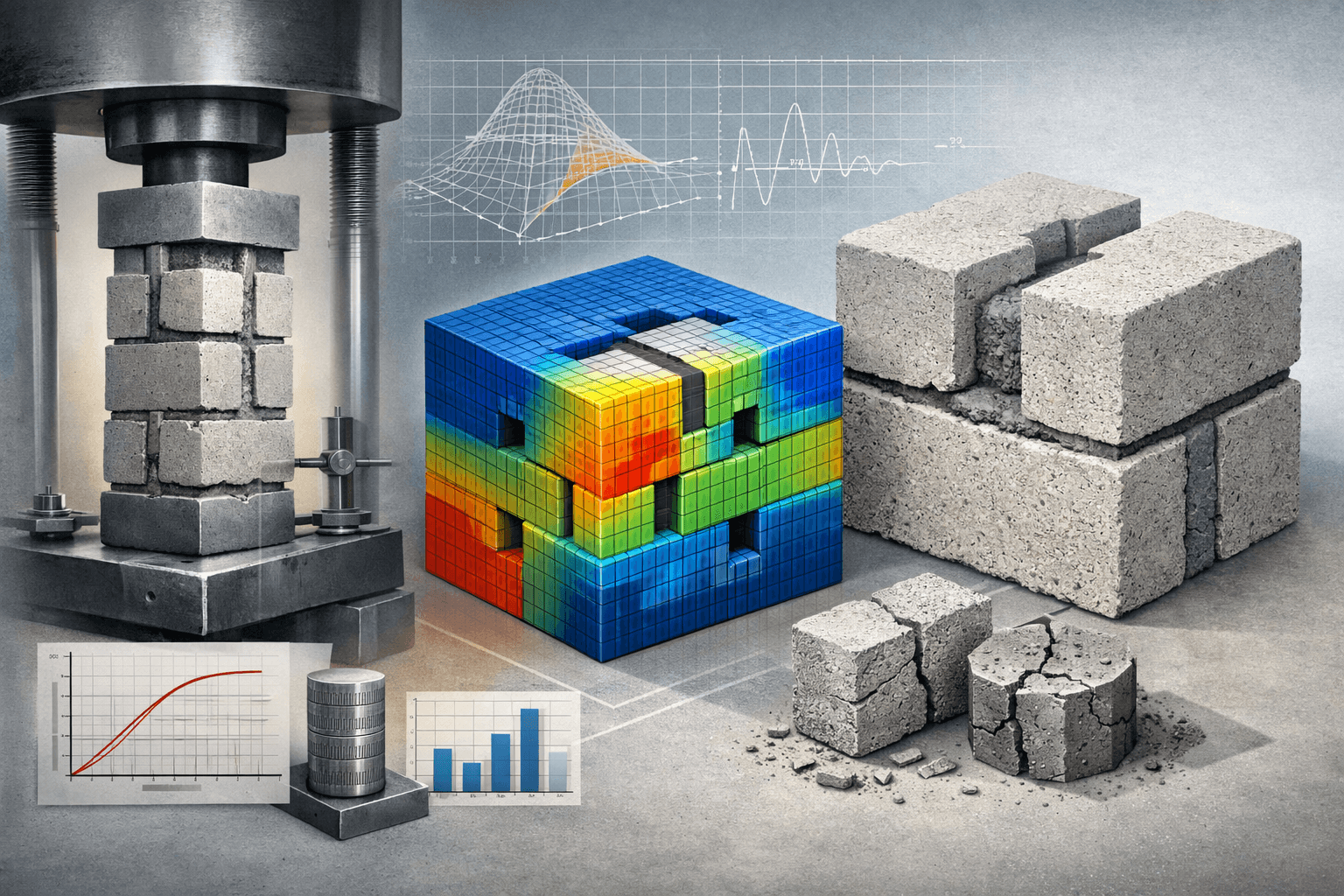
The study found that mortise-and-tenon grouted masonry (MTGM), a masonry system with interlocking joints and grouted cores, can improve compressive performance. Steel fiber-reinforced concrete as the core filling material increased ductility and toughness, and higher eccentricity reduced load-bearing capacity.
Why the authors say this matters
The authors conclude that the study provides a reliable theoretical foundation and practical computational tools for the structural design and application of MTGM. They present the work as relevant to improving the mechanical performance and engineering applicability of masonry.
What the researchers tested
The researchers studied axial and eccentric compressive behavior through experiments and numerical simulation. They developed a refined three-dimensional finite element model in DIANA that included material nonlinearity and interfacial contact, then used 52 numerical models to examine the effects of block strength, core material type, wall thickness, steel fiber content, and geometric ratios.
What worked and what didn't
The finite element model matched the experimental results closely. SFRC, or steel fiber-reinforced concrete, improved ductility and toughness, and an SFRC content of 1.6% increased ultimate strain by about 37%. In contrast, increasing eccentricity from 0.1 to 0.3 reduced load-bearing capacity by an average of 40%.
What to keep in mind
The abstract does not describe specific limitations beyond the scope of the tested models and conditions. The reported results are based on the MTGM system studied here, including the tested material choices, geometry, and loading conditions.
Key points
- MTGM is a mortise-and-tenon grouted masonry system studied for compressive behavior.
- A three-dimensional finite element model in DIANA closely matched experimental results.
- Steel fiber-reinforced concrete increased ductility and toughness; 1.6% SFRC increased ultimate strain by about 37%.
- Raising eccentricity from 0.1 to 0.3 lowered load-bearing capacity by an average of 40%.
- The authors derived calculation formulae and a stress-strain relationship for MTGM.
- A design method for eccentric compression was reported to predict better than existing code provisions.
Disclosure
- Research title:
- Mortise-tenon grouted masonry showed improved compressive performance
- Authors:
- Shugang Yu, Zhongmin Han, Kaiwei Liu, Kai Zhang, Yichen Yang, Juntao Zhu
- Institutions:
- Henan Provincial Academy of Building Research, Zhengzhou University, Zhengzhou University, Zhengzhou University, Zhengzhou University, Zhengzhou University
- Publication date:
- 2026-01-28
- OpenAlex record:
- View
Get the weekly research newsletter
Stay current with peer-reviewed research without reading academic papers — one filtered digest, every Friday.