

A Three-Layer Transformation Strategy toward Functionalized Fused Hydantoins and Diketopiperazines

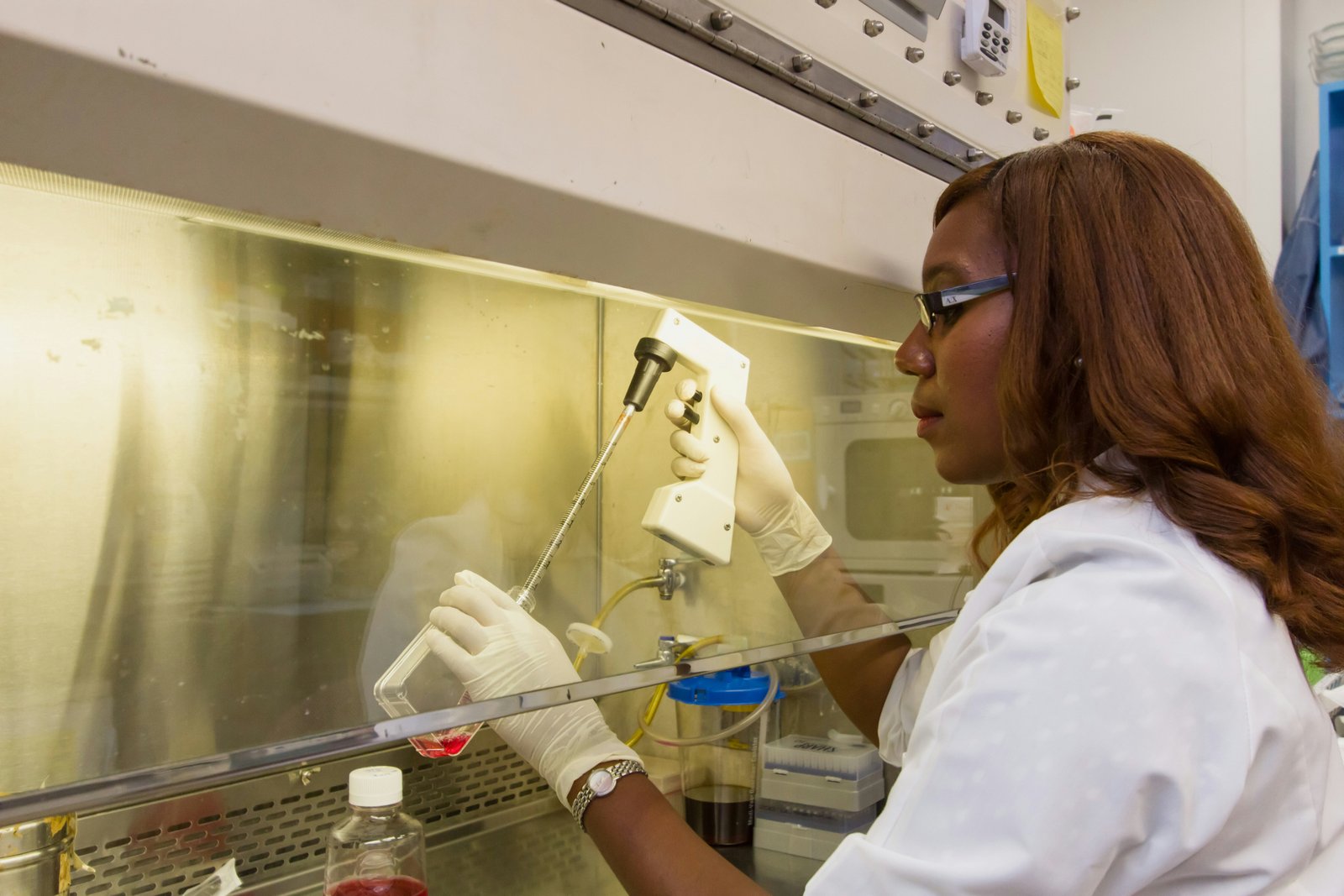
A researcher in a white lab coat and safety glasses works inside a biosafety cabinet, handling laboratory equipment and materials during what appears to be a chemical or biological procedure.
Image Credit: Photo by National Cancer Institute on Unsplash (SourceLicense)

AI Summary of Peer-Reviewed Research

This page presents an AI-generated summary of a published research paper. The original authors did not write or review this article. See full disclosure ↓

Organic Letters·2026-01-30·Peer-reviewed·View original paper ↗·Follow this topic (RSS)
Publication Signals show what we were able to verify about where this research was published.MODERATECore publication signals for this source were verified. Publication Signals reflect the source’s verifiable credentials, not the quality of the research.
  • ✔ Peer-reviewed source
  • ✔ Published in indexed journal
  • ✔ No retraction or integrity flags

Key findings from this study

  • The study demonstrates that the mAUCy strategy produces thiazolo-hydantoins in 49-90% yield and thiazolo-diketopiperazines in 65-83% yield over three steps in under 3 hours.
  • The authors report that a fully telescoped one-pot protocol delivers products from six components without intermediate workup or chromatographic purification.
  • The researchers found that diastereoselectivity in the Ugi-Joullié reaction depends on acid strength, with trichloroacetic acid yielding 1:1 ratios and chloroacetic acid yielding 1:0.5 ratios.

Overview

This study introduces mAUCy (modified Asinger-Ugi cyclization), a three-layer synthetic strategy for rapid, scalable production of thiazolo-hydantoins and thiazolo-diketopiperazines. The method integrates a modified Asinger reaction, an Ugi-Joullié multicomponent reaction, and base-induced annulation to generate fused heterocyclic scaffolds. The approach operates without chromatographic purification, enables one-pot telescoped processing, and supports multigram-scale synthesis. These scaffolds are privileged structures in pharmaceutical development, frequently employed as peptidomimetics.

Methods and approach

The strategy begins with 3-thiazoline synthesis via a modified Asinger four-component reaction using chloroacetaldehyde, various ketones, sulfur, and ammonia in aqueous media. Asymmetrical, symmetrical, and cyclic ketones generate stereogenic centers or spiro systems at position 2. The second layer applies an Ugi-Joullié three-component reaction, treating thiazolines with diverse isocyanides and either trichloroacetic or chloroacetic acid in methanol at room temperature. The third layer completes heteroannulation using triethylamine in methanol for trichloroacetic acid-derived products or sodium hydride in tetrahydrofuran for chloroacetic acid-derived products. Optimization enabled a fully telescoped one-pot protocol that delivers products directly from starting ketone through all transformations without intermediate workup. Single-crystal X-ray analysis confirmed scaffold structures. Diastereoselectivity was examined using asymmetric thiazoline, revealing that trichloroacetic acid yields 1:1 diastereomeric ratios due to SN1-type transition states, while chloroacetic acid yields 1:0.5 ratios reflecting SN2-type pathways.

Results

The Asinger reaction produced thiazolines quantitatively within 30 minutes without purification. The Ugi-Joullié reaction accommodated aliphatic and aromatic isocyanides with diverse substitution patterns, including tosylate, ether, and ester functionalities, completing in under 30 minutes with visible color change or precipitation. Base-induced cyclization yielded thiazolo-1,5-hydantoins in 49-90% total yield over three steps and thiazolo-2,5-diketopiperazines in 65-83% total yield. Cyclization proceeded rapidly, with hydantoin formation occurring exothermically in 20-30 minutes.

The fully telescoped one-pot protocol delivered products from six components in less than 3 hours without intermediate workup. Diastereoselectivity studies with asymmetric thiazoline showed that trichloroacetic acid produced Ugi adducts in 1:1 diastereomeric ratio, attributed to full imine nitrogen protonation favoring SN1-type transition states. Chloroacetic acid yielded 1:0.5 ratios due to weaker acidity and SN2-type pathways. Upon cyclization, diastereomeric ratios shifted to 1:0.6 for trichloroacetic acid-derived products and equilibrated to 1:1 for chloroacetic acid-derived products, likely through epimerization.

Implications

The mAUCy strategy addresses sustainability demands in organic synthesis by enabling high atom economy, eliminating chromatographic purification, and supporting multigram-scale operations. The method aligns with principles emphasized in the United Nations Sustainable Development Goals and the European Green Deal for environmentally responsible synthesis. The union of multicomponent reactions demonstrates how orthogonal reactivity enables higher-order transformations without functional group protection, expanding synthetic complexity while maintaining efficiency.

Access to thiazolo-hydantoins and thiazolo-diketopiperazines is significant for pharmaceutical development, as these scaffolds appear in approved drugs and clinical trials for various conditions. The incorporation of synthetically versatile functionalities provides handles for late-stage derivatization, supporting structure-activity relationship studies in drug discovery. The limited prior methodologies for fused 1,5-hydantoins and the synthetic underexploration of these peptidomimetic families underscore the value of this approach. The rapid synthesis time and scalability position mAUCy as a practical tool for accessing privileged structures in medicinal chemistry campaigns.

Scope and limitations

This summary is based on the study abstract and available metadata. It does not include a full analysis of the complete paper, supplementary materials, or underlying datasets unless explicitly stated. Findings should be interpreted in the context of the original publication.

Disclosure

  • Research title: A Three-Layer Transformation Strategy toward Functionalized Fused Hydantoins and Diketopiperazines
  • Authors: Maria-Aikaterini Giannakaki, Marios Zingiridis, Konstantinos G. Froudas, Constantinos G. Neochoritis
  • Institutions: University of Crete
  • Publication date: 2026-01-30
  • DOI: https://doi.org/10.1021/acs.orglett.5c05391
  • OpenAlex record: View
  • Image credit: Photo by National Cancer Institute on Unsplash (SourceLicense)
  • Disclosure: This post was generated by Claude (Anthropic). The original authors did not write or review this post.

Get the weekly research newsletter

Stay current with peer-reviewed research without reading academic papers — one filtered digest, every Friday.

More posts