

About This Article
This is an AI-generated summary of a research paper. The original authors did not write or review this article. See full disclosure ↓
Overview
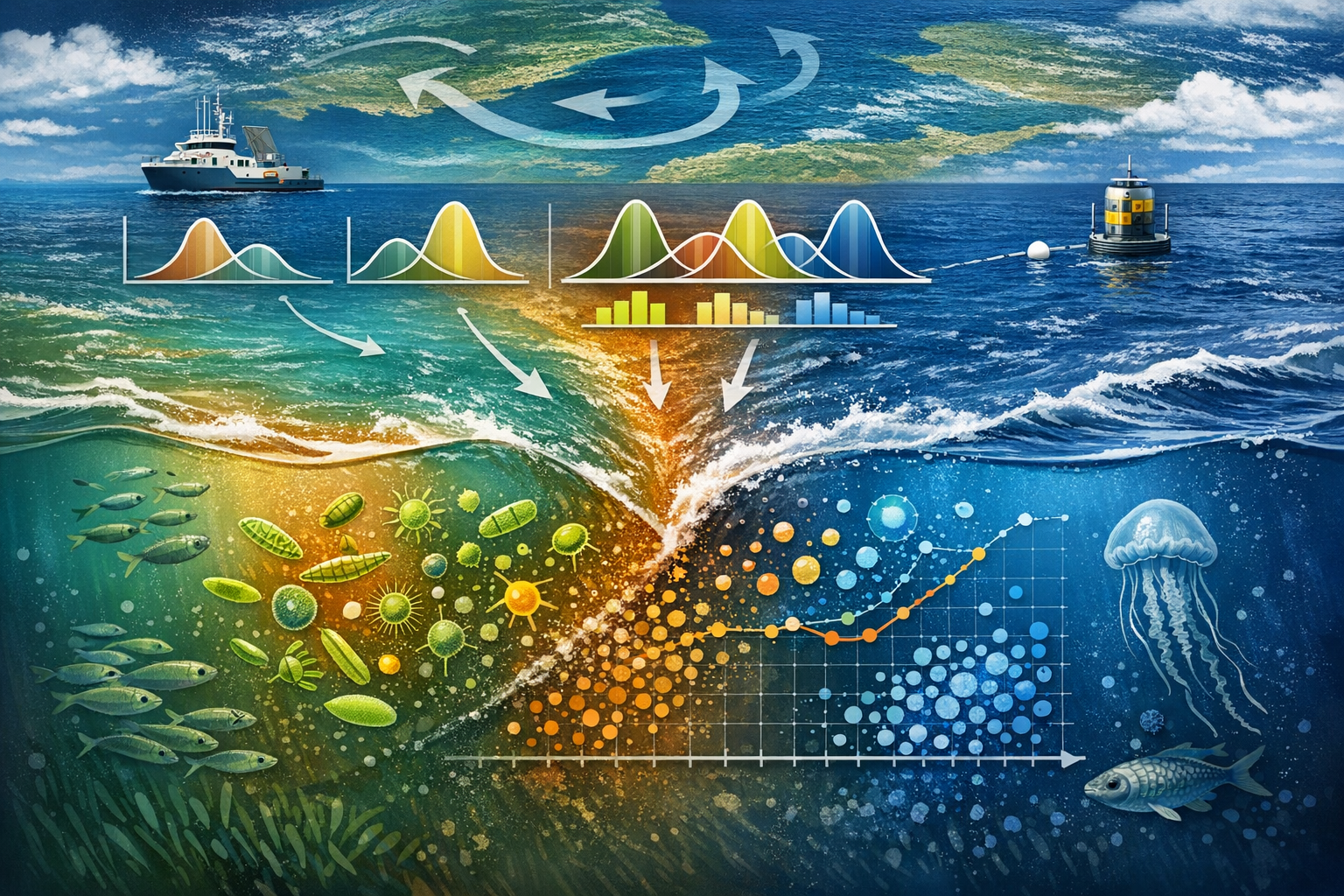
Fine-scale oceanic fronts generate sharp biophysical gradients that can restructure phytoplankton community composition (PCC) over short spatial and temporal scales. Empirical study of PCC within fronts is impeded by sparse sampling and high multivariate variability. A statistical framework was developed to test whether fronts harbor a distinct phytoplankton community component versus being simple mixtures of adjacent water masses, applied to in situ Mediterranean frontal and adjacent-water PCC datasets.
Methods and approach
The frontal PCC was modeled as a three-component finite mixture: two components representing the adjacent water-mass communities and a third representing a potential front-adapted community. Each component was itself represented as a discrete mixture of an unknown number of multivariate Gaussian subcomponents to capture within-community heterogeneity. An Expectation–Maximization algorithm estimated Gaussian parameters and selected the optimal number of subcomponents via model selection criteria on the separate adjacent- and frontal-area datasets. Subsequently, a hierarchical Bayesian model inferred the mixture weights within the frontal observations, propagating uncertainty from estimated Gaussian components and incorporating priors to regularize estimation under sparse frontal sampling.
Results
Inference identified a distinct community component within the frontal dataset that is statistically separable from the two adjacent water-mass components. The posterior weight of this front-adapted component was concentrated near 0.70, indicating it accounts for approximately 70% of frontal observations, with uncertainty quantified via posterior distributions. Model diagnostics and posterior predictive checks indicated that the hierarchical mixture captured the multivariate structure of the PCC within the front better than alternatives that omitted a dedicated front component.
Implications
Findings indicate that fine-scale oceanic fronts can support an emergent, compositionally distinct phytoplankton community rather than being mere assemblages of adjacent water masses. The combined EM and hierarchical Bayesian approach provides a pragmatic pathway to infer community structure in contexts of limited frontal observations and high variability, enabling probabilistic quantification of front influence. The methodological framework is transferable to other regions and can inform targeted sampling designs and incorporation of fine-scale community structure into ecosystem and biogeochemical models.
Disclosure
- Research title: A statistical approach to unveil phytoplankton adaptation to ocean fronts
- Authors: Théo Garcia, Laurina Oms, Xavier Milhaud, Andrea M. Doglioli, Monique Messié, Pierre Vandekerkhove, Claire Lacour, Gérald Grégori, Denys Pommeret
- Publication date: 2026-01-30
- DOI: https://doi.org/10.5194/ascmo-12-21-2026
- OpenAlex record: View
- Disclosure: This post was generated by artificial intelligence. The original authors did not write or review this post.