

Overview
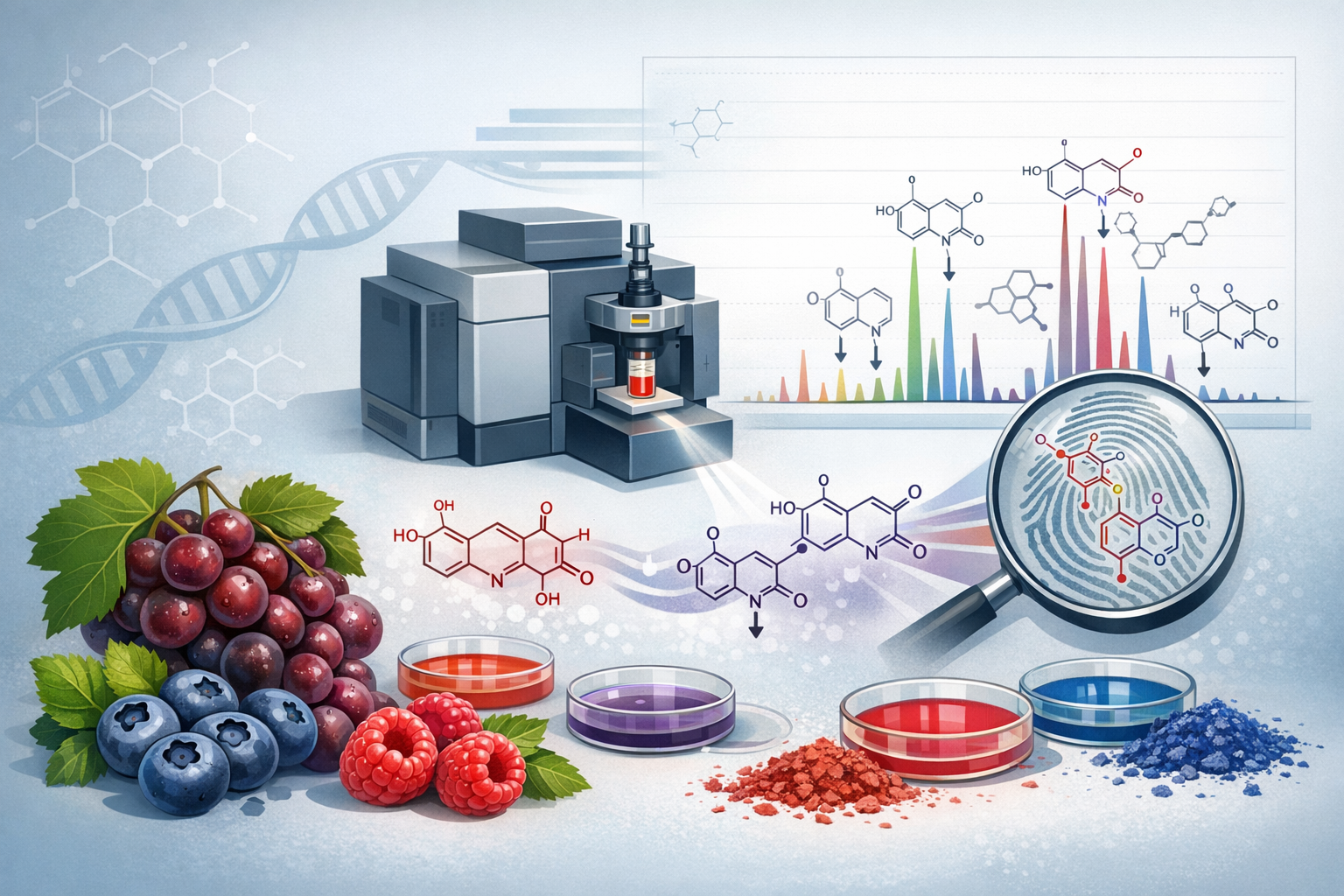
A targeted high-resolution mass spectrometry investigation characterized the anthocyanin composition of three red-berry fruit types: blueberry, raspberry, and two fungal-resistant red grape cultivars. The study aimed to resolve isobaric and isomeric anthocyanins and to generate a comprehensive HR-MS/MS fingerprint to inform chemical profiling, varietal differentiation, and potential applications in nutraceutical and colorant sourcing. A total of 35 distinct anthocyanin species were annotated across the sampled materials.
Methods and approach
Samples from blueberry, raspberry, and two fungal-resistant red grape cultivars were analyzed by ultra-high-performance liquid chromatography coupled to quadrupole time-of-flight high-resolution tandem mass spectrometry (UHPLC/Q-TOF HR-MS/MS). MS/MS fragmentation patterns and accurate mass measurements were used to assign aglycone substitution patterns and glycosylation motifs, including mono-, di- and trisaccharide conjugates and acylated derivatives. Comparative analysis across species and cultivars was performed to identify shared and unique anthocyanin constituents and to resolve isobaric species through diagnostic fragment ions and retention behavior.
Results
Thirty-five anthocyanins were identified. Only cyanidin (Cy) 3-O-hexoside and peonidin (Pn) 3-O-hexoside were common to all three fruit types. Grape berries exhibited a predominance of diglucoside anthocyanins. Raspberry samples uniquely contained pelargonidin (Pg) derivatives and several di- and trisaccharide anthocyanins, including sophoroside and rutinoside conjugates. Blueberry samples accumulated peonidin-malonylhexoside and arabinosyl anthocyanins; cultivar-level differences were observed between cv Biloxi (southern highbush) and cv Titan (rabbiteye), with Biloxi containing acetyl- and p-coumaroyl glucosides absent in Titan and a higher proportion of B-ring tri-substituted anthocyanins. Two isobaric anthocyanins sharing the molecular formula C22H23O11 were distinguished as peonidin-hexoside and malvidin-arabinoside. Novel characterizations reported for raspberry include peonidin-hexosyl-rutinoside, cyanidin-3-hexosyl-sophoroside, and a cyanidin-rutinoside isomer.
Implications
The dataset refines chemotaxonomic differentiation among blueberry, raspberry and fungal-resistant grape cultivars by documenting species- and cultivar-specific glycosylation and acylation patterns of anthocyanins. The resolved isobaric and isomeric assignments enhance the HR-MS/MS reference library for anthocyanin identification in complex fruit matrices.
The chemical distinctions documented have practical relevance for selection of fruit materials in nutraceutical research and natural colorant development, and provide a high-resolution analytic foundation for subsequent studies of biosynthetic variation, breeding selection, and food-quality assessment across related fruit taxa.
Disclosure
- Research title: A Comprehensive Study of Anthocyanins in Two Fungal‐Resistant Grape Varieties, Blueberry and Raspberry, by High‐Resolution Mass Spectrometry
- Authors: Mirko De Rosso, Kasipandi Muniyandi, K. Kumar, T. N'gambi, N. Dai, Guy Tamir, Roberto Carraro, L. Tarricone, Gianvito Masi, S. Roccotelli, Massimo Gardiman, Annarita Panighel
- Publication date: 2026-01-21
- DOI: https://doi.org/10.1002/jms.70030
- OpenAlex record: View
- Disclosure: This post is an AI-generated summary of a research work. It was prepared by an editor. The original authors did not write or review this post.