

What the study found
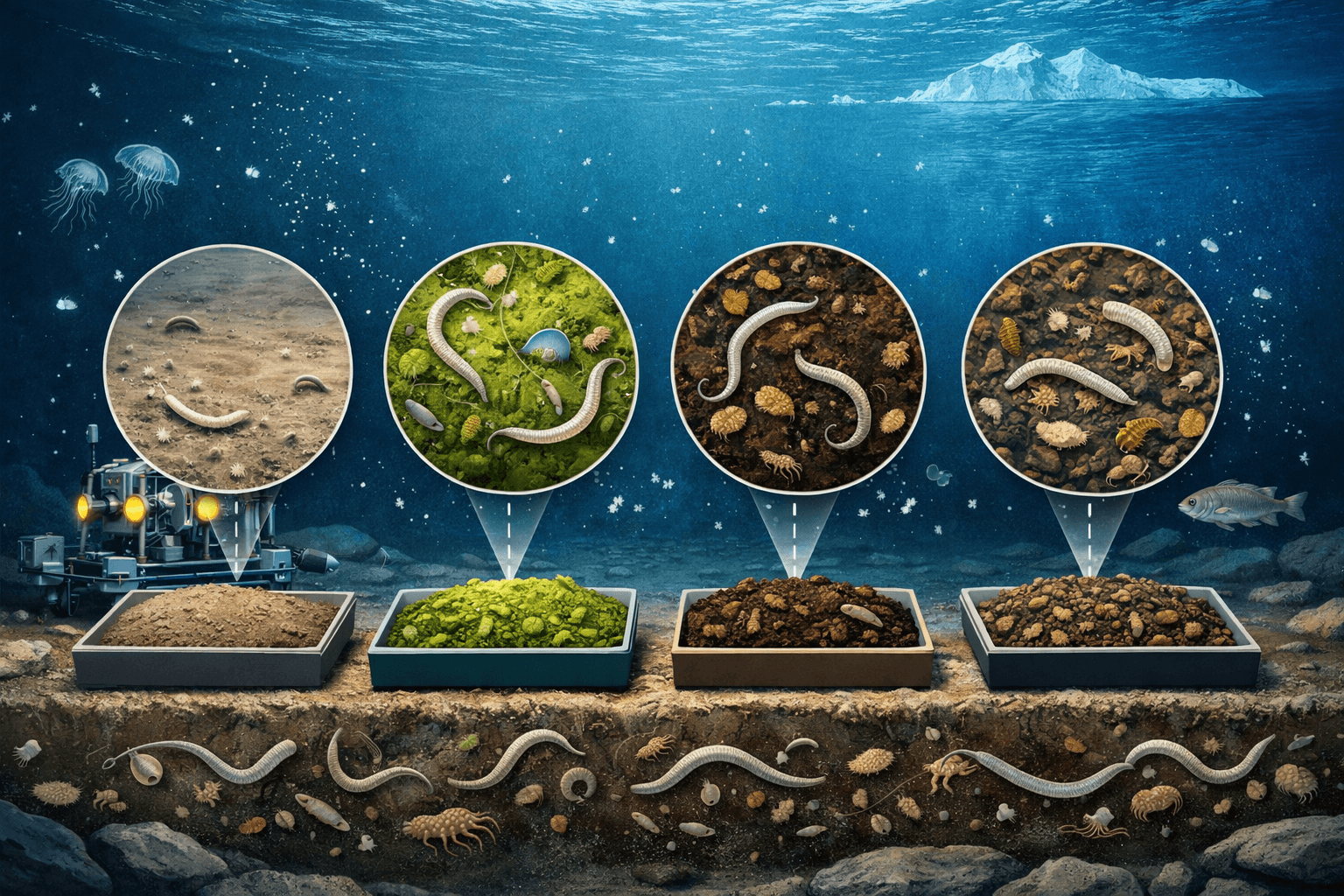
Artificial deep-sea sediments in the Arctic supported fewer nematodes and lower diversity than natural sediments, even when organic carbon content was similar. The community in these artificial sediments appeared to be in an early successional state, dominated by opportunistic taxa.
Why the authors say this matters
The authors conclude that deep-sea nematode communities depend on long-term organic matter retention and sediment accumulation, not just the amount of organic carbon present. The study suggests that changes in organic matter deposition caused by human activity could affect deep-sea biodiversity and ecosystem resilience.
What the researchers tested
The researchers carried out an in-situ experiment at 1265 m depth in the Arctic Ocean at the LTER HAUSGARTEN observatory in Fram Strait. They used azoic sediments, meaning sediments without animals, matched in grain size to natural deep-sea sediment, and applied three treatments: control azoic sediment, azoic sediment with fresh Phaeocystis, and azoic sediment with decaying Phaeocystis. The setup was deployed for three months and compared with natural sediment samples.
What worked and what didn't
Fresh Phaeocystis favored epistrate feeders, while decaying Phaeocystis supported later-stage colonisers. Natural sediments supported higher nematode abundance, greater functional diversity, and a more balanced trophic structure than the artificial sediments. The artificial sediments, despite similar organic carbon content, had lower abundance and diversity and were dominated by opportunistic genera.
What to keep in mind
The authors note that a mature community likely needs more time to develop than the three-month experiment allowed. The abstract does not describe additional limitations beyond this time constraint.
Key points
- Artificial sediments had lower nematode abundance and diversity than natural sediments.
- The artificial sediments were dominated by opportunistic taxa, suggesting an early successional stage.
- Fresh Phaeocystis favored epistrate-feeding nematodes.
- Decaying Phaeocystis supported later-stage nematode colonisers.
- Natural sediments had higher functional diversity and a more balanced trophic structure.
- The authors state that three months was likely too short for a mature community to develop.
Disclosure
- Research title:
- Organic enrichment reshaped Arctic deep-sea nematode communities
- Publication date:
- 2026-03-10
- OpenAlex record:
- View
Get the weekly research newsletter
Stay current with peer-reviewed research without reading academic papers — one filtered digest, every Friday.