

What the study found
The study found that a cored Plummer dark matter halo changes the optical and thermodynamic behavior of a black hole. The authors report that it also enhances null geodesic and thermodynamic stability and allows phase transitions that are absent in the pure Schwarzschild solution.
Why the authors say this matters
The authors conclude that the dark matter environment affects both photon behavior and black hole thermodynamics in the system they studied. They present this as evidence that the halo modifies shadow formation, lensing, stability, and phase transition behavior.
What the researchers tested
The researchers constructed a new exact static, spherically symmetric black hole solution embedded in a cored Plummer dark matter halo. They then examined photon dynamics, black hole shadow, eikonal-limit quasinormal modes, and thermodynamic quantities including mass function, enthalpy, entropy, temperature, heat capacity, and Gibbs free energy.
What worked and what didn't
The authors state that light rings, gravitational lensing, and shadow formation were studied using null geodesics derived from the principle of least action. They report that the Lyapunov exponent characterizes the stability of circular photon orbits and controls the imaginary part of massless quasinormal mode frequencies. They also report that the cored Plummer halo modifies the system in ways that increase null geodesic and thermodynamic stability and permit phase transitions not seen in the pure Schwarzschild case.
What to keep in mind
The summary does not provide numerical results or detailed parameter ranges. It also does not describe observational data; the abstract only states that the study is analytical and graphical. Limitations are not described in the available summary.
Key points
- A new exact static, spherically symmetric black hole solution was constructed in a cored Plummer dark matter halo.
- The study reports that the halo modifies black hole optical behavior, including light rings, lensing, and shadow formation.
- The Lyapunov exponent is said to control the imaginary part of massless quasinormal mode frequencies.
- Thermodynamic quantities analyzed included mass function, enthalpy, entropy, temperature, heat capacity, and Gibbs free energy.
- The authors report phase transitions in the dark matter-black hole system that are absent in the pure Schwarzschild solution.
Disclosure
- Research title:
- Dark matter halo alters black hole optics and thermodynamics
- Authors:
- David Senjaya, Phongsakorn Sereewat
- Institutions:
- Mahidol University, Mahidol University
- Publication date:
- 2026-03-05
- OpenAlex record:
- View
- Image credit:
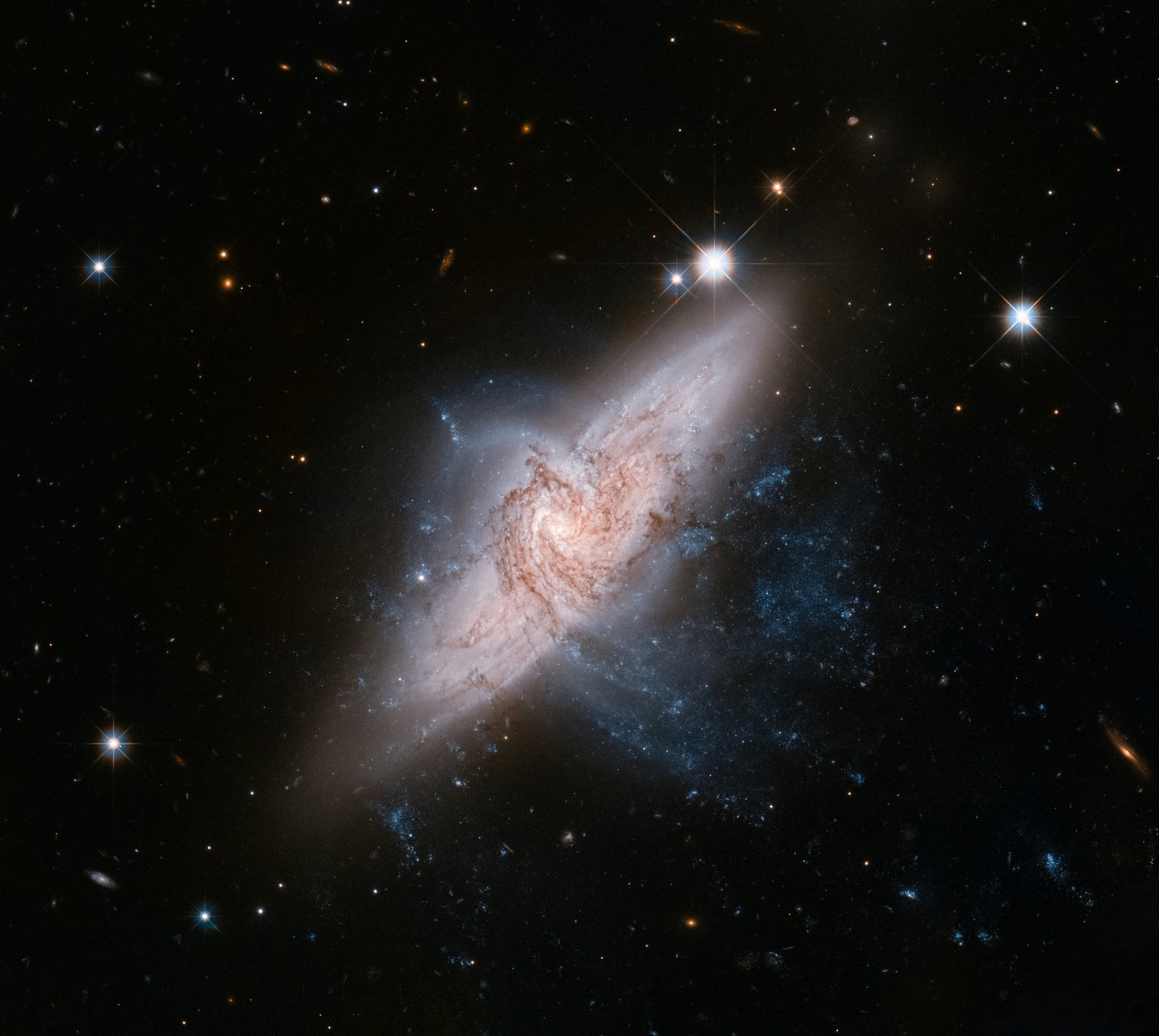
- Photo by NASA Hubble Space Telescope on Unsplash · Unsplash License
Get the weekly research newsletter
Stay current with peer-reviewed research without reading academic papers — one filtered digest, every Friday.