

Overview
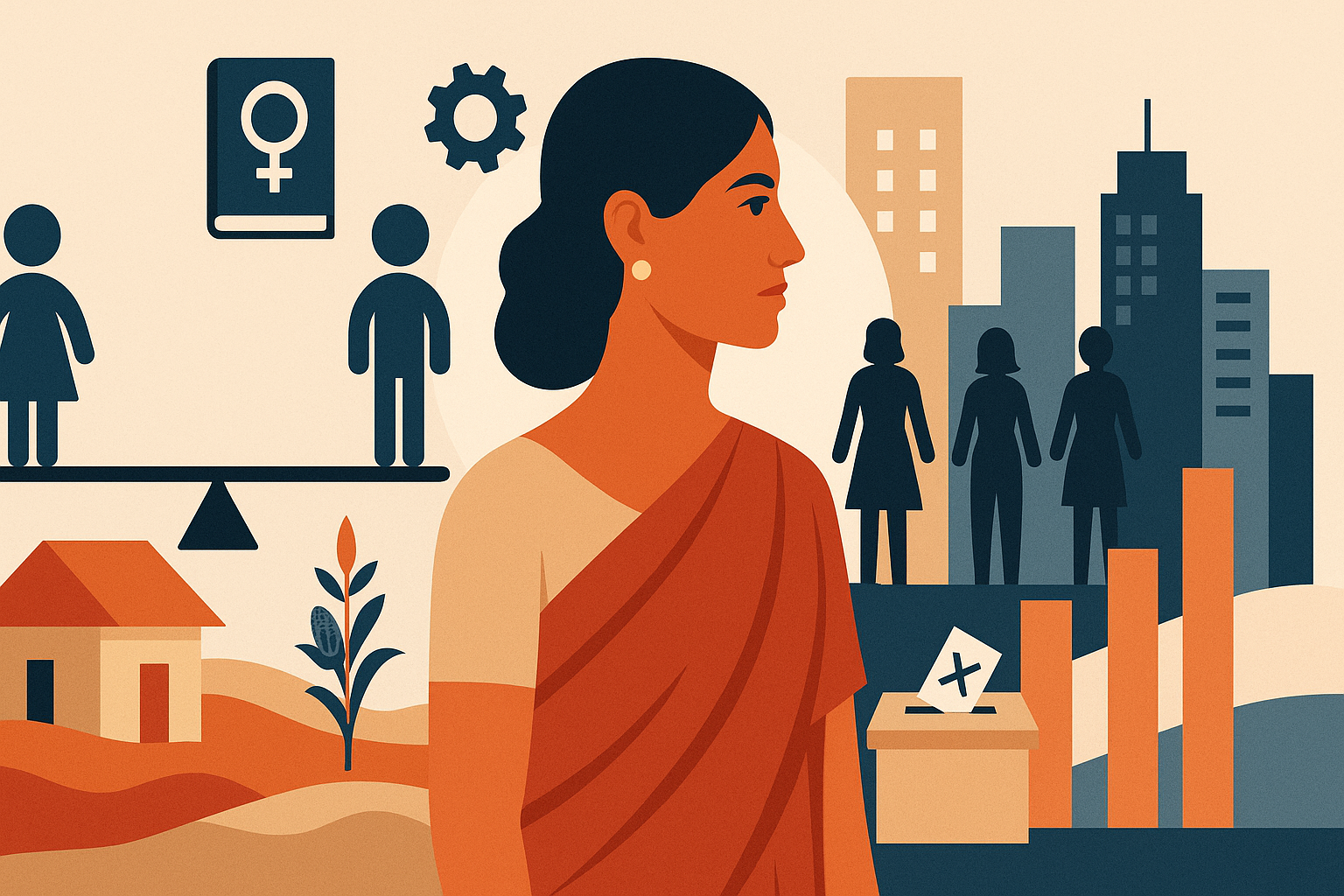
This study evaluates trajectories of women’s empowerment and gender equality in India since 1947, employing an explicit urban–rural comparative orientation. It situates post-Independence legal and policy reforms alongside socio-economic transformations to identify differential outcomes for women across spatial contexts. The analysis foregrounds education, labor-market participation, political representation, autonomy in household decision-making, and enduring patriarchal constraints as primary axes of inquiry.
Methods and approach
A multidisciplinary theoretical framework integrates feminist theory, modernization theory, and patriarchy as analytic lenses. The empirical approach synthesises secondary quantitative indicators (education attainment, labor force participation rates, sex ratios, political representation metrics) with qualitative findings from ethnographic and case-study literature to assess processes and mechanisms. Spatial disaggregation (urban versus rural) and temporal comparison across post-Independence decades are used to identify patterns, heterogeneity, and policy correlations.
Results
Urban sites exhibit marked improvements in female educational attainment, diversified employment in non-agricultural sectors, greater mobility, and increased instances of political participation and decision-making autonomy. Legal reforms and development programs correlate with measurable gains in these domains. Rural contexts display more limited change: persistent patriarchal norms, constrained access to land and credit, higher prevalence of early marriage and unpaid reproductive labor, and continued dependence on agrarian livelihoods that limit bargaining power. Cross-cutting findings indicate intra-urban and intra-rural heterogeneity by class, caste, region, and religion, with intersecting disadvantages producing differential empowerment outcomes.
Implications
Policy implications emphasise calibrated interventions that recognise spatial variation: urban-focused measures reinforcing labor-market integration and political inclusion, and rural-targeted strategies addressing land rights, access to services, and norms transformation. Programmatic design should incorporate intersectional targeting and multi-sectoral coordination to mitigate structural barriers. Future research should prioritise longitudinal, disaggregated data and rigorous evaluation of norm-change interventions to elucidate causal pathways linking policy inputs to empowerment outcomes.
Disclosure
- Research title: Women Empowerment and Gender Equality in Post Independence India: An Urban Rural Study
- Authors: Chinmayi D. Marathe
- Publication date: 2026-01-31
- DOI: https://doi.org/10.5281/zenodo.18161626
- OpenAlex record: View
- Disclosure: This post is an AI-generated summary of a research work. It was prepared by an editor. The original authors did not write or review this post.