

About This Article
This is an AI-generated summary of a research paper. The original authors did not write or review this article. See full disclosure ↓
Overview
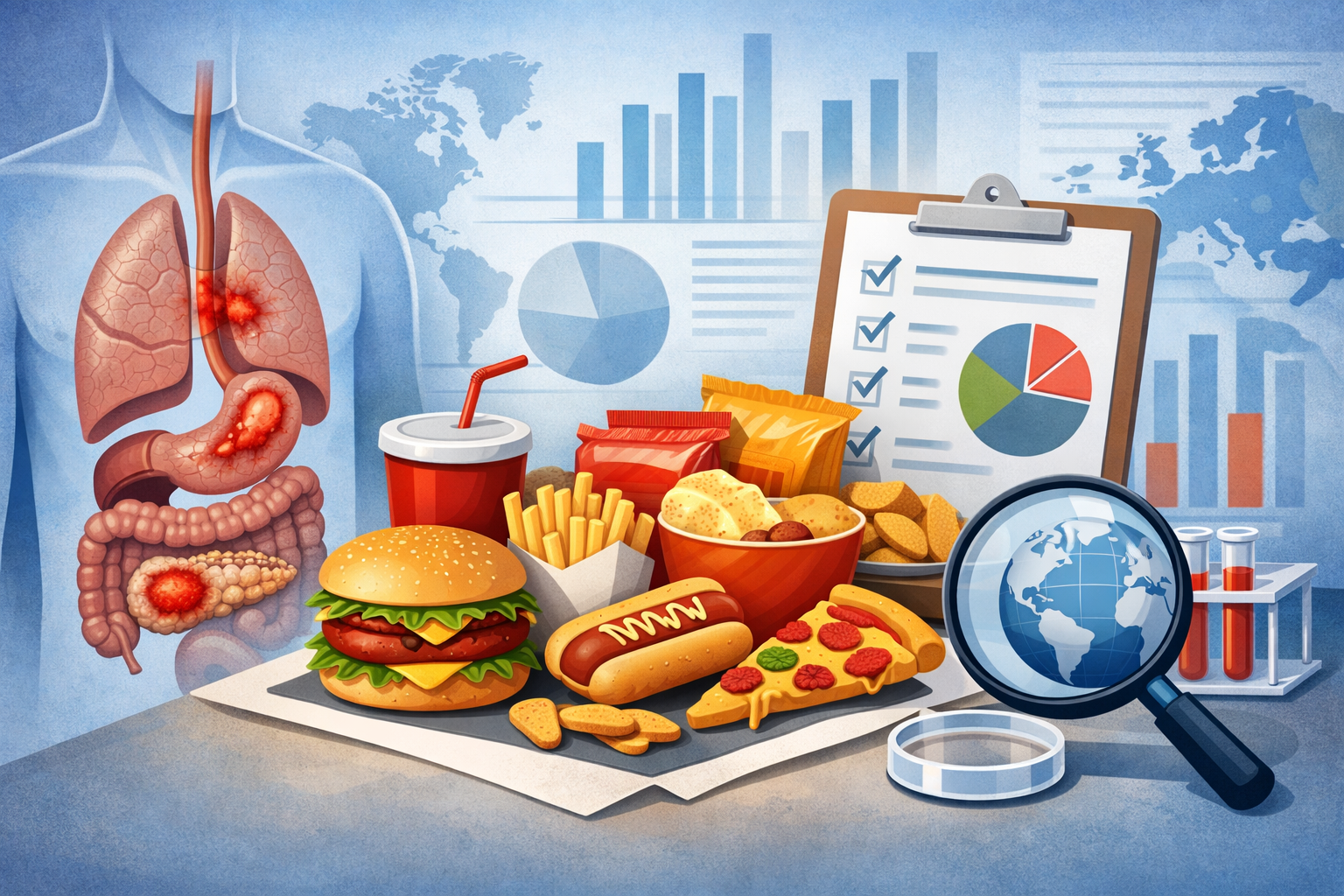
A multi-case control study examined the association between ultra-processed food (UPF) consumption and incident cases of oesophageal, stomach, and pancreatic cancers in a Mediterranean population. The analysis encompassed 1,218 participants including 766 cancer cases and 452 controls from the PANESOES study. Dietary assessment was conducted retrospectively using a validated food frequency questionnaire administered five years prior to interview, with UPF consumption quantified using the NOVA classification system.
Methods and approach
The study employed multinomial logistic regression to estimate relative risk ratios with 95% confidence intervals, adjusting for potential confounders. UPF consumption was operationalized both as absolute intake in grams per day and as a percentage of total dietary intake, then stratified into tertiles for comparative analysis. Specific UPF subcategories including ultra-processed dairy products, sweets and pastries, pre-cooked foods, and ultra-processed beverages were examined separately to identify category-specific associations with cancer outcomes.
Results
Higher tertiles of absolute UPF consumption demonstrated significant positive associations with oesophageal cancer (highest tertile RRR = 2.29; 95% CI: 1.37–3.82) and stomach cancer (RRR = 1.56; 95% CI: 1.08–2.27) compared to the lowest tertile. For stomach cancer specifically, ultra-processed dairy products and sweets/pastries exhibited elevated risk estimates of 2.10 and 1.76 respectively. Ultra-processed drinks and pre-cooked foods were associated with increased oesophageal cancer risk. No statistically significant associations were identified for pancreatic cancer across exposure categories.
Implications
The findings provide epidemiological evidence supporting an association between UPF consumption and gastrointestinal cancer risk in upper digestive tract locations, with variation in effect magnitude by specific product categories. The differential effect by cancer site and food type suggests potential distinct mechanistic pathways or differential exposure routes relevant to oesophageal versus gastric carcinogenesis. The absence of association for pancreatic cancer warrants clarification through mechanistic investigations and confirmation in independent cohorts.
Disclosure
- Research title: Ultra-processed food consumption and risk of oesophagus, stomach, and pancreatic cancers: a multi case–control study
- Authors: Laura Torres-Collado, Sandra González-Palacios, Laura María Compañ-Gabucio, Carolina Ojeda-Belokon, Marielisa Gabriela Belisario-Ubeto, Manuela García-de-la-Hera, Alejandro Oncina-Cánovas, Jesús Vioque
- Publication date: 2026-02-26
- DOI: https://doi.org/10.3389/fnut.2026.1764868
- OpenAlex record: View
- PDF: Download
- Disclosure: This post is an AI-generated summary of a research work. It was prepared by an editor. The original authors did not write or review this post.