

About This Article
This is an AI-generated summary of a research paper. The original authors did not write or review this article. See full disclosure ↓
Overview
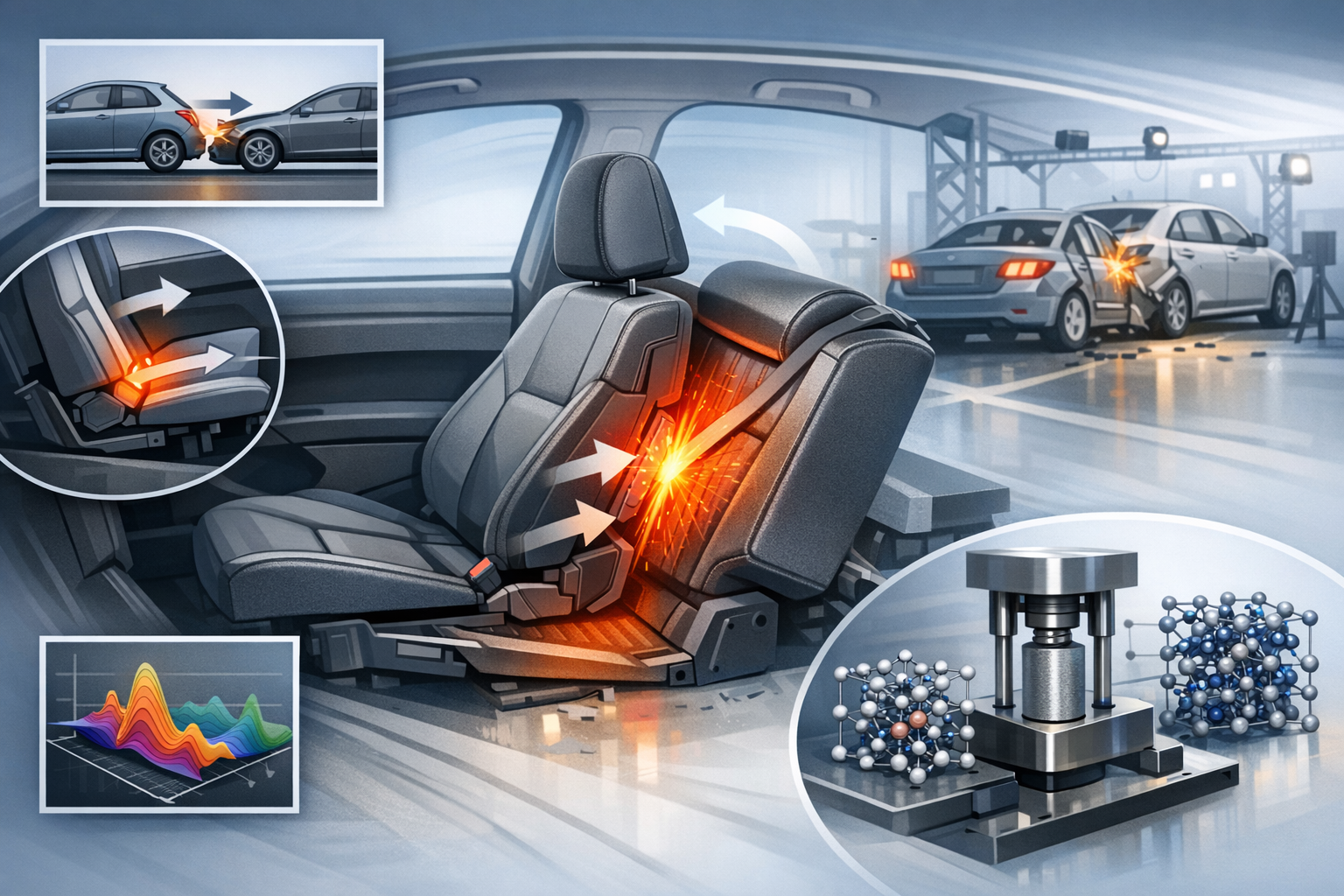
Analysis of a fatal rear-impact crash in which underride-type intrusion concentrated forces under the vehicle beltline, driving the rear seat pan forward into the rearward-rotating front seatback. The front occupant sustained lethal thoracic trauma despite appropriate head support; the case implicates a seatback–seat pan bottoming interaction as a proximate mechanism amplifying upper-torso loading. The study combines forensic reconstruction of the real-world event with a controlled vehicle-to-vehicle crash test designed to replicate intrusion kinematics and quantify thoracic load amplification associated with seatback bottoming out.
Methods and approach
Forensic analysis of the collision scene, vehicle deformation, and occupant injury patterns established impact configuration, intrusion vectors, and probable load paths. A surrogate vehicle-to-vehicle crash test reproduced the underride loading geometry, wheel contact conditions, and relative mass/inertia parameters observed in the case. Instrumentation included high-speed videography, tri-axial accelerometers on seat structures and a cadaveric or biofidelic anthropomorphic test device instrumented for thoracic force and deflection measurement, and displacement transducers on the rear seat pan and front seatback. Kinematic timelines were extracted to define onset and duration of seatback contact, seat pan travel, and relative phase of forward impulse delivery to the upper torso. Data analysis focused on peak thoracic force, energy transfer during bottoming events, and comparison of occupant loading with and without pronounced seatback bottoming.
Results
The crash test replicated rapid forward translation of the rear seat pan driven by under-beltline intrusion through the rear wheel path. The rearward rotation of the front seatback combined with upward/forward travel of the seat pan produced a bottoming-out contact approximately coincident with peak rear-seat intrusion velocity. Bottoming-induced forward impulse increased upper-torso anterior chest loading beyond levels attributable to pure seatback rearward rotation. Measured thoracic forces and deflections demonstrated marked amplification (multiples of baseline rotational loading) during the bottoming interval, consistent with the observed fatal thoracic injuries in the real-world case. Temporal alignment of peak seat pan force and peak thoracic load confirmed the seatback–seat pan interaction as the proximate loading mechanism.
Implications
The findings indicate that rear-structure design must account for underride force paths that bypass the occupant compartment and concentrate energy into the rear seat pan. Structural countermeasures should limit rear seat pan excursion and prevent bottoming geometry that converts translational intrusion into impulsive anterior thoracic loading. Front seatback design should incorporate controlled energy absorption and stop features to avoid abrupt rearward collapse into a bottoming condition. Crash compatibility targets and test protocols should be extended to include scenarios that reproduce under-beltline intrusion and rear seat pan–seatback interactions to better evaluate occupant thoracic risk.
Disclosure
- Research title: Thoracic Injury Mechanisms Due to Front Seatback–Rear Seat Pan Interaction in Severe Rear-Impact Collisions: A Case Study
- Authors: Chandrashekhar K. Thorbole
- Publication date: 2026-01-16
- DOI: https://doi.org/10.4271/2026-26-0005
- OpenAlex record: View
- Disclosure: This post was generated by artificial intelligence. The original authors did not write or review this post.