Tag: Statistical and Nonlinear Physics
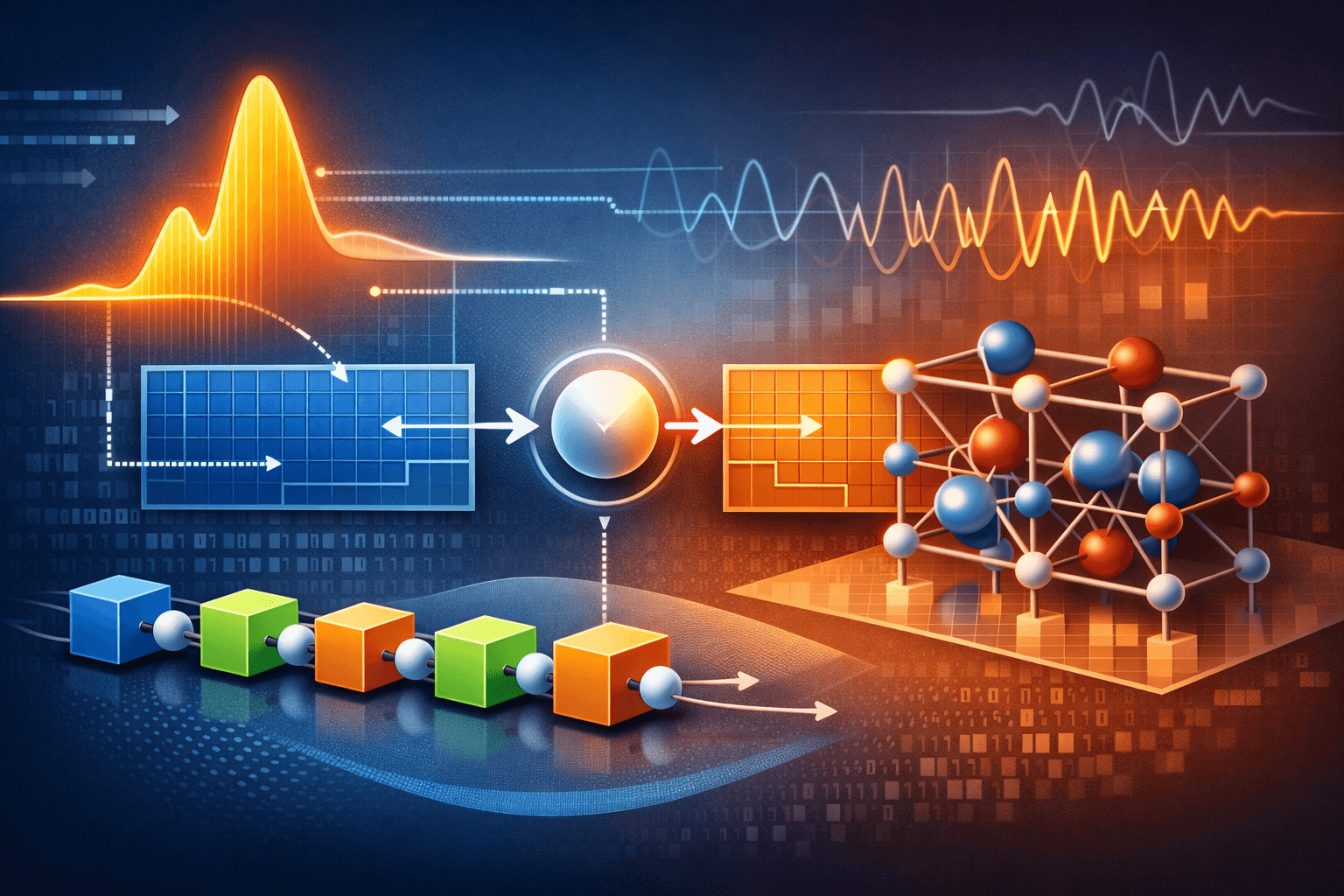
THERMO-NET reduces dissipation in modeled thermal systems
What the study found THERMO-NET is a physics-informed artificial intelligence framework that the authors say can model, predict, and actively suppress irreversible entropy production in several high-density computational and thermal settings. The abstract reports improved performance across five tested regimes, including quantum hardware and nano-scale thermal networks. Why the authors say this matters The authors…

Inertial active chains show multiple dynamical crossovers
Analysis of inertial active particles in harmonic chains reveals multiple dynamical crossovers and non-Gaussian fluctuations, with experimentally testable signatures.

Self-gravitating bosonic configurations have a stability limit
Numerical study of self-gravitating bosonic systems reveals critical thresholds for equilibrium and stability in the nonrelativistic regime, with applications to ultralight dark matter candidates.

Nonlocal media support dark, antidark, and mixed soliton pairs
Researchers identify two families of vector soliton pairs in nonlocal nonlinear systems, including novel mixed-polarity solutions with symmetry-breaking structure.

TTCF matches time averages for nonequilibrium transport in test systems
TTCF method computes nonequilibrium transport coefficients from short-time dynamics, offering computational advantages over traditional time-average approaches in linear and nonlinear regimes.

Causality-based algorithm extends nonequilibrium Green’s function time simulations
Algorithm exploiting causality for efficient nonequilibrium Green’s function calculations via quantics tensor trains, enabling extended simulations of quench dynamics in symmetry-broken phases.