

About This Article
This is an AI-generated summary of a research paper. The original authors did not write or review this article. See full disclosure ↓
Overview
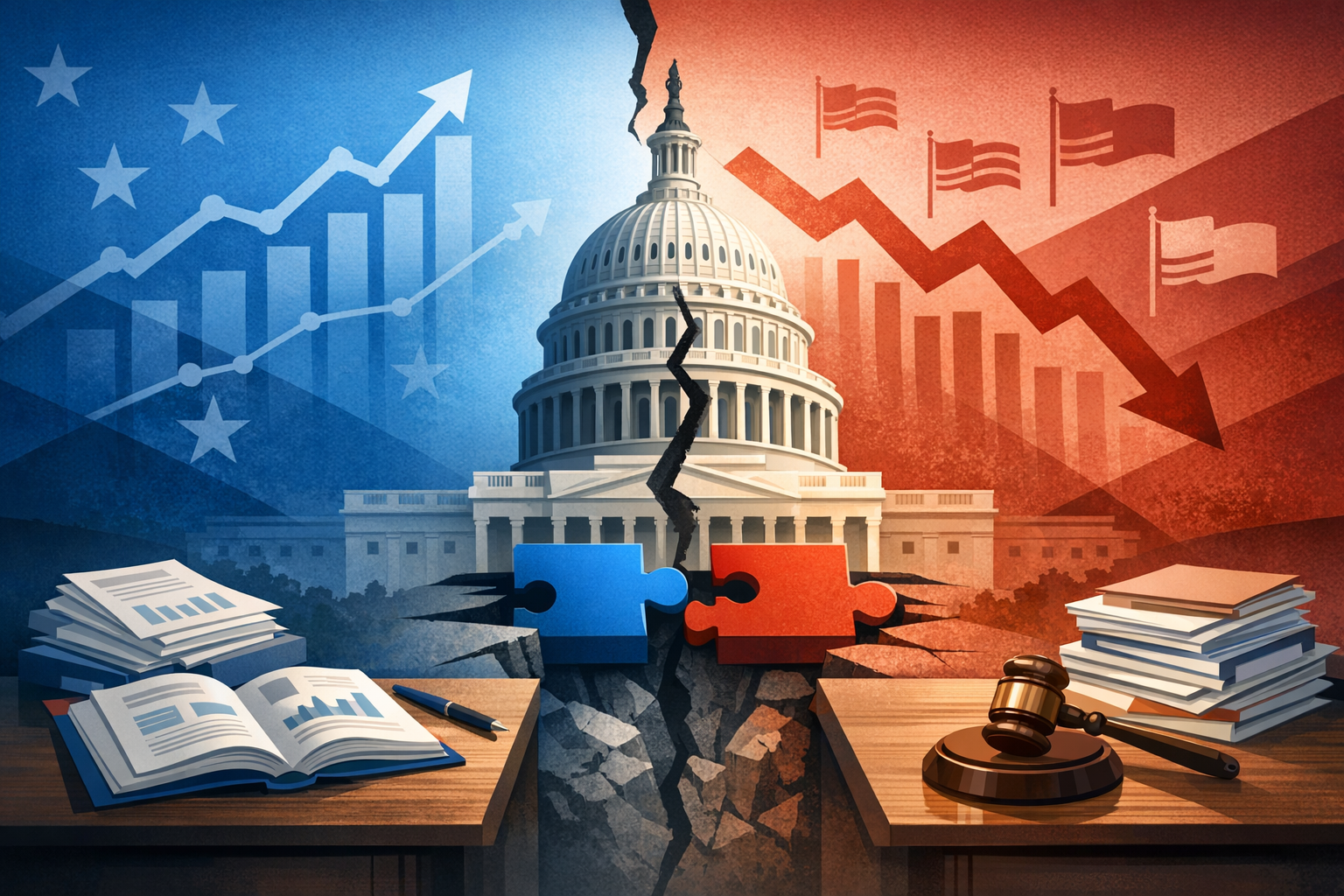
This research provides a reassessment of Congress's capacity for problem solving in the context of contemporary American political polarization. Challenging prevailing negative assessments within political science scholarship, the work argues that Congress maintains significant functionality across three dimensions: representation, institutional processes, and policy outcomes. The analysis focuses on how the institution navigates intense partisan divisions while continuing to produce legislative results. The central argument posits that Congress exhibits underappreciated virtues in reflecting political diversity, maintaining procedural respect for that diversity, and generating broadly supported policy outcomes despite the polarized environment.
Methods and approach
The study examines Congress through a tripartite analytical framework encompassing representational fidelity, institutional procedural characteristics, and legislative productivity. The representational dimension assesses how well congressional membership and party composition reflect the political diversity present in the American electorate. The institutional analysis evaluates internal processes for their accommodation of diverse political viewpoints. The policy outcomes component includes both quantitative measures of legislative volume and qualitative assessment of cross-party support patterns. Temporal comparisons are employed, benchmarking contemporary congressional output against legislative production in the 1980s and 1990s to establish baseline productivity levels and identify trends in bipartisan collaboration.
Results
The analysis demonstrates that contemporary Congress achieves substantial legislative productivity despite heightened polarization. Congressional membership and party distribution credibly reflect the political diversity existing within the national electorate. Institutional processes demonstrate procedural respect for this diversity through accommodative mechanisms. Legislative output by volume equals or exceeds levels observed during the 1980s and 1990s, periods often characterized as less polarized. Policy outcomes typically secure broad cross-party support, with large majorities from both parties backing enacted legislation. These findings contradict conventional assessments that characterize the contemporary Congress as fundamentally dysfunctional or incapable of productive governance under conditions of partisan polarization.
Implications
The findings challenge dominant narratives within political science regarding congressional dysfunction and suggest that standard evaluative frameworks may inadequately capture the institution's problem-solving capacity. The evidence of sustained legislative productivity and bipartisan support patterns indicates that polarization does not necessarily preclude effective governance or consensus building on substantive policy matters. The research implies that congressional processes maintain adaptive capacity to accommodate political diversity while producing outcomes acceptable to broad coalitions. These results have theoretical implications for understanding how representative institutions function under conditions of partisan division and practical implications for assessing institutional performance. The work suggests that evaluations of congressional effectiveness may benefit from greater attention to legislative volume, coalition breadth, and representational fidelity rather than focusing exclusively on partisan conflict dynamics.
Disclosure
- Research title: Congress as Problem Solver: Building Consensus and Remaining Policy Productive Despite Polarization
- Authors: James M. Curry, Frances E. Lee
- Publication date: 2026-01-09
- DOI: https://doi.org/10.1515/for-2025-2018
- OpenAlex record: View
- Disclosure: This post was generated by artificial intelligence. The original authors did not write or review this post.