

About This Article
This is an AI-generated summary of a research paper. The original authors did not write or review this article. See full disclosure ↓
Overview
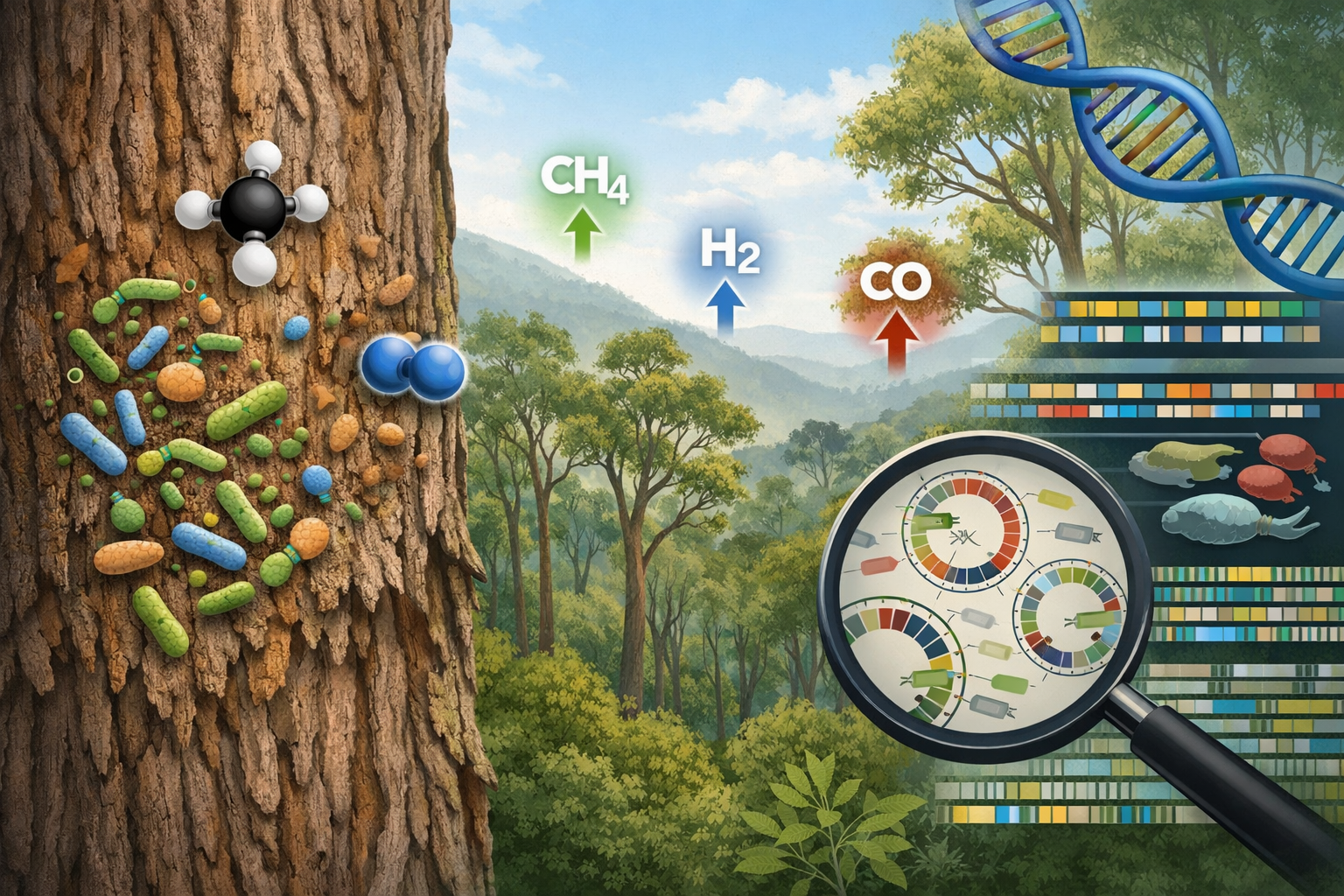
Bark-associated microbial communities in Australian tree species possess metabolic functions relevant to atmospheric gas cycling. The study employs gene-centric and genome-resolved mettagenomics to characterize bacterial assemblages, revealing specialized communities dominated by hydrogen-cycling facultative anaerobes with the capacity to metabolize multiple climate-active gases including methane, hydrogen, and carbon monoxide.
Methods and approach
Metagenomic analysis was conducted on bark samples from eight common Australian tree species to characterize microbial community composition and function. Microcosm experiments were designed to measure aerobic consumption and anaerobic production of methane, hydrogen, and carbon monoxide at environmentally relevant concentrations. Field-based measurements were conducted in situ to quantify metabolic rates of climate-active gases within tree stems and validate laboratory observations.
Results
Bark microbiota are composed of abundant and specialized bacterial communities. Hydrogen-cycling facultative anaerobes constitute the predominant bacterial group, exhibiting metabolic adaptation to dynamic redox conditions. Methanotrophs and hydrogenotrophic methanogens coexist within bark environments. Microcosm assays demonstrated aerobic consumption of methane, hydrogen, and carbon monoxide at in planta concentrations, with production of these gases under anoxic conditions. Field measurements confirm substantial metabolic activity of climate-active gases within tree stems.
Implications
The metabolic activities of bark microbiota represent a previously undercharacterized microbial contribution to atmospheric gas cycling. The capacity of these communities to consume and produce multiple climate-active gases at quantifiable rates suggests the potential for substantial influence on local and global atmospheric composition, particularly given the abundance of tree biomass in terrestrial ecosystems. Integration of microbial metabolic processes within tree bark into models of global biogeochemical cycles may be necessary for accurate assessment of terrestrial contributions to climate-active gas fluxes.
Disclosure
- Research title: Bark microbiota modulate climate-active gas fluxes in Australian forests
- Authors: Pok Man Leung, Luke C. Jeffrey, Sean K. Bay, Paula Gomez-Alvarez, Montgomery Hall, Scott G. Johnston, Johannes Dittmann, Elisabeth Deschaseaux, Billie Hopkins, Jasmine B. Haskell, Thanavit Jirapanjawat, Tess F. Hutchinson
- Publication date: 2026-01-08
- DOI: https://doi.org/10.1126/science.adu2182
- OpenAlex record: View
- Disclosure: This post was generated by artificial intelligence. The original authors did not write or review this post.