

Key findings from this study
This research indicates that:
Key points
- Camaran Island served as the Ottoman Empire's principal quarantine station for Hajj pilgrims traveling between India and the Hejaz, embodying both medical function and administrative authority.
- International sanitary conventions and inter-imperial cooperation against epidemics shaped maritime health governance in the Red Sea, though this cooperation coexisted with Ottoman-British strategic rivalry.
- Sanitary measures and quarantine infrastructure on Camaran operated as instruments of sovereignty and population control beyond their epidemiological purposes.
Overview
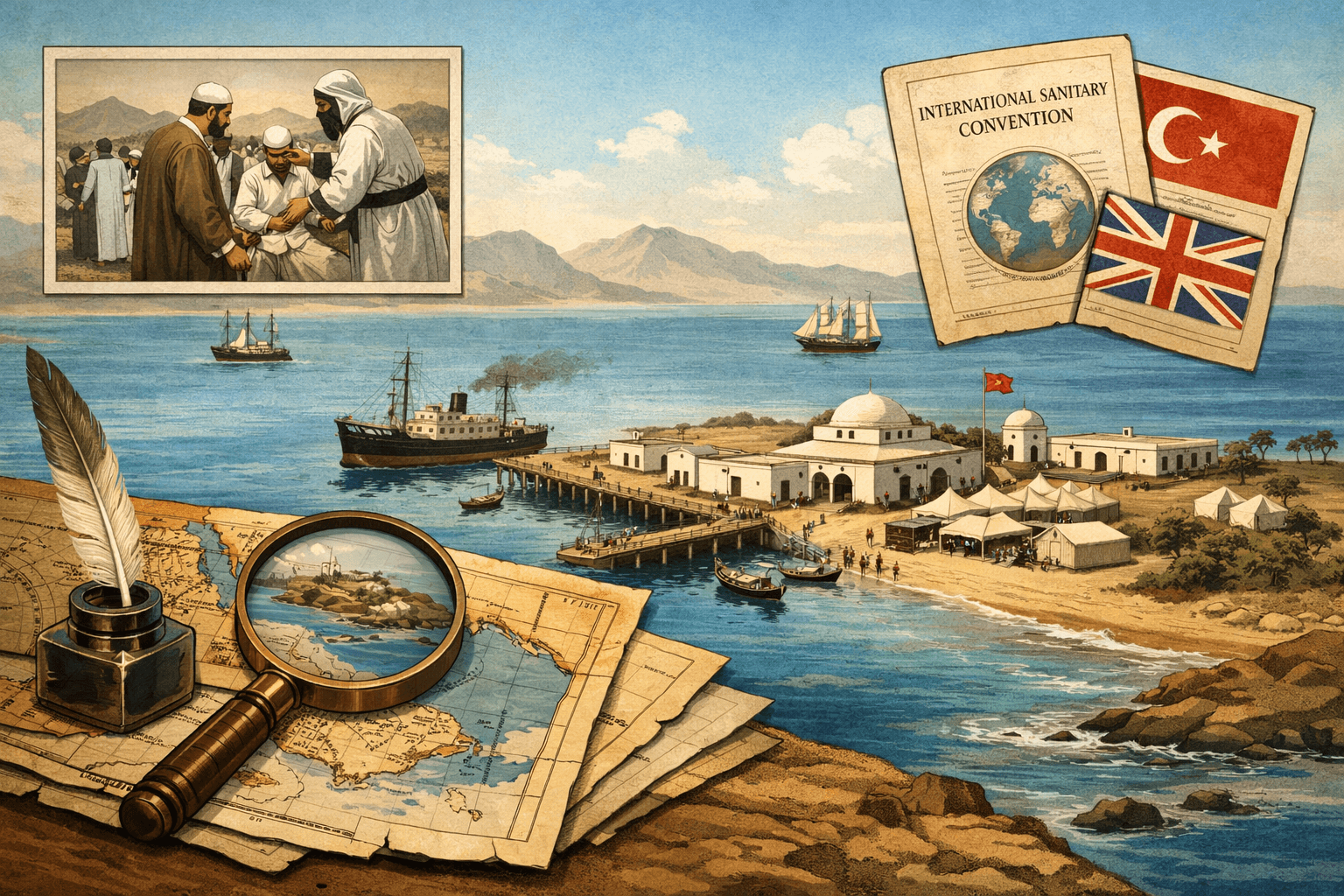
This historical study examines Camaran Island's function as the Ottoman Empire's primary quarantine station for Hajj pilgrims in the late nineteenth and early twentieth centuries. Located at the Red Sea's southern gateway, the island emerged as a strategic site where international sanitary conventions intersected with Ottoman administrative power and British imperial oversight. The research situates Camaran within the broader institutional development of global health governance and inter-imperial competition.
Methods and approach
The study draws on archival materials from British and Ottoman sources to reconstruct Camaran's operational and geopolitical contexts. A historical international relations framework guides the analysis, positioning quarantine infrastructure and sanitary measures as expressions of sovereignty and control. The research integrates evidence from late-nineteenth- and early-twentieth-century international sanitary conferences and conventions.
Results
Camaran functioned simultaneously as a medical frontier and geopolitical arena where Ottoman and British interests converged and competed. Sanitary measures and quarantine infrastructure became instruments through which the Ottoman state demonstrated administrative authority while accommodating British imperial surveillance of pilgrimage routes. The island's quarantine regime reflected institutionalized inter-imperial cooperation against epidemic disease alongside deeper tensions over Eastern Mediterranean and Red Sea governance.
The research reveals how international health protocols operated concretely at Camaran through practical enforcement of quarantine standards, inspection procedures, and disease management. Religion, public health, and empire intersected at the island, creating a space where medical regulations served dual purposes: preventing epidemic transmission and consolidating imperial control over maritime commerce and population movement. Ottoman-British rivalry directly shaped the technical and administrative dimensions of pilgrim health governance.
Implications
The case of Camaran demonstrates that global health governance in the late Ottoman period emerged not as a neutral technical domain but as a contested arena reflecting imperial hierarchies and power asymmetries. Quarantine infrastructure and sanitary protocols functioned as extensions of state authority and international authority, revealing how public health became inseparable from geopolitical objectives. Understanding nineteenth-century health governance requires attention to how empires negotiated sovereignty through medical institutions.
The study contributes to historical analysis of the Eastern Mediterranean as a space where multiple imperial systems negotiated control over critical strategic and commercial nodes. Camaran's history illuminates the relationship between international regulations, local implementation, and the exercise of power across empires. The research suggests that examining health infrastructure offers productive methodological access to understanding broader patterns of imperial competition and cooperation.
Scope and limitations
This summary is based on the study abstract and available metadata. It does not include a full analysis of the complete paper, supplementary materials, or underlying datasets unless explicitly stated. Findings should be interpreted in the context of the original publication.
Disclosure
- Research title: From International Sanitary Conventions to Local Quarantine Practice: Camaran Island in the Late Ottoman Pilgrim Traffic Regulations
- Authors: Recep KÜREKLİ
- Institutions: Nevşehir Hacı Bektaş Veli University
- Publication date: 2026-03-31
- DOI: https://doi.org/10.24186/vakanuvis.1803714
- OpenAlex record: View
- PDF: Download
- Disclosure: This post was generated by Claude (Anthropic). The original authors did not write or review this post.
Disclosure
- Research title:
- From International Sanitary Conventions to Local Quarantine Practice: Camaran Island in the Late Ottoman Pilgrim Traffic Regulations
- Publication date:
- 2026-03-31
- OpenAlex record:
- View
Get the weekly research newsletter
Stay current with peer-reviewed research without reading academic papers — one filtered digest, every Friday.