

What the study found
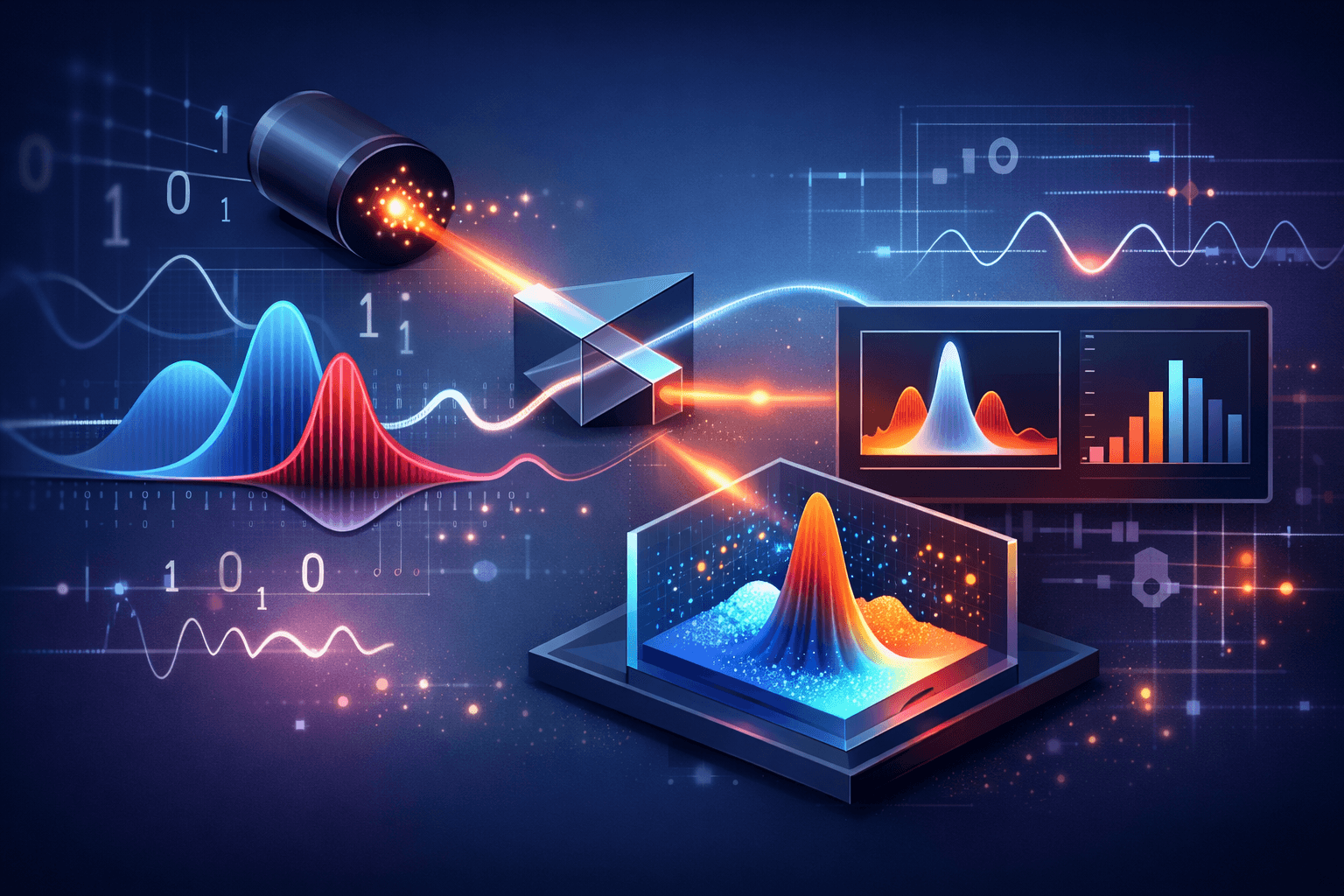
Continuously labelled non-Gaussian measurements can achieve near-optimal discrimination of coherent states. The authors report that photon detection is not required for near-optimal performance, and that their schemes can reach error rates close to the Helstrom bound at low energies.
Why the authors say this matters
The authors state that their findings show photon detection is not necessary for near-optimal coherent state discrimination. They also conclude that continuously labelled measurements can retain an advantage over the photon detection-based Kennedy receiver over a moderate range of coherent state amplitudes.
What the researchers tested
The researchers studied optical quantum state discrimination, which is the task of telling quantum states apart. They compared commonly used measurement approaches: photon detection, which gives discrete outcomes, and homodyne detection, which gives continuous outcomes. They then designed two discrimination protocols, one using non-Gaussian unitary operations with homodyne detection and another based on orthogonal polynomials.
What worked and what didn't
Both proposed protocols surpassed the Gaussian limit, which is the minimum error rate often associated with homodyne detection. The abstract says these continuously labelled non-Gaussian methods achieved error rates close to the Helstrom bound at low energies. It also says they maintained an advantage over the Kennedy receiver for a moderate range of coherent state amplitudes.
What to keep in mind
The abstract does not describe experimental constraints, numerical values, or broader limitations beyond the stated range of coherent state amplitudes. No additional caveats are provided in the available summary.
Key points
- Continuously labelled non-Gaussian measurements can achieve near-optimal coherent state discrimination.
- The proposed methods surpass the Gaussian limit associated with homodyne detection.
- The abstract says the schemes reach error rates close to the Helstrom bound at low energies.
- Photon detection is reported as not required for near-optimal performance.
- The schemes maintain an advantage over the Kennedy receiver over a moderate range of coherent state amplitudes.
Disclosure
- Research title:
- Non-Gaussian measurements enable near-optimal coherent state discrimination
- Publication date:
- 2026-03-09
- OpenAlex record:
- View
Get the weekly research newsletter
Stay current with peer-reviewed research without reading academic papers — one filtered digest, every Friday.