

A free energy landscape analysis of resistance fluctuations in a memristive device

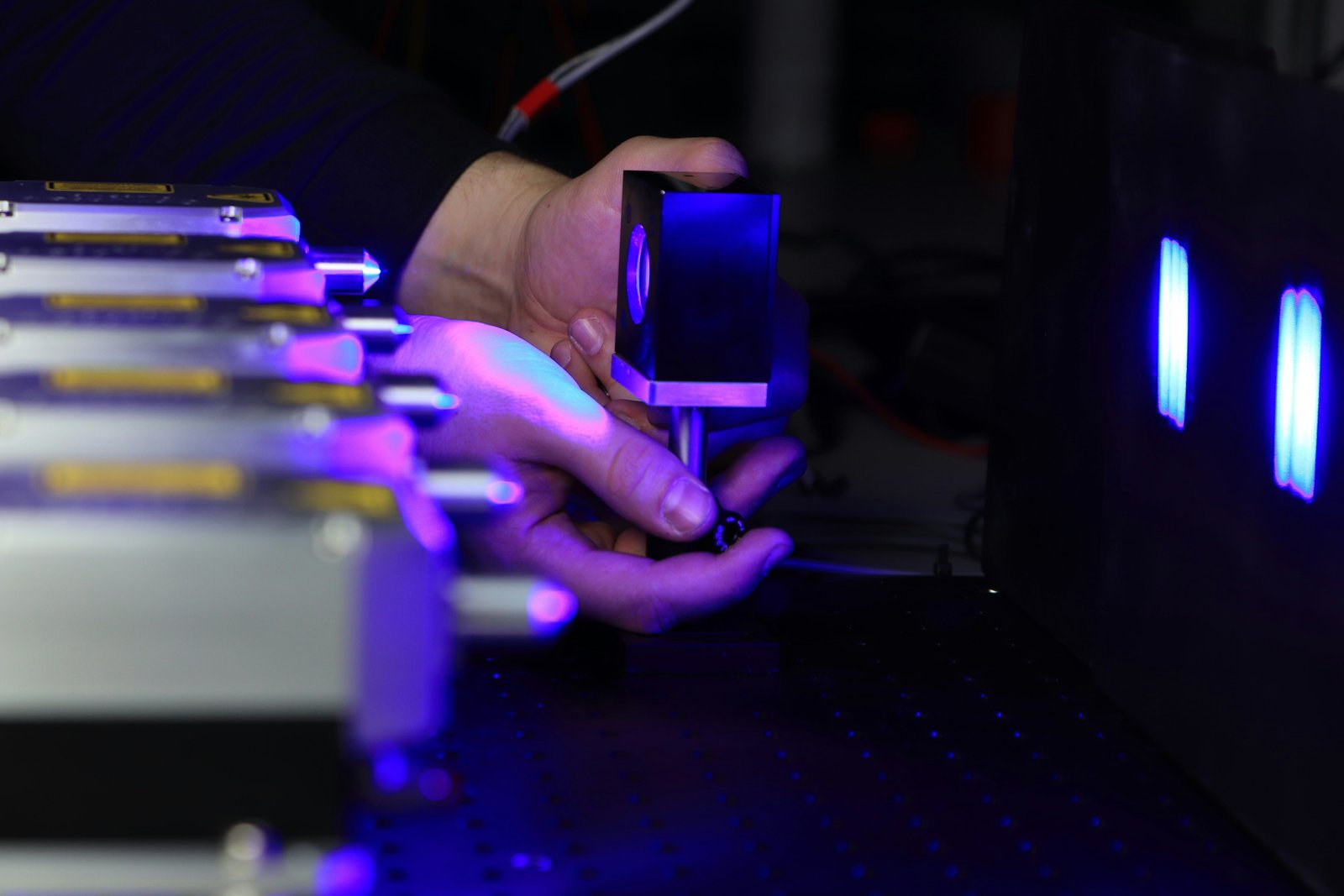
A person's hand holds a blue illuminated electronic testing probe or device connected to laboratory equipment with purple and blue LED indicators in a darkened laboratory setting.
Image Credit: Photo by Opt Lasers on Unsplash (SourceLicense)

AI Summary of Peer-Reviewed Research

This page presents an AI-generated summary of a published research paper. The original authors did not write or review this article. See full disclosure ↓

Nature Materials·2026-01-30·Peer-reviewed·View original paper ↗·Follow this topic (RSS)
Publication Signals show what we were able to verify about where this research was published.STRONGWe verified multiple publication signals for this source, including independently confirmed credentials. Publication Signals reflect the source’s verifiable credentials, not the quality of the research.
  • ✔ Peer-reviewed source
  • ✔ Published in indexed journal
  • ✔ No retraction or integrity flags

Key findings from this study

  • The study found that attempt frequencies in memristive switching span several orders of magnitude and frequently fall below phonon frequencies, indicating substantial entropic contributions to switching barriers.
  • The authors demonstrate that hidden Markov modeling provides experimental access to free energy landscapes in phase-change materials by tracking discrete resistance state transitions.
  • The researchers report that entropic effects—rather than energetic factors alone—govern resistance fluctuations in germanium telluride across the temperature range studied.

Overview

Resistance noise in memristive devices arises from transitions between multiple local minima in a free energy landscape, not solely from single-barrier thermal activation. This study employed hidden Markov modeling to analyze resistance fluctuations in germanium telluride across wide temperature ranges. The findings reveal that entropic contributions substantially shape the barriers governing these transitions.

Methods and approach

The authors analyzed resistance fluctuations in a nanoscopic volume of phase-change germanium telluride using hidden Markov model analysis. Transition rates between discrete resistance states were quantified over a wide temperature range. Individual transitions were tracked across multiple temperatures to separate energetic and entropic contributions to free energy barriers.

Results

Transition rates follow Arrhenius-like behavior, yet extracted attempt frequencies span several orders of magnitude. Many attempt frequencies fall far below typical phonon frequencies. This wide spread indicates substantial entropic contributions to the free energy barriers, which the researchers quantified by monitoring state transitions as temperature varied. The entropic effects demonstrate that the free energy landscape governing memristive switching involves complex atomic dynamics beyond simple two-state models.

Implications

The hidden Markov modeling approach successfully reveals entropic effects obscured by conventional single-barrier thermal activation analysis. This methodology provides experimental access to high-dimensional free energy landscapes in memristive systems. The technique directly quantifies the atomic-scale complexity governing resistance changes in phase-change materials and related systems.

These results suggest that accurate modeling of memristive device behavior requires accounting for entropic contributions alongside energetic barriers. Current theoretical frameworks may underestimate the role of configurational entropy in driving atomic transitions. Understanding this complex landscape enables more precise prediction and control of resistance switching behavior in these materials.

The applicability of this approach extends broadly across memristive device classes where atomic-scale transitions produce measurable resistance changes. Characterization of entropic contributions may guide materials design strategies targeting improved device performance. The methodology could inform development of more sophisticated models incorporating multi-minima energy landscapes.

Scope and limitations

This summary is based on the study abstract and available metadata. It does not include a full analysis of the complete paper, supplementary materials, or underlying datasets unless explicitly stated. Findings should be interpreted in the context of the original publication.

Disclosure

  • Research title: A free energy landscape analysis of resistance fluctuations in a memristive device
  • Authors: Sebastian Walfort, Xuân Thắng Vũ, Jakob Ballmaier, Nils Holle, Niklas Vollmar, Martin Salinga
  • Institutions: RWTH Aachen University, University Hospital Münster, University of Münster
  • Publication date: 2026-01-30
  • DOI: https://doi.org/10.1038/s41563-026-02487-9
  • OpenAlex record: View
  • Image credit: Photo by Opt Lasers on Unsplash (SourceLicense)
  • Disclosure: This post was generated by Claude (Anthropic). The original authors did not write or review this post.

Get the weekly research newsletter

Stay current with peer-reviewed research without reading academic papers — one filtered digest, every Friday.

More posts