

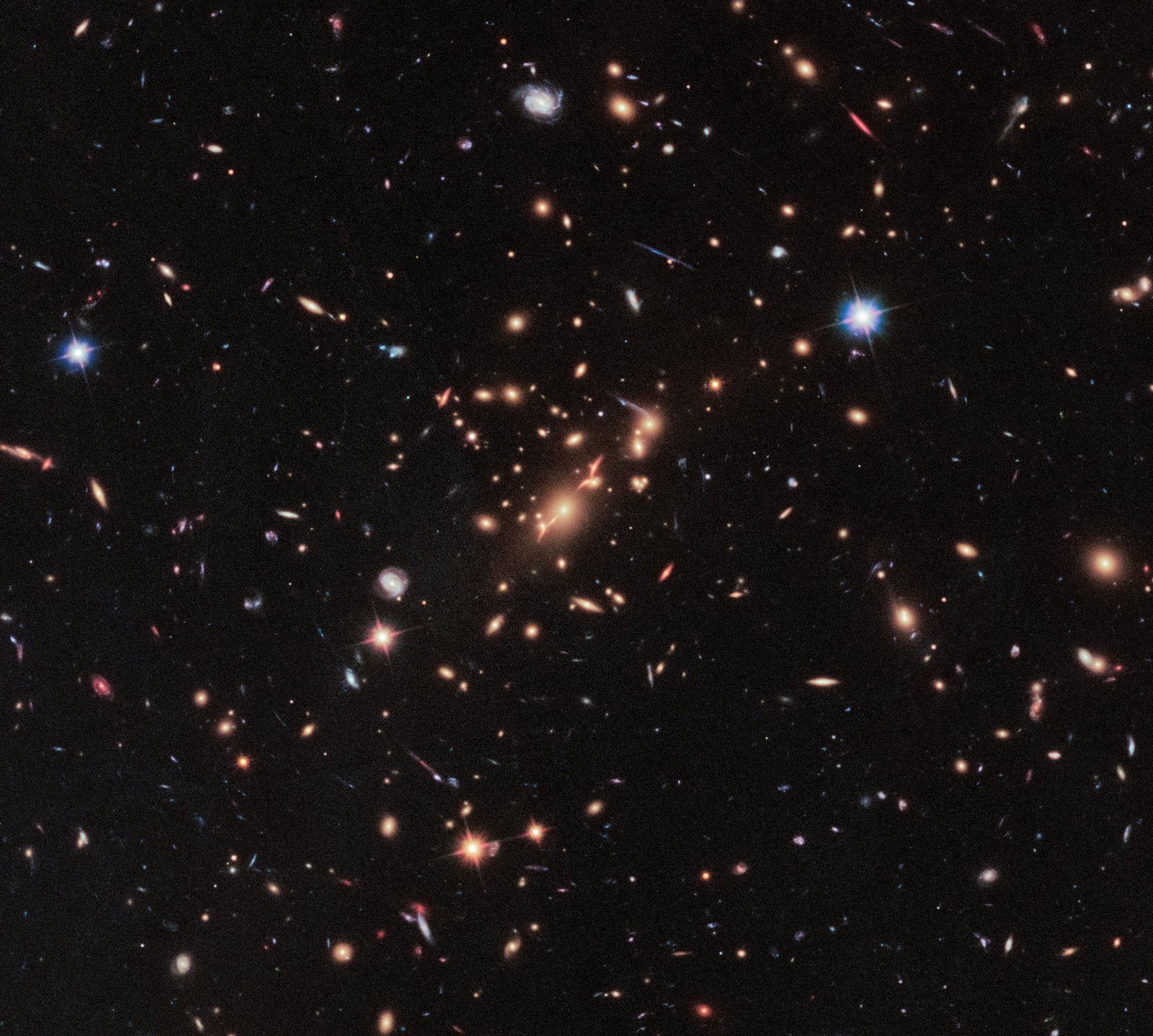
Overview
A game-theoretic statistical framework termed Cosmological Teleodynamics is introduced to address fundamental problems in cosmology through nonequilibrium statistical mechanics rather than particle-based dark sector models. The framework recasts dark energy, dark matter, large-scale structure formation, and observed cosmological tensions as emergent phenomena arising from nonlocal memory effects and persistent organization inherent to self-gravitating systems. By applying maximum-caliber principles and bias functionals encoding structural memory, the approach reformulates classical cosmological equations to generate observed large-scale phenomena without invoking exotic particles or exotic scalar fields.
Methods and approach
The framework employs maximum-caliber statistical weighting applied to cosmic histories combined with a bias functional that encodes structural memory in the Universe's evolution. This leads to derivations of modified Friedmann equations governing cosmic expansion, modified Boltzmann equations for particle distributions, and modified Poisson equations for structure growth. The approach treats the cosmos as a self-organizing potential game where configurations evolve toward Nash equilibrium states. A generalized horizon entropy and associated temperature are derived from nonequilibrium statistical principles, establishing the foundation for understanding cosmic acceleration as a statistical phenomenon rather than a dynamical consequence of specific matter-energy components.
Key Findings
Modified cosmological equations naturally produce dark energy-like acceleration and dark matter-like clustering without particle or scalar-field models. Scale-dependent growth suppression emerges from the framework's structure. The approach demonstrates potential for alleviating the H₀ tension (discrepancies in Hubble constant measurements) and S₈ tension (constraints on matter clustering amplitude). Environment-dependent halo signatures predicted by the theory cannot be reproduced by conventional particle dark matter or scalar-field dark energy models. Anisotropic velocity fields arise naturally from the formalism. A Law of Universal Arbitrage Equilibrium is derived, characterizing cosmic expansion as evolution toward continuous Nash equilibrium configurations.
Implications
The framework provides a unified treatment of dark sector phenomena through statistical and systemic properties rather than introducing new fundamental particles or fields, potentially offering enhanced predictive power for structure formation and large-scale dynamics. The environment-dependent halo signatures and anisotropic velocity field predictions represent testable distinguishing features that differentiate this approach from standard cold dark matter and quintessence models, offering empirical pathways for model validation or falsification through observational cosmology.
Scope and limitations
This summary is based on the study abstract and available metadata. It does not include a full analysis of the complete paper, supplementary materials, or underlying datasets unless explicitly stated. Findings should be interpreted in the context of the original publication.
Disclosure
Key points
- Research title: Game theory in cosmology
- Authors: Oem Trivedi, Venkat Venkatsubramanian
- Publication date: 2026-03-13
- DOI: https://doi.org/10.1016/j.dark.2026.102277
- OpenAlex record: View
- Image credit: Photo by NASA Hubble Space Telescope on Unsplash (Source • License)
- Disclosure: This post was generated by Claude (Anthropic). The original authors did not write or review this post.
Disclosure
- Research title:
- Game theory in cosmology
- Publication date:
- 2026-03-01
- OpenAlex record:
- View
- Image credit:
- Photo by NASA Hubble Space Telescope on Unsplash · Unsplash License
Get the weekly research newsletter
Stay current with peer-reviewed research without reading academic papers — one filtered digest, every Friday.