

What the study found
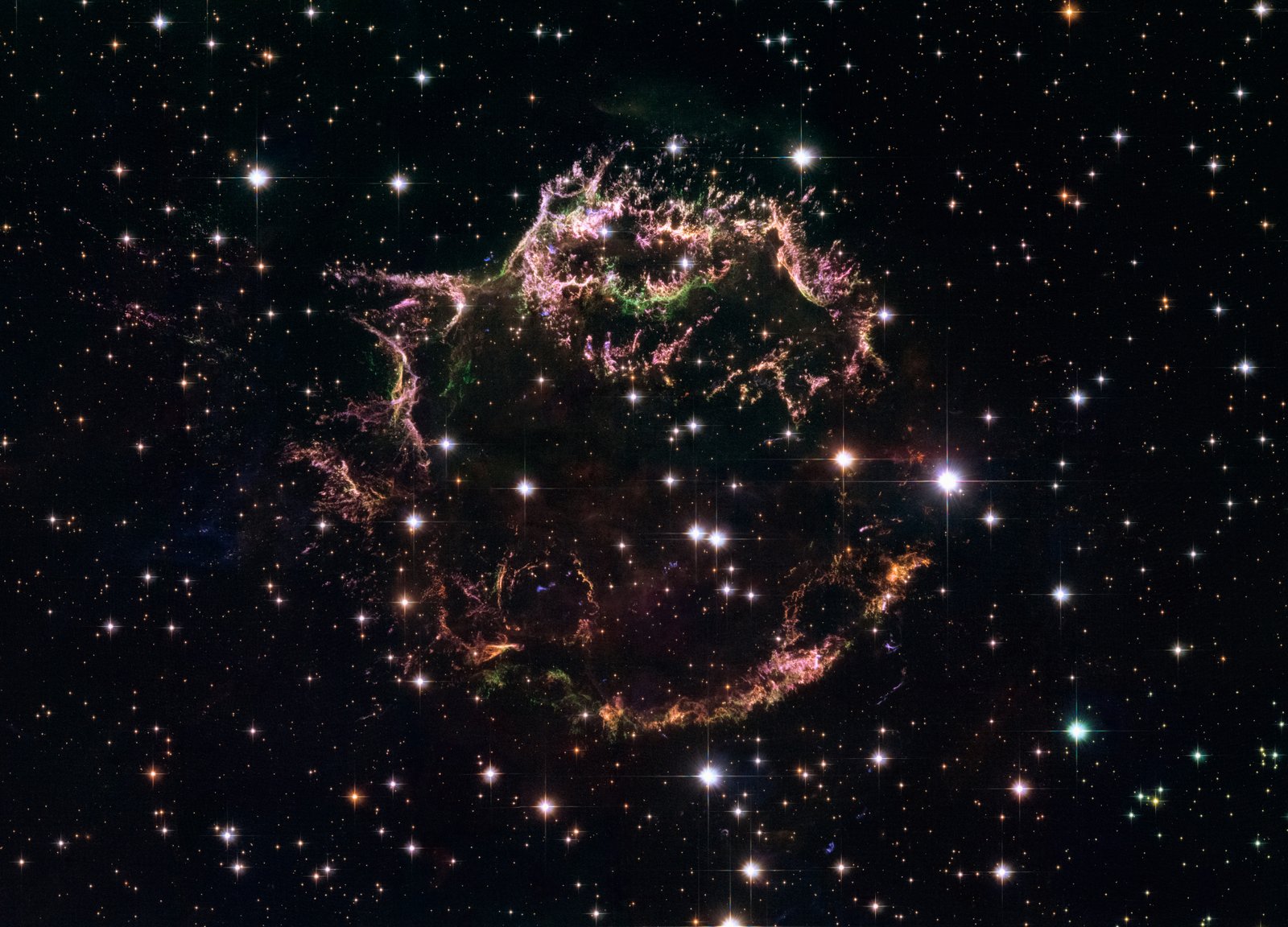
TransFit-CSM is a fast, physically consistent framework for modeling interaction-powered transients, which are luminous astronomical events powered by interaction between ejecta and circumstellar medium (CSM, material surrounding a star before it explodes). The study says the method reproduces the sequence of an early dark phase, a diffusion-mediated rise and peak, and a post-interaction cooling tail.
Why the authors say this matters
The authors conclude that the framework helps explain why Arnett-like peak rules break down in optically thick CSM, meaning when the surrounding material is so dense that light transport is strongly affected. They also say the method is Bayesian-ready and can constrain physical parameters from bolometric or joint multiband light curves, which the findings indicate may support population-level inference for current and future time-domain surveys.
What the researchers tested
The researchers built a model that self-consistently couples ejecta–CSM shock dynamics to radiative diffusion from a moving heating boundary tied to the shocks. They numerically solved the mass–momentum equations for the forward and reverse shocks together with the diffusion equation in the unshocked CSM. They then applied the framework to bolometric and joint multiband light curves.
What worked and what didn't
The framework reproduced the canonical light-curve sequence described in the abstract and clarified the breakdown of Arnett-like peak rules in optically thick CSM. Applications to SN 2006gy and SN 2010jl produced accurate fits and physically interpretable posteriors. The abstract does not describe specific failures or cases where the method did not work.
What to keep in mind
The available summary does not provide detailed limitations, uncertainty ranges, or a comparison with alternative methods beyond saying the framework bridges simple analytic prescriptions and radiation-hydrodynamic simulations. The abstract also does not state performance metrics or describe where the approach may be less effective.
Key points
- TransFit-CSM models interaction-powered transients by coupling shock dynamics and radiative diffusion.
- The method reproduces an early dark phase, a rise and peak driven by diffusion, and a cooling tail after interaction.
- The authors say it clarifies why Arnett-like peak rules break down in optically thick CSM.
- Applications to SN 2006gy and SN 2010jl gave accurate fits and physically interpretable posteriors.
- The abstract says the framework is Bayesian-ready and may support population-level inference for time-domain surveys.
Disclosure
- Research title:
- TransFit-CSM models interaction-powered transients with consistent shock diffusion
- Publication date:
- 2026-03-03
- OpenAlex record:
- View
- Image credit:
- Photo by NASA Hubble Space Telescope on Unsplash · Unsplash License
Get the weekly research newsletter
Stay current with peer-reviewed research without reading academic papers — one filtered digest, every Friday.