

About This Article
This is an AI-generated summary of a research paper. The original authors did not write or review this article. See full disclosure ↓
Overview
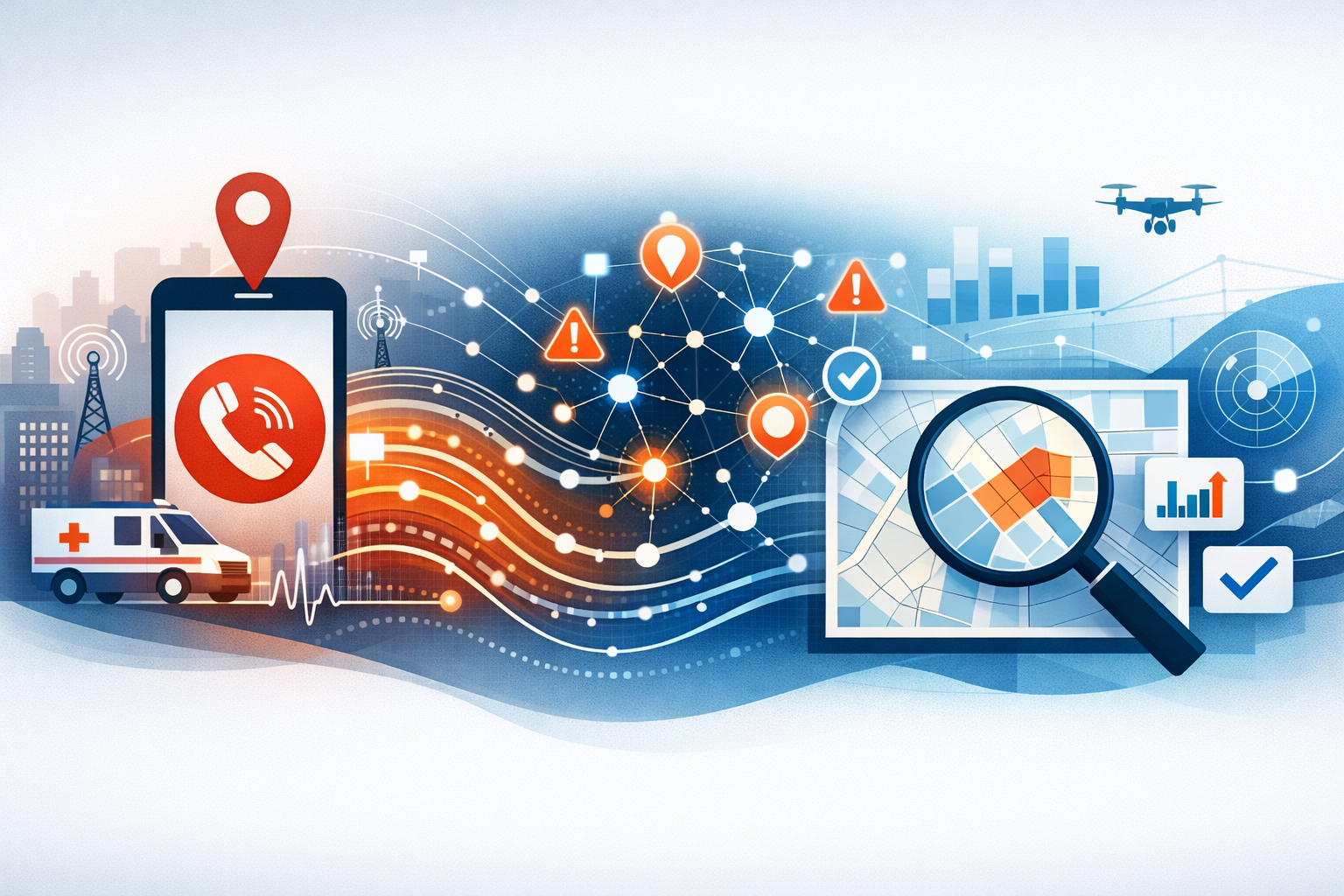
This doctoral research examines emergency call data, specifically from the European Single Emergency Number (112), as a source of crowdsourced information to enhance situational awareness and support decision-making in crisis management. The investigation establishes that emergency call data overcomes key limitations associated with social media-derived information through improved reliability, geolocation accuracy, and automated verification. The research positions emergency communication systems as potential advanced territorial monitoring infrastructures capable of integrating conventional sensor networks with citizen-generated information to develop adaptive, data-driven emergency management models.
Methods and approach
The dissertation employs a multi-chapter article-based structure integrating four primary research axes. The first establishes conceptual and methodological foundations, comparing informational value and data quality between emergency call datasets and social media sources. The second axis evaluates integration capabilities between emergency call information and meteorological sensor networks for enhanced situational assessment. The third explores how emergent collective intelligence from call data can inform operational strategies and broader risk communication policies. The fourth examines feasibility of translating identified potentials into operational applications within emergency response centers, investigating technological readiness including artificial intelligence integration and evolution from call routing units to advanced territorial monitoring infrastructure.
Results
Emergency call data demonstrates substantive advantages over social media-derived information, providing reliable, automatically verified, and accurately georeferenced records of local conditions in real time. Integration with conventional meteorological networks substantially refines situational understanding. Collective intelligence embedded in call data patterns extends utility beyond spatio-temporal dimensions, informing both tactical operations and strategic risk communication. The research identifies significant organizational readiness requirements for emergency response centers to transition from specialized dispatch functions to comprehensive monitoring infrastructure, with artificial intelligence technologies presenting operational implementation opportunities.
Implications
The findings establish empirical support for reconceptualizing emergency call infrastructure as a foundational component of hybrid decision-support systems integrating conventional sensor networks with social information sources. Emergency response centers represent underutilized institutional assets capable of generating real-time territorial awareness through systematic analysis of call pattern data, supporting more responsive and contextually informed crisis management. The research contributes to expanding evidence regarding citizen-generated content applications in civil protection contexts, establishing methodological and analytical frameworks for future implementations.
Disclosure
- Research title: Emergency Communication and Crowdsourced Information: From Digital Noise to Actionable Intelligence
- Authors: Giuseppe Lelow
- Publication date: 2026-03-06
- OpenAlex record: View
- Disclosure: This post was generated by artificial intelligence. The original authors did not write or review this post.