

What the study found
Fourier transform rheology was used to identify rheological markers in dense granular flows, including viscoelastic crossovers at relatively low shear rates and secondary loops at higher shear rates. The authors report that these patterns are consistent with a transition from quasistatic, friction-like flow to dense inertial, fluid-like flow.
Why the authors say this matters
The authors say the findings provide characterization criteria relevant to managing dense granular flows in quasistatic and dense inertial regimes. They also frame the work as relevant to geophysical and industrial applications that require handling dense particulate flows.
What the researchers tested
The researchers explored oscillatory rheometry for dense granular flow using a chute-flow rheometer, or CFR, with multimodal sensing. The CFR applied oscillatory shear in a Couette gap and measured torque, wall pressure, and axial flow; the cyclic data were then separated into elastic and viscous components using Fourier transforms.
What worked and what didn't
Torque data normalized to the active mass of granular material were converted to specific torque and shear stress and analyzed with Lissajous-Bowditch plots. Viscoelastic crossovers were observed at relatively low shear rates, and secondary loops appeared at higher shear rates in elastic shear-rate/torque plots. The authors also compared inertial number scaling in granular rheology using specific torque and the conventional pressure-and-density definition, and they summarized shear-normal force coupling in a contour diagram.
What to keep in mind
The abstract does not describe detailed numerical results or uncertainty measures. It also does not state limitations beyond the scope of the CFR measurements and the flow regimes examined.
Key points
- Fourier transform rheology was applied to dense granular flow in a chute-flow rheometer.
- Viscoelastic crossovers appeared at relatively low shear rates.
- Secondary loops appeared at higher shear rates in elastic Lissajous-Bowditch plots.
- The authors interpret the patterns as consistent with a transition from quasistatic to dense inertial flow.
- The study discusses inertial number scaling and coupling between shear and normal forces.
Disclosure
- Research title:
- Fourier analysis identified flow-regime changes in dense granular rheology
- Image credit:
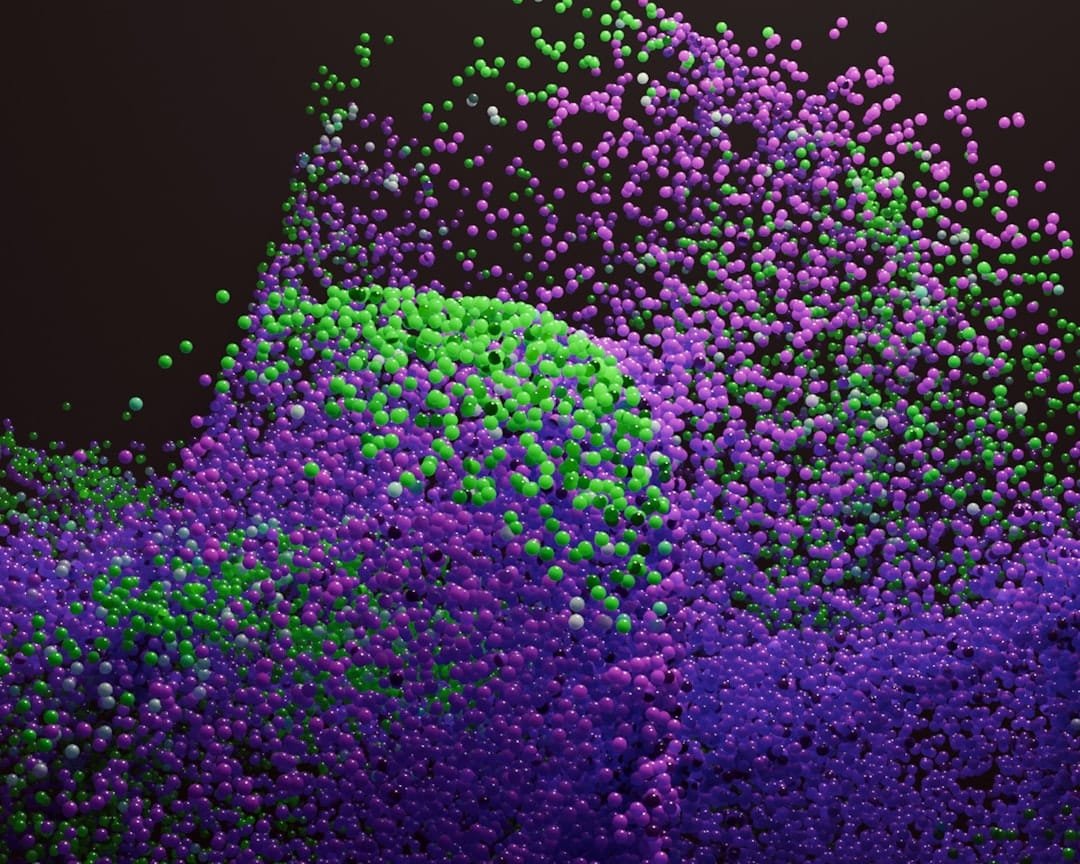
- Photo by pompom art on Unsplash
Get the weekly research newsletter
Stay current with peer-reviewed research without reading academic papers — one filtered digest, every Friday.